
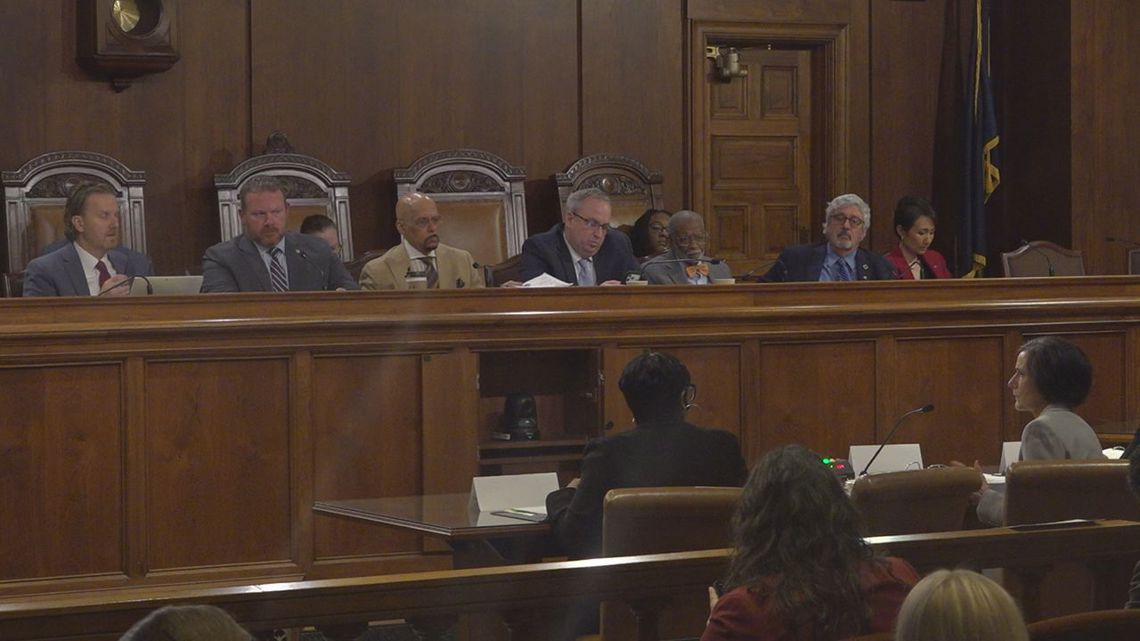
The State Senate Appropriations Committee questioned Human Services Secretary Val Arkoosh at the hearing.
HARRISBURG, Pa. — Department of Human Services Secretary Val Arkoosh outlined her department’s response to federal policy changes as she faced questions from lawmakers during a budget hearing before the Pennsylvania Senate Appropriations Committee.
The cost to administer the Supplemental Nutrition Assistance Program (SNAP) and Medicaid in Pennsylvania is expected to increase, while new work requirements for SNAP have already led to thousands of residents being removed from the program through changes made this past June and September.
“Since June 1, what we have seen in total is about 89,000 individuals lose access to SNAP,” Arkoosh said. “59,000 of that 89,000 is a result of those changes in September.”
The hearing comes as Pennsylvania Gov. Josh Shapiro’s proposed budget includes roughly $1 billion in new spending to fund Medicaid. Arkoosh told lawmakers that rising administrative costs, along with SNAP enrollment changes that could impact Medicaid participation, make additional investment necessary.
“Worst case scenario, starting in 2028 we’ll begin to see what we total up over the next decade, $20 billion of cuts,” Arkoosh said.
The spending proposal drew scrutiny from committee chairman Scott Martin (R-Lancaster), who noted the administration’s projected $200 million annual spending increase over the next five years is significantly lower than the roughly $900 million average annual increases seen over the past 12 years.
“So, by increasing the 2026–27 budget request by the actual average increase, instead of the unrealistic $200 million, we’re left with a $7 billion hole over those planning years,” Martin said.
Arkoosh said uncertainty surrounding potential federal funding reductions is the reason behind the more conservative projections.
Funding for rural hospitals also became a major topic during the hearing. Arkoosh warned that many potential Medicaid cuts would disproportionately affect rural healthcare systems, losses the state may not be able to replace.
“We’re really in a very difficult spot in terms of our hospitals. I don’t want to sugarcoat it,” Arkoosh said. “If HR 1 is not mitigated in some way, it will be quite difficult for us to backfill these levels of cuts.”
The hearing sets the stage for a broader budget battle in Harrisburg, as lawmakers weigh how much Pennsylvania can afford to backfill potential federal reductions to social programs serving millions of residents, while also maintaining the commonwealth’s long-term fiscal stability.
“If there’s another turnaround to say we need another $1.6 billion — whatever the number is — you can understand why that causes a lot of budget heartburn and doesn’t truly reflect the commonwealth’s fiscal direction,” Martin said.