
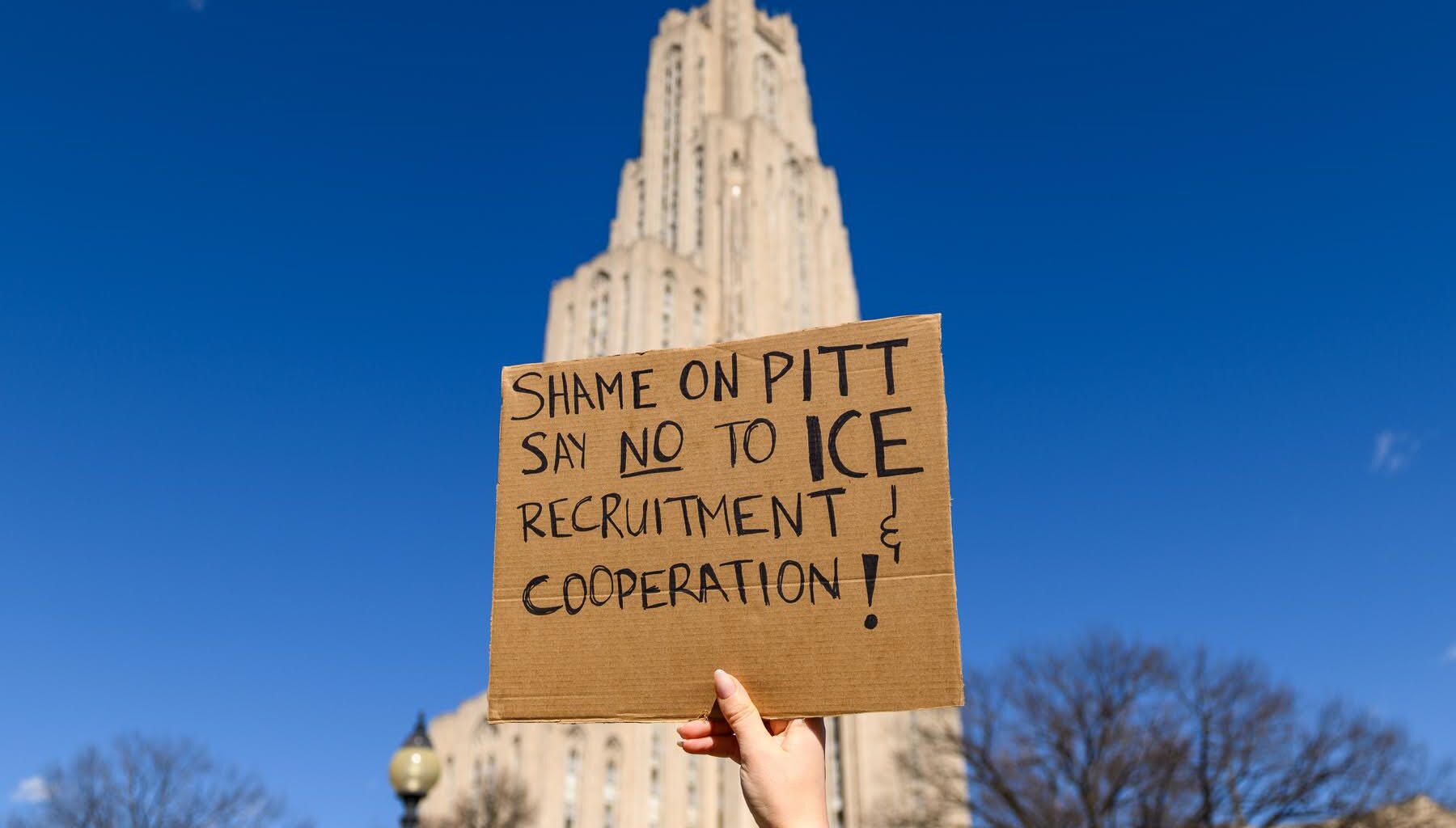
Chants of “Don’t recruit for your own demise” and “Shame on Pitt” rang out at Schenley Plaza last week. Demonstrators gathered to protest what they believed to be a University of Pittsburgh-sanctioned recruitment event for U.S. Customs and Border Patrol, after a listing appeared on the school’s career center website earlier this month.
Pitt spokesperson Jared Stonesifer said the CBP webinar post, which originated on a non-university platform and has since been deleted, wasn’t an indication of an “endorsement or partnership” with immigration agencies.
Nationwide, though, recruitment for the federal agency — and ensuing backlash — is ramping up across campuses.
CBP representatives have been present at several college career fairs this winter, while listings for recruitment webinars have also appeared across university web pages. Many of these instances prompted protests, petitions and calls for schools to disinvite the agency or remove listings.
Students and faculty involved in these actions cite CBP participation in President Donald Trump’s immigration crackdown, which has targeted and aggressively detained individuals with both lawful and unlawful standing to live in the country. Some also point to the death of Minnesota nurse Alex Pretti, who was shot and killed in January by two CBP agents after assisting a woman who had been pushed by officers.
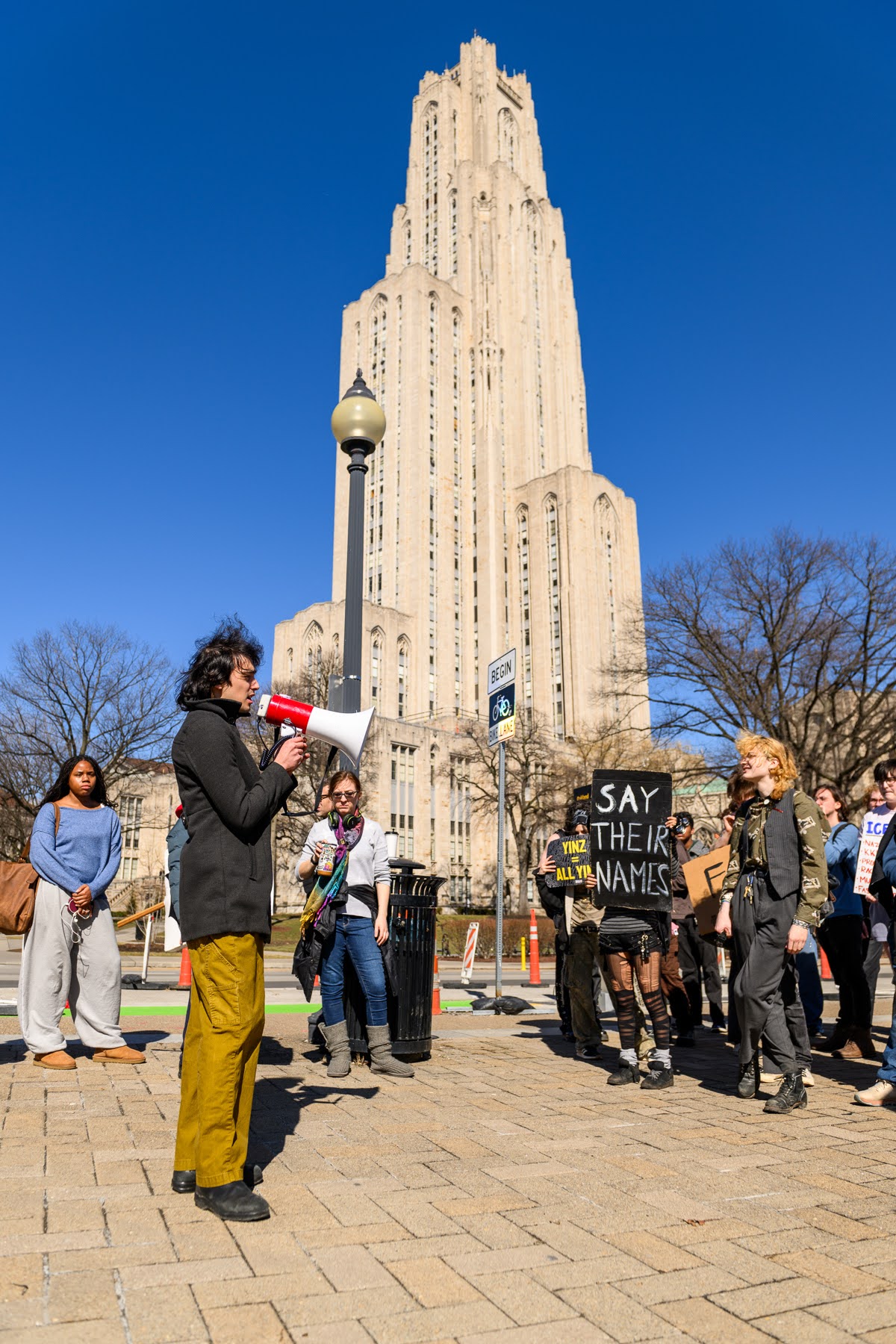 Sunrise Movement Pittsburgh member Ilyas Khan speaks during the ICE Out Walkout in Schenley Plaza on Feb. 20. Protestors rallied against ICE enforcement and demanded a stronger response from the University of Pittsburgh after a U.S. Customs and Border Protection recruitment event was listed on Pitt’s Career Central event calendar. (Photo by Alex Jurkuta/Pittsburgh’s Public Source)
As a result of widespread campus concern, some universities announced CBP’s withdrawal from career fairs or, like Pitt, removed agency job listings from web pages. Others doubled down on permitting the agency’s presence.
Immigration policy analyst Peter Mancina was critical of the latter approach, calling it “tone-deaf.” The visiting scholar at the Rutgers Law School Center for Immigration Law, Policy and Justice said university administrators need to consider “the current era of immigration enforcement” when making decisions about federal agents’ presence on campus. Otherwise, he continued, they fail to acknowledge “the new factors that are at play” for “all students of color.”
The Trump administration initially stoked fear for international and undocumented students last January when it reversed protection against immigration enforcement at schools. This change prompted numerous colleges and universities around the country to adopt or update guidelines for potential ICE visits. In the wake of the Minnesota surge, these got renewed attention at some institutions.
Public Source asked 10 Pittsburgh-area schools about their policies and guidance on campus presence of federal immigration agencies.
Sparse public protocols
Guidance regarding ICE’s presence at the six schools that responded varied widely:
Carlow University: The university is following existing policies and procedures that “support the well-being and success of all students and members of our community,” its spokesperson said. Public Source did not find any public information regarding potential visits from federal immigration agencies.
Community College of Allegheny County: The college’s protocols have remained “unchanged,” said its spokesperson. Public Source did not find any public information regarding potential visits from federal immigration agencies. The spokesperson emphasized that the privacy of those at the school is fully protected, and CCAC offers resources to anyone affected by immigration enforcement. They also added that the college will cooperate with any “lawful” requests made by ICE and other agencies.
Carnegie Mellon University: A spokesperson directed the reporter to view the university’s international education office website, where “relevant updates and resources” are housed. There is a frequently asked questions page about ICE, which appears to have been published in April 2025.
Chatham University: The university updated procedures for ICE presence in March 2025, and a spokesperson said it’s since been shared throughout the campus “multiple times.”
Point Park University: The university encourages its members to “immediately notify” campus police if they see federal agents at the school, said its spokesperson. They also responded that the university would cooperate with “all local, state and federal authorities.” However, ICE would need a judicial warrant to enter private areas of the school, according to the spokesperson. Public Source did not find any public information regarding potential visits from federal immigration agencies.
Pitt: An administrator said in a campuswide email sent Friday that protocols for this situation were designed to engage with government representatives “appropriately and consistently.” Pitt included a link to an April 2025 page titled “Best Practices for Visits by Government Officials”.
None of the six colleges that responded to Public Source indicated any engagement or interactions with federal immigration agencies thus far. Duquesne, La Roche, Penn State Greater Allegheny and Robert Morris did not respond. Public Source also sought input from CBP and ICE, but neither agency responded.
Pitt was the only school that detailed how students are being supported. Stonesifer said campus members on university-sponsored visas are advised one-on-one by an immigration specialist within the school’s international services office. Beyond this, he said, administrators have routinely met with student organizations to discuss immigration-related topics.
These discussions, however, have not stopped students at the university from asking that more be done to address the concerns and needs of international campus members.
Pitt students demand more support
Pitt has seen the bulk of the region’s campus pushback regarding immigration enforcement. In November, Pitt’s student government board passed a resolution calling for the university to do “everything in its power to resist federal attempts to seize protected information and disrupt campus life.”
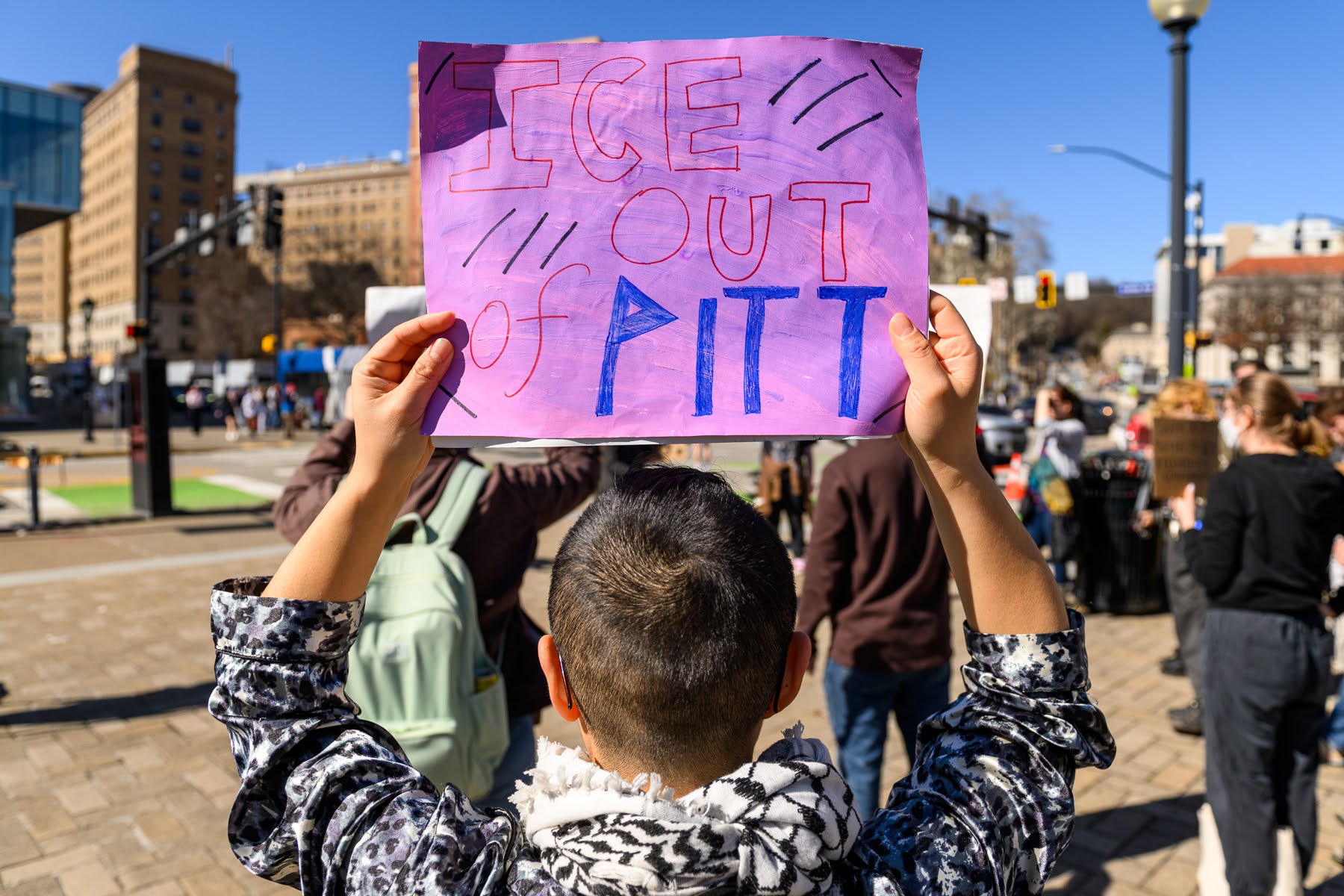 A protestor holds an anti-ICE sign during the ICE Out Walkout in Schenley Plaza on Feb. 20. Protestors rallied against ICE enforcement around Pittsburgh and demanded a stronger response from the University of Pittsburgh. (Photo by Alex Jurkuta/Pittsburgh’s Public Source)
The resolution said Pitt has maintained “limited communication” and not “sufficiently” informed those on campus about their rights and protections, as well as what to do if federal agents visit. It calls on the university to provide training on proper protocols, create a centralized webpage with the information and use emergency alerts if ICE appears on campus.
These asks are consistent with advice given by several education and advocacy nonprofit organizations, such as the American Civil Liberties Union and the Presidents’ Alliance on Higher Education and Immigration.
Stonesifer said the university has “consistently reinforced” information regarding potential ICE visits, and sent several campuswide messages on the topic, most recently on Friday. He did not respond regarding whether Pitt plans to implement any parts of the resolution.
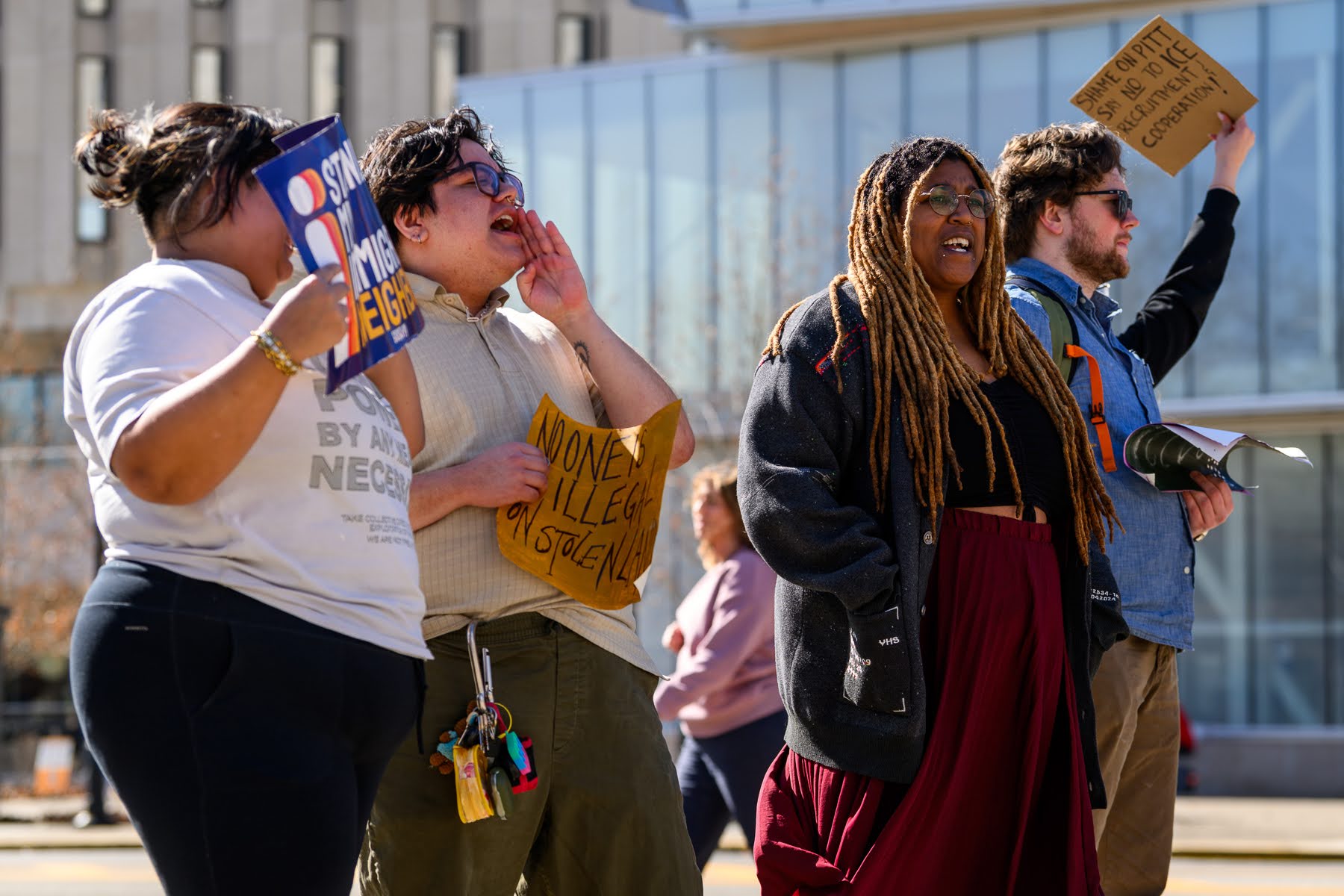
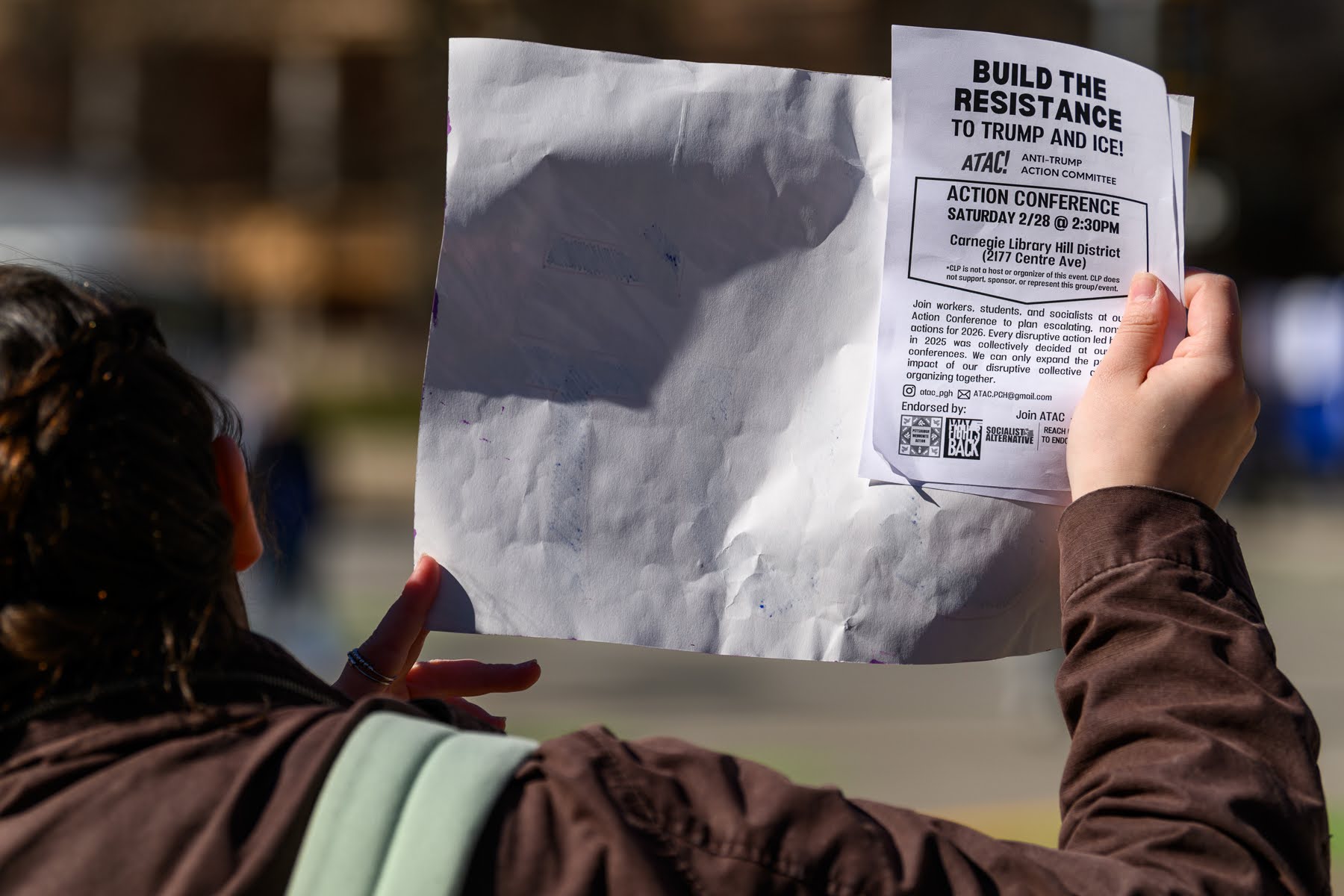
Protestors during the ICE Out Walkout in Schenley Plaza on Feb. 20. They rallied against area ICE enforcement and demanded a stronger response from the University of Pittsburgh after a U.S. Customs and Border Protection recruitment event appeared on Pitt’s Career Central event calendar. (Photo by Alex Jurkuta/Pittsburgh’s Public Source)
Pitt’s grad student workers union is also trying to secure protections for international employees during negotiations for its first contract. One of the union’s key provisions would commit Pitt to not allowing law enforcement in private areas of campuses without a warrant, along with notifying the union “as soon as practicable” if a warrant names one of its members.
Earlier this month, the university submitted a counterproposal and removed the due process section, which included those provisions. This prompted a rally at which the union said hundreds of Pitt grad students and community members left messages for Pitt Chancellor Joan Gabel, demanding protections for workers from ICE.
Stonesifer did not respond to a question about why Pitt’s counterproposal eliminated the union’s proposed due process provisions.
The grad worker union on Feb. 19 submitted another proposal that added the protections back. As of publication, Pitt has not countered again. The next negotiations are scheduled for March 11.
Maddy Franklin reports on higher ed for Pittsburgh’s Public Source, in partnership with Open Campus, and can be reached at madison@publicsource.org.
This story was fact-checked by Rich Lord.
This <a target=”_blank” href=”https://www.publicsource.org/pittsburgh-universities-respond-federal-immigration-agency-recruitment/”>article</a> first appeared on <a target=”_blank” href=”https://www.publicsource.org”>Pittsburgh’s Public Source</a> and is republished here under a <a target=”_blank” href=”https://creativecommons.org/licenses/by-nd/4.0/”>Creative Commons Attribution-NoDerivatives 4.0 International License</a>.<img src=”https://i0.wp.com/www.publicsource.org/wp-content/uploads/2025/07/cropped-ps_circle_favicon_blue.png?resize=150%2C150&ssl=1″ style=”width:1em;height:1em;margin-left:10px;”>
<img id=”republication-tracker-tool-source” src=”https://www.publicsource.org/?republication-pixel=true&post=1329869&ga4=G-CCLXQK5C14″ style=”width:1px;height:1px;”><script> PARSELY = { autotrack: false, onload: function() { PARSELY.beacon.trackPageView({ url: “https://www.publicsource.org/pittsburgh-universities-respond-federal-immigration-agency-recruitment/”, urlref: window.location.href }); } } </script> <script id=”parsely-cfg” src=”//cdn.parsely.com/keys/publicsource.org/p.js”></script>