
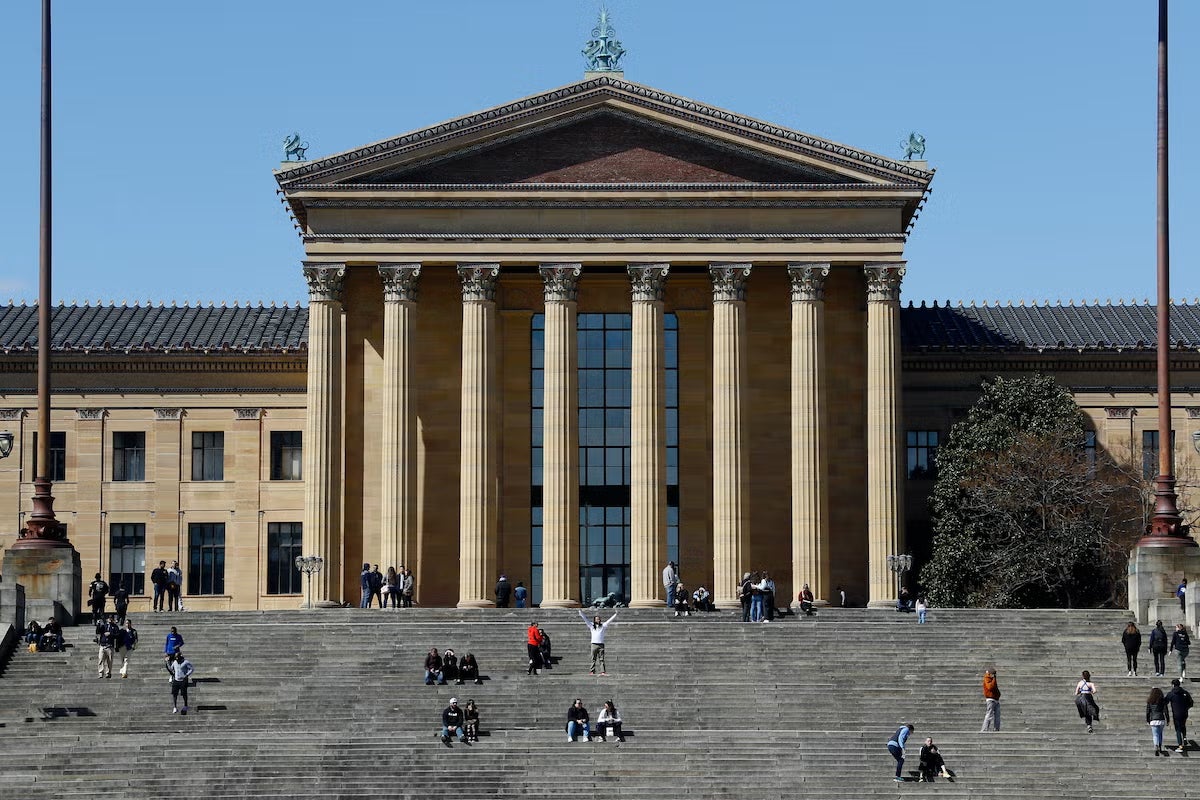
From industrial art to fine art
Fiske Kimball, who became the museum’s president in 1925 and remained for 30 years, pushed the construction over the finish line. He is largely credited with putting the museum on the international map.
“He is like a god,” MacDonald said.
Several prominent Philadelphia art collectors made promises of donations, anticipating the museum’s success. George Elkins stipulated in his will that the donation of his art collection was contingent on the building being completed within five years of his death. He died in 1919, so in 1924, Kimball opened the museum’s basement as a gallery space for a few days to comply with the terms of Elkins’ will.
“When the main building opened in 1928, only about 20 galleries were truly complete,” Smith said. “Fiske Kimball was an ambitious guy and built the building, understanding that it would leave quite a bit of room for growth. People joked that it was like a Greek warehouse. There were these empty spaces but that provided Fiske Kimball with extraordinary opportunity.”
A big building needs lots of art and Kimball immediately started acquiring the best. In 1930, he bought Renaissance art and artifacts collected by Edmond Foulc of Paris. The reported price for 191 objects exceeded $1 million, a record at the time for a museum purchase.
“In the purchase of so large a group of objects, it is usual to find that some of the objects are pieces of little consequence or of minor value,” Kimball told reporters at the time. “In the Foulc collection, however, every one of the 191 objects is a museum piece of the first quality.”
If Americans still felt in the shadow of European art and design, landing the Foulc purchase was a coup, even if it would take Kimball two decades to pay for it.
“There is nothing like the Foulc collection still in private hands today,” said Marcel Aubert, curator at the Louvre Museum in Paris at the time. “Since we could not keep it in France, there is no place where I would rather see it than in your museum.”
The Foulc collection was followed by other major acquisitions, including the John G. Johnson Collection of European art, the Alfred Stieglitz Collection of photographs, the John D. McIlhenny Collection of furniture and the George Grey Barnard Collection of Medieval art.
In 1950, Kimball secured the highly coveted Walter Arensberg collection of modernist art, including pieces by Pablo Picasso, Marcel Duchamp and Paul Cézanne. The Arensberg collection formed the basis of the museum’s now substantial modern art holdings, including the finest Duchamp collection anywhere.
One of Kimball’s strengths was his ability to visualize for donors how their collections would be seen in Philadelphia, Smith said.
“Fiske Kimball had a background in architectural history and was able to literally draw what the spaces would look like with their collection there,” she said. “Aresnberg sent Duchamp to the museum to case the joint.”
In 1939, during this period of rapid acquisition, the museum became the Philadelphia Museum of Art, officially shedding its industrial art beginnings and adopting the name it was already colloquially known by. The museum recently changed its name again to the even more colloquial Philadelphia Art Museum, but then changed it back.