
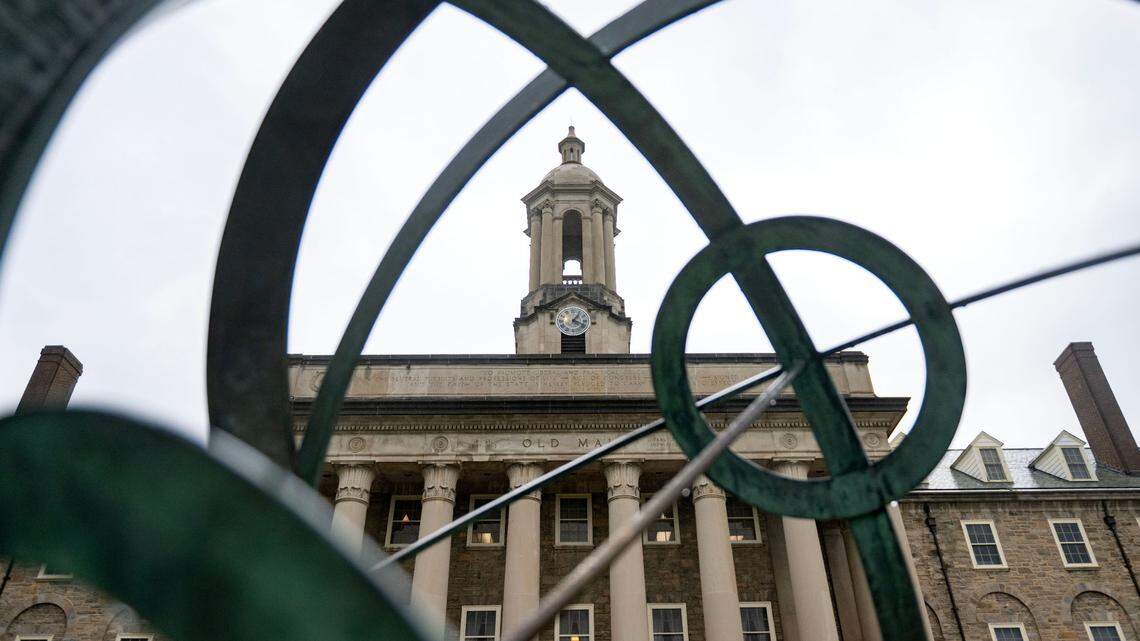
Old Main on the Penn State University Park campus on Wednesday, May 21, 2025.
Abby Drey
adrey@centredaily.com
As faculty at Penn State move toward finalizing a date for a unionization election, more than 100 Pennsylvania state legislators have banded together to urge the university administration to “exercise neutrality toward faculty unionization.”
In a letter sent to Penn State President Neeli Bendapudi last week, 102 state legislators, senators and representatives of the General Assembly said they were encouraged to hear faculty members are coming together to “strengthen their ability to serve the educational and research missions of the university.”
“The faculty workplace is the students’ learning space, and ensuring that faculty can embody excellence both in and outside of the classroom will ultimately benefit Penn State students. Collective bargaining of Penn State faculty will deepen the robust academic experience that we have come to expect from your institution,” reads the letter , which was signed by two state house representatives from Centre County, Rep. Scott Conklin, D- Rush Township, and Rep. Paul Takac, D, College Township.
The letter, which can be read in full at the bottom of this article, listed requests the signers urged Bendapudi and the administration to commit to, including:
Allowing faculty a free and fair process to form their union and to bargain collectively, without intimidation or threatsAvoiding actions that delay or interfere with their right to seek union representation or collectively bargainNot spending state funds, taxpayer dollars or tuition dollars on “union-avoidance tactics” or on engaging with union-avoidance firmsBeginning good faith negotiations without delay if a majority of Penn State faculty members choose union representation in an election
“The process of faculty organizing and collective bargaining at Penn State will enable the university to join all other public institutions of higher education in the Commonwealth in providing a clear and transparent process for true shared governance. Improved working conditions and opportunities for faculty to help charter the course of Penn State’s future will result in even stronger results for your investment in students and communities across Pennsylvania,” the letter states.
In an email to the Centre Daily Times, Conklin reiterated his support for the Penn State Faculty Alliance and their unionization efforts.
“I fully support Penn State Faculty Alliance’s efforts to unionize, and always maintain that the will of the worker must prevail,” Conklin said. “All they are asking for is to be treated with dignity and respect without the fear of retaliation.”
Julio Palma, an assistant professor of chemistry at Penn State Fayette, told the Centre Daily Times it is encouraging to have the support from elected officials, and they’re grateful for it. He’s been part of the organizing effort for six years and filing for the election in December isn’t the end, he said, it’s just the beginning.
“We care about our profession. We care about our mission as educators, we know that this is the best way, the only way, to actually protect academic freedom, protect job security, and at the end, all this is good for education and also our students. Protecting academic freedom is actually supporting our students and their education at Penn State,” Palma said.
Takac said he’s always maintained that workers should have the right to unionize if they want, which is why he signed onto the letter but wasn’t taking a position on whether they should unionize or not. And although a press release from SEIU Local 668, the union that faculty would be represented by, said the letter called for the administration to exercise neutrality toward faculty unionization, Takac thought the word “neutrality” is misleading.
“I’m not taking sides. I’m not saying whether one side or the other is right, but they both have the right to represent their own interests, and I believe that that’s proper,” Takac said. “I actually think the word ‘neutrality’ might be a little misleading. I think what we’re calling for is them not to interfere with the unionization efforts. I believe that Penn State, the administration, is well within their rights to advocate for the way they see the downsides or disadvantages of unionization is. I think that’s well within their legal rights to be able to do, and I would argue that they should have the right to that as well. That’s not necessarily neutrality, but it is not interfering.”
In a statement, Penn State said it’s committed to working closely with the faculty and noted faculty are integral to the university’s core mission.
“We respect their right to seek union representation, and we are working with the Penn State Faculty Alliance and the Pennsylvania Labor Relations Board to finalize the details of the election, which we anticipate could begin later this semester via mail-in ballots. Faculty unionization would represent a fundamental shift in University operations, and we urge all eligible faculty to educate themselves and — most importantly — to vote,” a university spokesperson said.
During a faculty senate meeting Tuesday, Fotis Sotiropoulos, executive vice president and provost, said it will be a “historic” election for Penn State. He said Kathleen Bieschke, senior vice provost, and Jennifer Wilkes, vice president for human resources and chief human resources officer, will soon hold town halls with each unit to give faculty the opportunity to ask questions and learn more.
A faculty member asked Sotiropoulos about how a vote to unionize could impact the flexibility that faculty have to pick up overload and other compensated opportunities that they currently have access to now. He said they’re entering an “uncharted territory;” when a union is established, they have a negotiated contract and many of the things they currently do now will be on the negotiation table, where they’ll start from scratch, he said.
“It’s not very easy for me to address this, but there will be impacts. I think it is possible that flexibility will significantly be reduced,” Sotiropoulos said. “What I would encourage you, for instance, to do is to go and look at some of the contracts that are out there. You should look at the Pittsburgh, for instance, contract which has a lot of specifics about what the workloads, what the expected teaching loads of faculty, what are the expected contributions for benefits and many other things that are prescribed there. But these are all going to be subject to the negotiations, and we have to wait and see what happens.”
Allegations of anti-union messaging
The press release accompanying the legislators’ letter alleges that recently Penn State has “increased its anti-union messaging, designed to divide and confuse faculty.” The Penn State Faculty Alliance on Facebook posted one example, a letter sent to faculty from Sotiropoulos. The PSFA annotated the letter to highlight different parts, including one part of the letter that states, “I cannot overstate the importance of each person educating themselves and taking time to vote. Because the outcome is determined by a majority of votes cast – not a majority of all eligible faculty – a small group of voters could decide the issue for our institution and thousands of our faculty, now and into the future. So, for example, if only 10 faculty members vote, those 10 individuals would decide the outcome for everyone.
The PSFA’s annotation is: “statistically, quite unlikely,” with a laughing emoji, and pointed faculty members to their website for information and updates, pennstatefacultyalliance.org.
Another example comes from comments made during a town hall held by Penn State that focused on research. WPSU reported earlier this month that during the town hall, Andrew Read, senior vice president for research at Penn State, said he had “serious concerns” about faculty unionization — and that a union could have a negative impact on research. WPSU’s reporting states Read said when looking at the country’s top 30 research universities by expenditure, only one university has unionized faculty, the University of Pittsburgh. In that ranking, Penn State lands at 25th.
“I think it’s going to make it harder to return to being a top 15 university,” Read said, according to WPSU.
Palma disputed that idea and said just because the majority of universities are not unionized does not mean they aren’t unionized because they’re ranked highly in research expenditures.
“(It’s) very, very unfortunate that our own vice president of research needs a refreshment of what’s the difference between correlation and causation,” he said.
Related Stories from Centre Daily Times