
This is WESA Arts, a weekly newsletter by Bill O’Driscoll providing in-depth reporting about the Pittsburgh area art scene. Sign up here to get it every Wednesday afternoon.
Around the country, arts groups are rolling out their “America 250” programs, marking the semiquincentennial of the nation’s founding. At a time of heated political divisions, one animating idea of these exhibits and performances is that things like visual art, music and dance can bring us all together.
That’s also the hope behind Next 250, a national initiative that’s betting a handful of key issues can unite people across lines of age, race and even political affiliation.
Back in September, Next 250 publicly launched with an event at the National Museum of African American History and Culture, in Washington, D.C.
The initiative had begun as a response to the May 2022 Uvalde school shootings, said Saru Jayaraman, president of the group One Fair Wage, which fights to replace the subminimum wage earned by many tipped workers. Listening sessions followed across the country with a diverse group of more than 2,500 participants, arranged through groups including Pittsburgh-based 1Hood Media. Now, Next 250 is organizing a series of town hall meetings like the one it held Tuesday at the Heinz History Center.
About 50 individuals and representatives of local nonprofits gathered to hear from folks like Felicity Williams, executive director of the Pennsylvania Policy Center, which works on issues like raising more tax revenue from the state’s wealthiest residents; Ebony Flowers, of the Black-led New Voices for Reproductive Justice; and Heaven Sensky, of the Center for Coalfield Justice, which serves the mostly white and mostly conservative residents suffering from the fallout of “constant fossil fuel extraction” in Washington and Greene counties.
Other panelists Tuesday included disability rights advocate Alisa Grishman; Miguel Sague Jr., of the Council of Three Rivers American Indian Center; Shayla Holmes, of gun control group Moms Demand Action; and Laura Nesbitt, of Keystone Progress.
The goal, said 1Hood’s Miracle Jones, is “to imagine a world where we have a future that works for all of us.” That includes supplementing the much-celebrated, 250-year-old Declaration of Independence with a brand-new “Declaration of Interdependence.”
A living wage for all, climate justice; reproductive rights and health care for all; gun control for all; voting rights for all: If that roster of issues sounds unwieldy — and decidedly progressive — Jayaraman said they were chosen because they all resonated across demographic lines, and especially with younger potential voters.
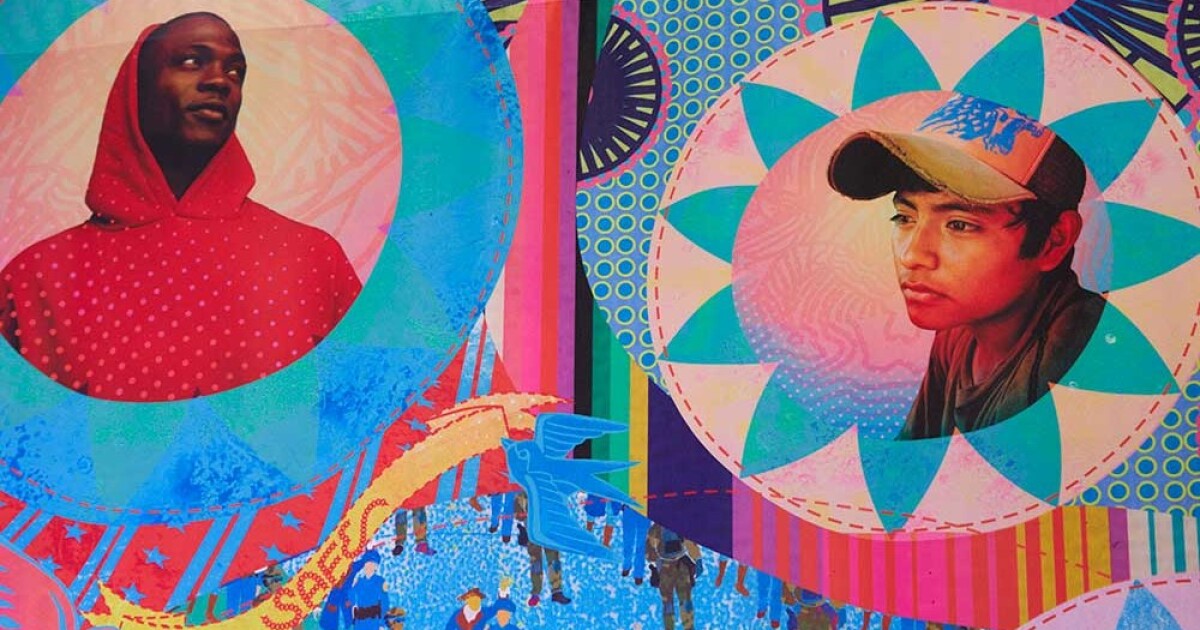
Next 250 (not to be confused with other projects with similar names) has an art component of its own. “WE | BE | GOING: An American Tapestry” is a collage-style installation work led by Wyatt Closs, of the Los Angeles-based firm Big Bowl of Ideas. At 9 feet high and 25 feet wide, it depicts diverse individuals and groups fighting for social justice.
The idea, reads the artwork’s web page, is to counter the flood of “grand patriotic messaging that often feels bombastic, predictable, and disconnected from real communities” by retelling the nation’s story “from the perspectives and contributions of women of color and other marginalized identities.”
“Instead of telling people what America is, the installation invites people to consider what America could become when we look at our shared history honestly and imagine our future with intention,” reads the site. The work has traveled to Hawaii, Detroit and Los Angeles.
Next 250 is asking people to sign on to its Declaration of Interdependence. It’s also looking for a big turnout for its mass mobilization at the National Museum of African American History. That’s on June 27 — one week in advance of the Fourth of July.