
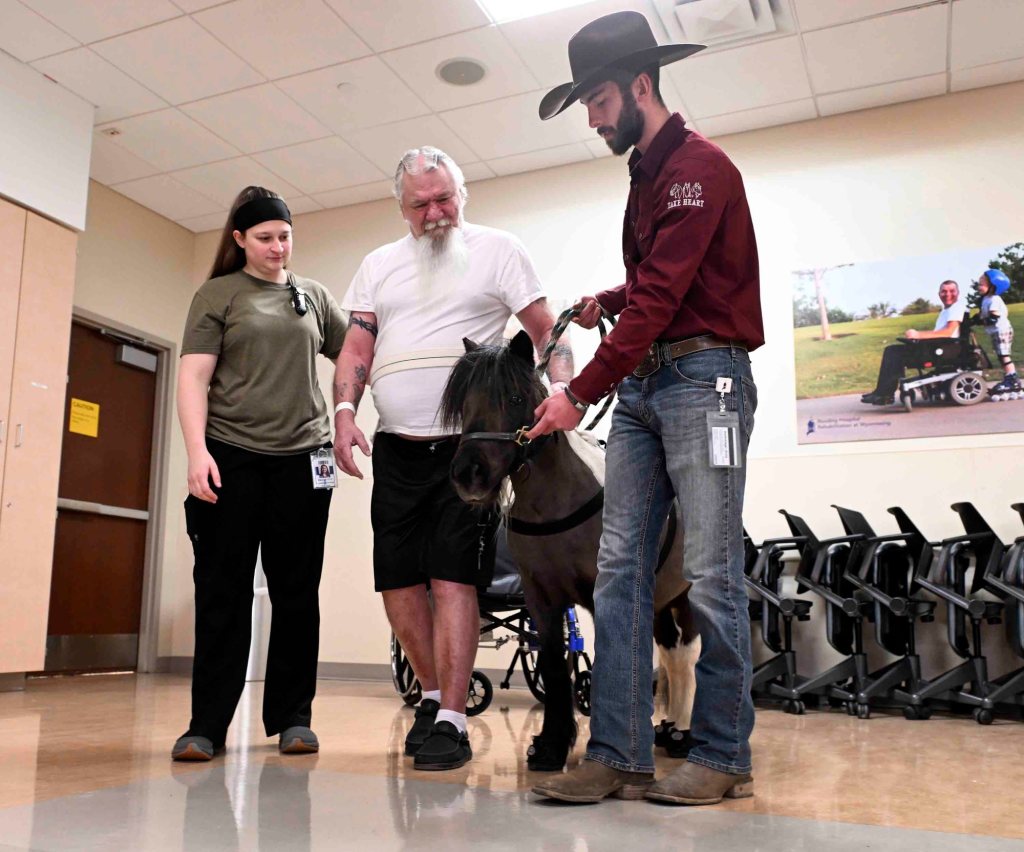
A stroll through Reading Hospital Rehabilitation at Wyomissing on Thursday morning produced a lot of typical hospital sights.
There were patients and doctors, wheelchairs and walkers. There were diagnostic machines and medical supplies, nurses and therapy devices.
And, there was a horse. Of course.
While that last one might seem a bit shocking and out of place to some, for those who regularly traverse the rehabilitation center’s halls it has, in fact, become a common thing to spy.
That’s because, starting the second week in January, a 7-year-old American mini horse named Raphie has been stopping by for two hours each Thursday.
His visits are part of a new horse therapy program Tower Health has introduced at the facility, designed to help stroke patients in their recoveries.
Nikki Hartman, acute rehab program director for Reading Hospital Rehabilitation, said the center was looking for ways to help patients deal with post-stroke depression, which is a common occurrence.
“Studies have shown that when you incorporate animal-assisted therapy it helps to improve mood and participation,” she said.
So the hospital connected with Take Heart, a counseling and equine-assisted therapy company near Wernersville. Through Take Heart — and a grant from the Reading Hospital Foundation — Raphie now spends from 9 to 11 a.m. helping three patients per week with their therapy.
The early results have been nothing short of astounding, Hartman said.
“We bring Raphie in and you can see a change immediately,” she said.
Patients walk with Raphie, they braid and brush his hair, they work on speech issues by naming his body parts or reciting horse facts.
Hartman said Raphie’s presence has improved patients’ abilities to tackle all of those tasks.
“We’ll have a patient who can maybe walk 20 feet on their own, and with Raphie it’s 50 or 100 feet,” she said. “It’s magic.”
So far, Hartman said, 90% of the patients who have done therapy with Raphie have had positive functional outcomes along with improvements in mood.
“The outcomes we’re seeing are just off the charts,” she said. “It’s amazing.”
One of the patients who has seen improvements working with Raphie is Floyd Walters, a 68-year-old stroke patient from Birdsboro.
On Thursday, Walters did laps around a large room inside the rehab hospital with Raphie at his side. He tussled the horse’s mane as they strolled, looking down at his walking partner with a smile.
“I think it’s great,” Walters said. “It gives you something to look forward to.”
Walters is no stranger to horses, having had several growing up on a farm near Royersford. Getting a chance to spend some time with an equine friend while doing therapy has brought back happy memories, he said, and makes the tedious task of rehab a little easier to swallow.
“It takes the boredom out of being in the hospital,” he said.
Walters said he didn’t know what to think when he first heard that horse therapy was going to be offered at the hospital, but he’s been pleasantly surprised by it.
“It’s better than walking with her,” he said with a wry smile, motioning toward his physical therapist.
Hartman said Raphie has not only boosted the mood of patients but has had a positive effect on staff.
“Everybody gets so excited,” she said, explaining that Raphie tours the building before starting his shift. “They hear the clip clop of him coming down the hall and everyone jumps out to see him.
“Thursdays have become everyone’s favorite day of the week.”
Raphie seems to enjoy the experience, too.
He exhibits a somewhat surprising level of calm in the unusual setting, interacting gently and compassionately with the patients. Brook Merritt, an equine professional with Take Heart, said those traits are just part of who Raphie is.
“A horse has to have the demeanor for it,” she said. “Not all horses can be in a room with all these people. Raphie takes it in stride.”
Most horses do have a sense of people’s energy and emotions, Merritt said, which make them great animals to use for therapy. That’s why she jumped at the chance to partner with Reading Rehabilitation Hospital.
“We know that our horses have this ability, so to be given this opportunity was super exciting,” she said. “We would like to see the program grow.”
As of now, the grant funding the hospital received from the Reading Hospital Foundation will support the program for a year. Hartman said that, based on its success, she hopes to extend that long into the future.