
In May 2023, The Philadelphia Inquirer published a detailed report on Montgomery County Democratic politics that described what it called a “pay-to-play culture.” The article examined campaign finance records, interviewed party insiders, and reported on concerns about how donor networks, politically connected law firms, and party leadership intersected in county decision-making.
The reporting focused on structure — not ideology.
That distinction matters in the 148th District Democratic primary.
On most major issues, the candidates sound similar. They support public education, reproductive rights, gun safety measures, and funding for SEPTA. Voters searching for sharp policy contrasts will not find much daylight.
Which means this race is less about policy differences and more about political structure.
Beyond One Episode
The 2023 endorsement reversal involving Danielle Duckett brought internal party tensions into public view. Under Chair Jason Salus, the Montgomery County Democratic Committee initially advanced Duckett as its preferred candidate to fill a County Commissioner vacancy, only to reverse course before the endorsement meeting. The Inquirer reported on criticism from some Democrats who questioned how that decision was made and how much influence was concentrated within a small leadership circle.
That episode did not create the broader debate — it illuminated it.
The Inquirer’s reporting framed the commissioner primary as a test of the party’s political machine and what it described as a pay-to-play culture. The article discussed donor networks, the role of politically active law firms, and concerns raised by Democrats about centralized control and access to power.
Whether one agrees with that characterization or not, it was independent reporting that documented an ongoing internal debate about how Montgomery County Democratic politics operates.
The Leadership Model
Under Salus’ tenure as county chair, the party has functioned through a highly organized leadership apparatus:
Executive influence over endorsements.
Coordinated institutional backing.
Consistent support from a network of politically active donors and firms.
None of this is inherently unlawful. Political parties consolidate influence. Donors support leadership they believe will be effective. Candidates align with structures that can help them win.
The question is not legality.
The question is whether Democratic voters want to reinforce that model.
The 148th as a Test Case
In the 148th race, one candidate is clearly aligned with Chair Salus and has accepted financial support from the same network of politically active firms and donors that also support him. Those contributions are public record. They are deliberate decisions.
Other candidates are not operating within that leadership structure.
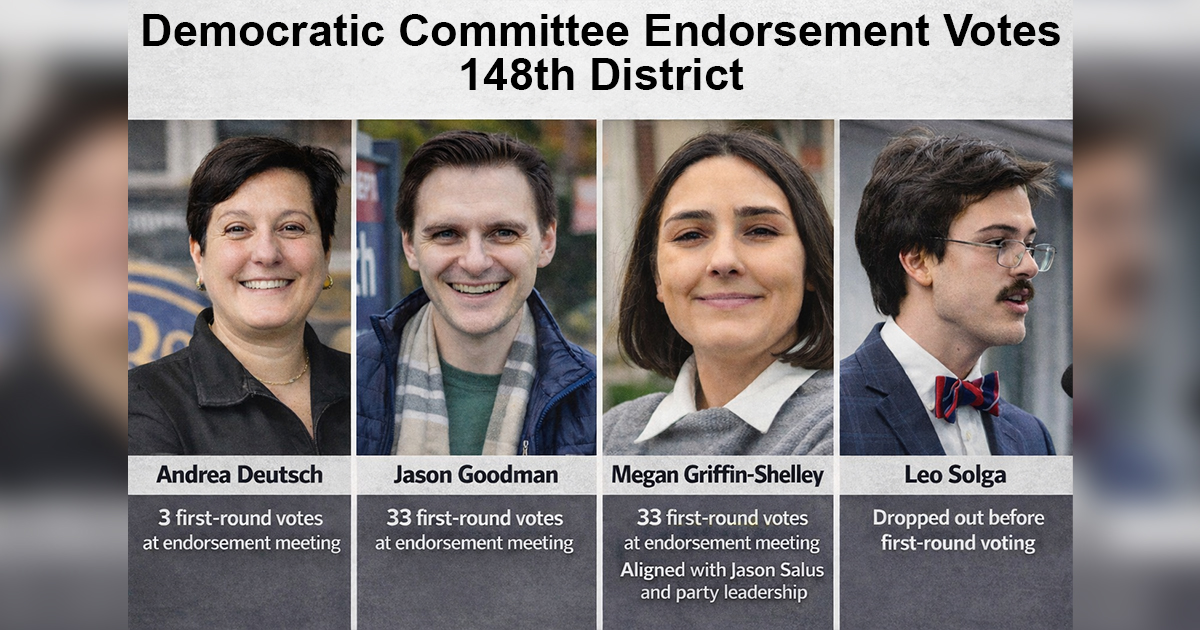
At the endorsement meeting on February 19, Jason Goodman received 33 votes, as did the Jason Salus-aligned Megan Griffin-Sheely. Andrea Deutsch received three votes, and Leo Solga withdrew before voting after calling for an open primary.
Those numbers illustrate where institutional support currently sits.
In a multi-candidate primary, a consolidated leadership-backed candidate can prevail while alternatives divide the rest of the vote.
Deutsch and Solga have every right to remain in the race. But the arithmetic of a fragmented field is straightforward.
If they remain in the race, are they comfortable increasing the likelihood that a divided field strengthens Chair Salus’ preferred candidate?
What Voters Decide
This primary is not primarily about tax policy or education funding formulas. The candidates largely agree.
It is about alignment.
Do voters in the 148th District want to extend the existing county leadership model — including the structure and donor alignment described in last year’s Inquirer reporting — into Harrisburg?
Or do they prefer a representative who operates outside that framework?
Some Democrats may view the Salus model as efficient and politically effective.
Others may view it as overly centralized and closely tied to entrenched donor networks.
That is the real choice in this race