
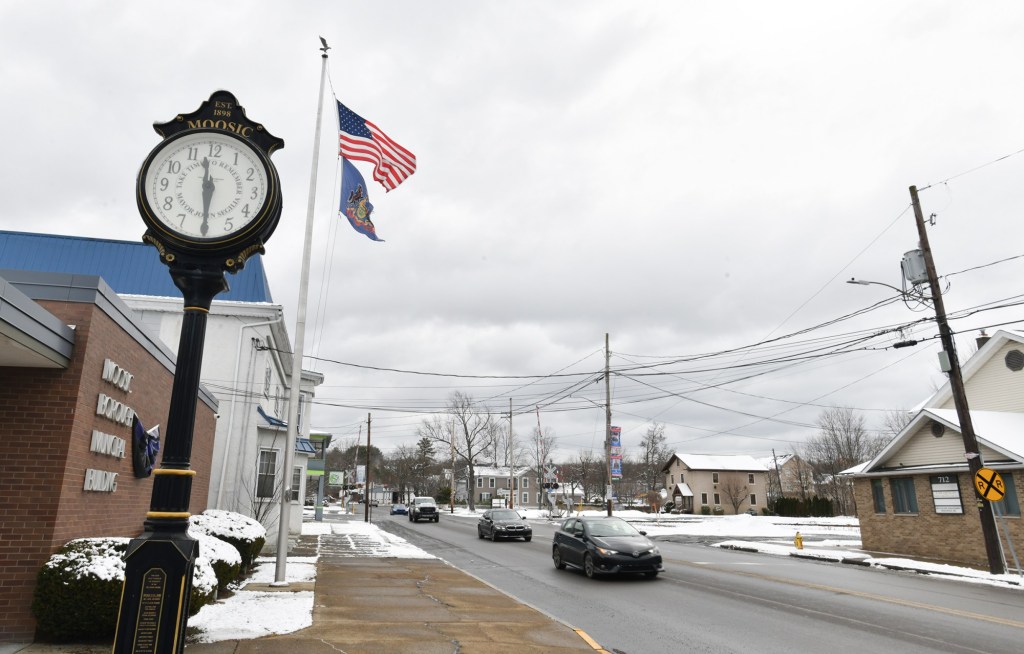
Moosic wants feedback from residents on regulating data centers.
Borough council will hold a work session Monday at 6 p.m. at the Borough Building, 715 Main St., to discuss a data center ordinance, according to a public notice published Saturday in The Times-Tribune. Council initially voted in September to begin the process of amending its zoning to regulate data centers and restrict where they can be built.
If the borough adopts the legislation at a future meeting, Moosic will become the first Downvalley community to regulate data centers. Throughout 2025 and into 2026, data center developers have largely focused on Lackawanna County’s Midvalley and North Pocono regions as they follow the high-tension power lines strung across the valley, but one of the latest proposals moved data centers south into Ransom Twp. on Newton Road, though that project is now in a legal battle.
Moosic has not yet received any inquiries or applications from data centers, but officials wanted to be proactive rather than reactive, Mayor Bob Bennie said.
“Unfortunately, we’re the beneficiary of some of the folks up the line here that have kind of gotten caught off guard,” Bennie said. “We’ve seen what’s happened to some of the other communities that didn’t have the luxury of getting updated, and they’re kind of dealing with this in real time.”
Municipalities in Pennsylvania must allow for every type of lawful land use somewhere within their borders, and failing to do so exposes them to legal challenges for exclusionary zoning.
Seeing Archbald’s inundation with data centers as it worked to amend its zoning, council President Marilyn French said Moosic officials realized they were vulnerable.
“This is a rapidly developing industry, and it’s hard to keep up with as a small municipality,” she said. “If we were the first, I think we would have experienced a lot of the chaos that we’re seeing some of our neighbors experience.”
The goal of Moosic’s data center zoning is to ensure it protects residents and taxpayers without being exclusionary, Bennie said.
“If a data center were to be located in Moosic, it would be to the complete benefit of the Moosic residents, not anything that would be detrimental to our community,” he said.
To achieve that, Moosic plans to make data centers conditional uses in its manufacturing zones — a similar approach to other communities throughout Lackawanna County. The majority of towns to adopt data center standards have designated them conditional uses, though some municipalities — Carbondale and Dickson City — made them special exceptions. Both determinations require developers to attend public hearings where residents can testify and ask questions, and they must adhere to conditions established by the local government, with the key difference being who ultimately approves a project. Councils and township supervisors rule on conditional uses, while zoning hearing boards determine special exceptions.
Moosic studied other municipalities’ data center zoning as it worked on its own, Bennie said, explaining borough officials believe conditional uses are more robust.
“It puts that responsibility and control, really, back in the hands of the elected officials who are making decisions as to what’s best for the borough,” Bennie said. “That’s the ultimate goal — do what’s best for Moosic and its residents.”
To write any of its data center legislation, Moosic is using former Lackawanna County solicitor and borough resident Donald Frederickson, rather than borough solicitor Raymond Rinaldi, to avoid any conflicts of interest, Bennie said. Rinaldi is actively representing data center projects in Archbald and Dickson City.
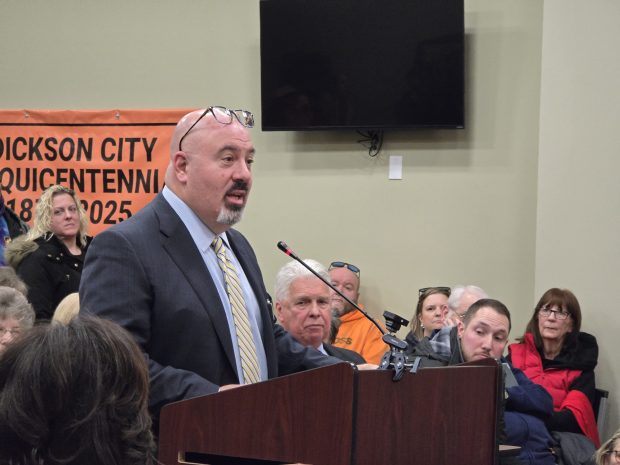 Data center attorney Raymond Rinaldi speaks during a public hearing Tuesday, Jan. 20, 2026, in the Dickson City Borough Building. (FRANK WILKES LESNEFSKY / STAFF PHOTO)
Frederickson, who left the county government several months ago for a job with the court system, served as Lackawanna County’s general counsel, solicitor and acting chief of staff during his 14-year tenure.
The ordinance will prevent data centers from being built next to residential areas, and it will address items like energy consumption, water consumption, setbacks, sound barriers, air quality, noise pollution and aesthetics, Bennie said. It also caps facilities at 45-feet tall, he said. Data center proposals in Lackawanna County are often 70- to 80-plus feet high.
“We’re trying to address all those major issues that other communities have faced,” he said.
Other items include noise studies and a water treatment plan, French said.
Comparing data centers to the coal mining industry — an increasingly popular parallel — Bennie said he was especially concerned with decommissioning them.
By limiting data centers to manufacturing zones, they can only built in four sections of the town: Moosic’s northern tier near the Scranton border by Davis Street, the bottom of Rocky Glen Road,, the site of the former DuPont or Goex gunpowder plant on Moosic’s southern border near the Wilkes-Barre/Scranton International Airport and Moosic’s western boundary between the turnpike and its borders with Old Forge and Taylor. However, the northernmost site is already slated for a warehouse at the site of the former McKinney Products Company, and western site has some floodplain designations along the Lackawanna River, Bennie said.
McKinney manufactured metal door hinges and other hardware until shutting down in June 2007, according to the U.S. Environmental Protection Agency.
Borough council will vote to introduce the ordinance during its March 9 meeting, Bennie said. Both the Lackawanna County and borough planning commissions will then review the draft ordinance, and after it receives recommendations from both advisory bodies, Moosic will hold a council hearing prior to voting on it.
Bennie was unsure exactly how long that process would take, as it’s contingent on the planning commissions.
Both Bennie and French want input from the community.
“This is a new phenomenon, so we don’t really know what the long-term effects or impacts are going to be, and that’s why we’re doing all of our due diligence,” Bennie said. “Come to the meeting, voice your opinion, read the ordinance.”