
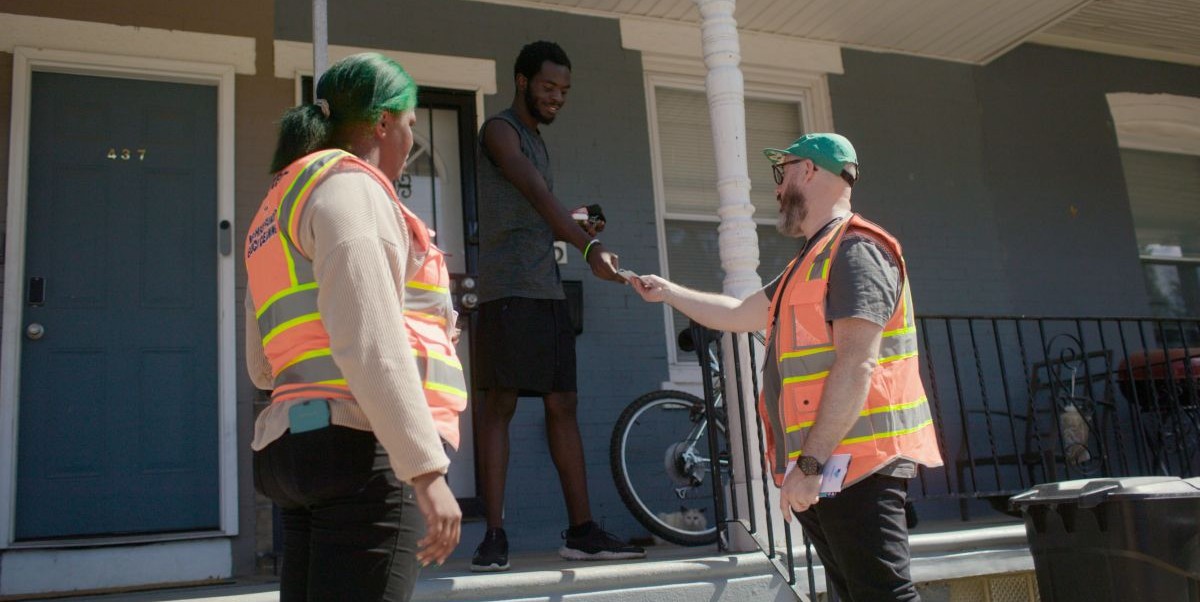
Ninety-year-old Patricia Russell has lived in West Philly’s Carroll Park neighborhood for much of her life — and in that time she’s seen it go from having lovely clean streets to trash-filled ones.
Russell lives in “the house my parents brought me home from the hospital to,” she says. Her sister lived down the street until she passed away two years ago. They used to talk about how the neighborhood had gotten dirtier. The City often neglects to pick up her recycling, causing neighbors to haul the bins back-and-forth from their alleys to the curb, spilling trash in the process. Pedestrians leave litter all over the neighborhood’s namesake 5-acre park.
“I get out there trying to clean,” she says. “It used to be, when I was growing up, that the sanitation department cleaned the streets. When they left, as the truck was moving along, there was another truck with a group of men cleaning the street up for anything that might have been dumped or leftover.” Now, that trash just stays, and often people walking to the park or waiting for the bus add to it.
Over the last month or so, that’s changed again. Glitter, a local subscription street cleaning service, started cleaning blocks in Carroll Park as part of Safe Steps West Philly, a program funded by a grant from the Pennsylvania Commission on Crime and Delinquency that seeks to reduce gun violence via making streets cleaner (we’ll get into why this works later). Russell signed up to support the program via subscription, so the cleaning can continue when the grant ends.
“Visually, it’s much calmer, more peaceful,” says Lavinia Solomon, another neighbor who runs the wellness nonprofit and community farm Sovereign Siblings in the neighborhood. “It’s just really changed the dynamic. It makes it much easier to get outside.”
Four-year-old Glitter, initially pitched as a City pilot, received its B Corp certification this summer, launched a new member hub that gives real time updates on block cleanings this fall, and is looking to expand its community partnerships and services — including a new edition of its Safe Steps program in elsewhere in West Philly, which aims to make streets safer and combat gun violence through cleaning.
Neighbors on 1,250 blocks pay Glitter to clean up. Grants and other resources fund another 500 blocks on a project basis. Looking ahead, the company hopes to become a resource for building community — not just cleaning streets. They’ve worked with neighborhoods to address issues like addiction, and are looking to add services like sidewalk repair.
“I like to say that Nextdoor’s where people go to complain; Glitter’s where people are going to go to solve problems,” Glitter Founder Morgan Berman says.
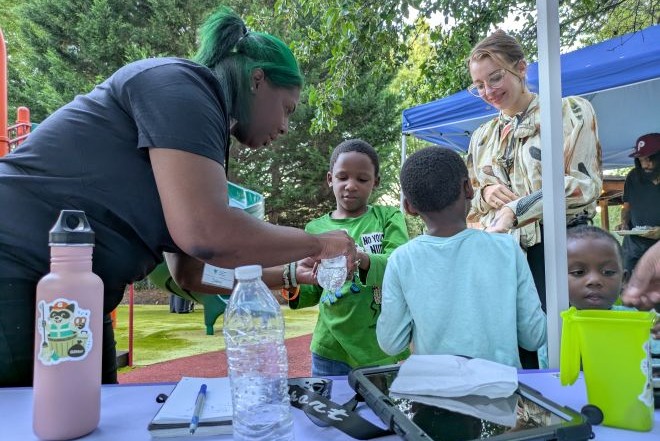 Kids at Glitter’s sign-up table get their hands clean. The antidote to Nextdoor
Back in 2018, Berman was a frustrated new mom who was sick of pushing her daughter’s stroller around piles of trash. She was also the founder of the tech company MilkCrate and a serial problem solver. So she became president of her civic association and set out to fix her South Philly neighborhood’s trash problem. She quickly found people were more interested in complaining than working together to find true solutions. “All of our neighborhood meetings were just people behaving horribly towards each other,” Berman remembers.
She came up with the idea for Glitter to address two problems at once: It would pay people in need of work to clean sidewalks in need of cleaning, on a block-by-block basis. The work would be flexible, so people could pick up trash whenever it fit into their schedules. The City initially agreed to fund the idea but then backed out, saying they didn’t want to fund an “unproven pilot,” citing the need for an RFP. Glitter embraced a neighborhood subscription model instead.
Quickly, Berman and Brandon Pousely, who joined as CEO about a year after Glitter’s founding, noticed their service did more than just keep streets clean. When trash was gone, more people went outside and built relationships with each other. Soon, neighbors started coming to them for help solving other problems.
One business owner in Kensington who purchased a subscription service for her block asked for help addressing the syringes that covered the streets. Glitter didn’t just pick them up, they helped neighbors work with police, the department of health, local property management companies and nonprofits to get people struggling with addiction the help they need and make the block cleaner and safer overall.
“A lot of people, for better or worse, are playing the game of: Where can we point the blame?” Pousely says. “We show up and say, Where can we get started on fixing the problem?”
Safer, cleaner, greener
Research has repeatedly found that cleaner streets are safer ones. In 2018, Penn’s Dr. Eugenia C. South found that cleaning and greening neighborhoods reduced crime thereby up to 29 percent. Glitter has seen similar results with its Safe Steps initiatives, which partner with local government leaders and use grant funding to clean streets to reduce gun violence. The first iteration of the program, Safe Steps Northwest, found that crime dropped an additional 25 percent on blocks Glitter cleaned.
PA State Senator Art Haywood, who represents parts of Northwest Philadelphia, approached Glitter about cleaning to reduce gun violence in 2022. He collected $5,000 from neighbors in Germantown and Mt. Airy and they did an eight-block pilot cleaning program that summer. The results were clear, if anecdotal: More people spent time outside when the streets were cleaner, hanging out on the porch or chatting with neighbors, which, in turn, made streets safer.
Glitter used those results to apply for a grant from the PA Commission on Crime and Delinquency’s Violence Intervention and Prevention program, won $818,000, and in the summer of 2024, expanded those efforts with Safe Steps Northwest. The program concluded this June. Throughout, Glitter cleaners worked with neighbors to report quality of life issues — like abandoned cars or illegal dumping — to the City and to build relationships with neighbors to help them transition to a paid subscription model when the grant funding ran out.
About 20 blocks in Safe Steps Northwest opted to start subscriptions so that Glitter could stay in the neighborhood and others in the area remain funded via programs like Glitter’s Impact Fund, which allows subscribers to donate money to support cleaning on other blocks.
“They’re sort of mini quality of life officers. We’re reducing crime. We’re increasing community pride. We should be doing this throughout the whole city.” — PA State Representative Jared Solomon
“Obviously, it’s not 300 blocks,” Pousley says. Still, he adds, “It’s nice to be able to see a continued presence in the area.”
Now, they’re using grant funding to bring Safe Steps to other parts of the city. The second iteration, Safe Steps Northeast, began this spring, and Safe Steps West Philly launched this fall, after the Carroll Park pilot. Pousley and Berman hope that the West and Northeast editions will be able to replicate the success of Northwest Philly.
“What we heard back from community members is that it was incredibly meaningful for them. They felt like they could engage in opportunities with their neighbors, sit on the front stoop, watch their children play,” says Rhena McClain, senior director of ECS St Barnabas Community Resource Center, which has partnered with Glitter on the pilot and the expansion of Safe Steps West Philly. “They wanted to keep it going.”
Northeast Philly State Representative Jared Solomon says he’s already seen an impact with Safe Steps Northeast. He’s long been a believer in the impact cleaning can have on crime, and procured a small grant to transform an overgrown parcel of land into a park he says reduced crime there by 40 percent.
“It was unbelievable,” he says. “It brought a sense of community pride to the area, which
really turned the tide.”
He thought, “if we could do that in this small area, imagine if we did it throughout the whole community.” So he partnered with Glitter, won another grant, and in March Glitter began hiring local cleaners for the more than 500 residential blocks in the district. Solomon has been impressed that the cleaners are keeping blocks tidier, but also that they’ve reported abandoned cars, mattresses left outside as junk, illegal dumping and other issues.
“They’re sort of mini quality of life officers,” Solomon says. “We’re reducing crime. We’re increasing community pride. I think it’s a great model. We should be doing this throughout the whole city.”
A responsibility for our sidewalks
Speaking of the City, you might wonder: Shouldn’t local governments be paying for services like street and sidewalk cleaning? Glitter was originally conceived of as something the City would use and pay for, after all.
Sidewalks (and keeping them clean) are a bit more complicated than that, however. Property owners — not the City — own and are responsible for the maintenance of sidewalks, alleys and driveways. That means everything from keeping the sidewalks free of trash to fixing any cracks falls to residents, landlords, and business owners.
Private companies and public-private partnerships have also long supplemented services offered by the City. An individual who wants to recycle more niche items may purchase a subscription to Rabbit Recycling. Business improvement districts often pay for additional street cleaning services in their neighborhoods.
“I like to say that Nextdoor’s where people go to complain; Glitter’s where people are going to go to solve the problems.” — Glitter Founder Morgan Berman
“We like the idea of people having an option when they want to receive an additional service — just like people who would like someone to help them maintain their lawn or their garden bed,” Pousley says.
Glitter pays its cleaners $25 per block, which, they estimate takes 60 to 90 minutes. For three out of the past four years, the company has been able to offer a profit-sharing bonus to employees, as well.
The Safe Steps programs focus on hiring local residents like Yasmene Hewlett. She had been job searching for months, hoping to find work flexible enough to allow her to care for her three young children. A friend who worked for Glitter suggested she apply. Hewlett appreciates Glitter’s flexibility and how it’s helped her connect with neighbors.
“It’s definitely gotten me out of my shell,” she says. “I have conversations with people. They love it when you clean.”
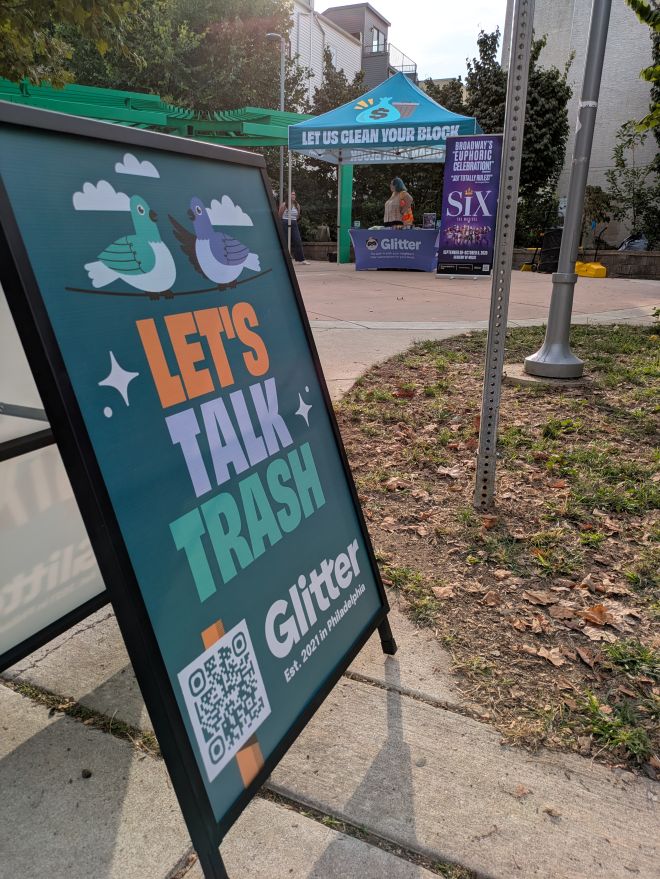 Where neighbors can sign up.
Glitter in every neighborhood
Pousley and Berman have a clear vision for Glitter’s future: Provide regular cleaning for 10,000 blocks in Philly. That number is taken from the City’s 2019 Litter Index (the last year we completed one), which found that half of Philly’s 18,000 blocks needed regular cleaning.
It will take time to get there, but they’re hoping their new member hub will help. The online tool provides updates from cleaners, shows before and after photos, allows neighbors to submit feedback and tracks subscription numbers. Non-members can search for their block, see if their neighbors are working to fund a subscription, and decide to pitch in, hopefully growing the service.
“We wanted to make it super easy to be like, Hey, neighbor, do this,” Berman says.
Glitter is profitable and they’re exploring adding more quality-of-life services, many of which aren’t covered by the City, in the future. It’s still early, but they’re looking at things like adding sidewalk and lighting repair, and working with street trees and planters. They’re also in the process of developing a partnership with composting companies to help bring more residents curbside composting. And they’re building more community partnerships. In September, they partnered with Ensemble Arts Philly to host a community cleanup block party at Carpenter Green Park about 10 blocks south of Rittenhouse Square.
The events serve a dual purpose: They help get people out, cleaning their neighborhood, and they help them learn about Glitter, hopefully turning them into subscribers. Berman loves to see these interactions, because they remind her why she founded Glitter in the first place. “I needed to create a way where people can be the best versions of themselves and actually try to contribute towards a solution to a concrete problem,” she says. “I certainly had enough of the nonsense.”
 MORE SOLUTIONS FOR OUR TRASH AND LITTER PROBLEM
Glitter workers speak with residents