
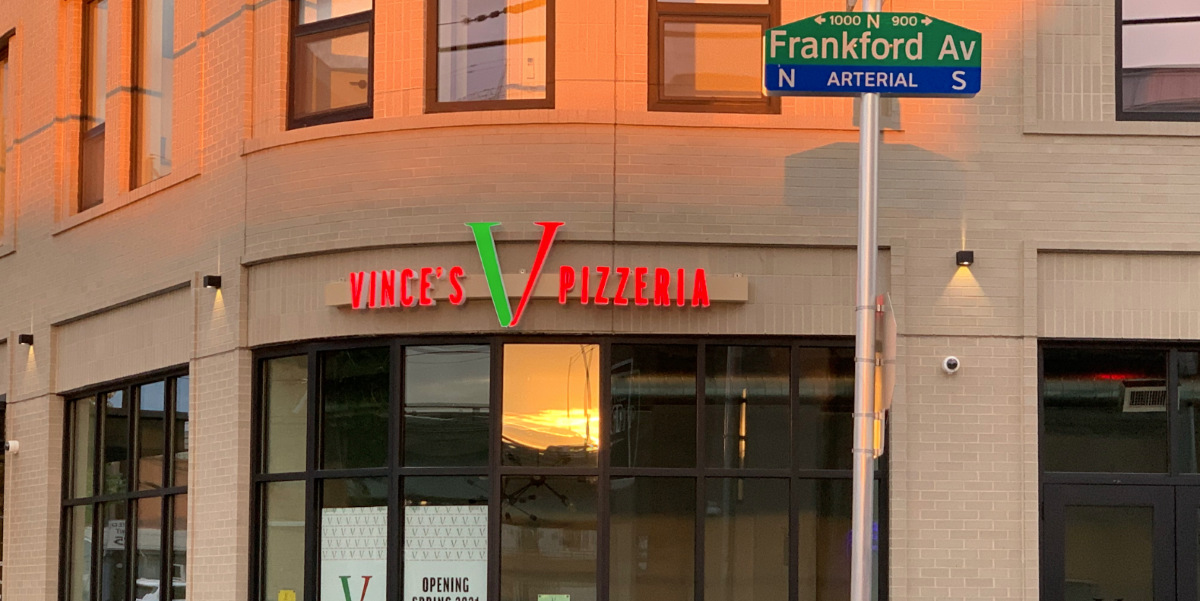
Most Fridays, my family likes to order from Vince’s Pizzeria in Fishtown, and I’ll admit I have some unhealthy brand loyalty to the place.
Every time, without fail, my kids are going to hear about the time I supported Vince’s at a Zoning Board of Adjustment (ZBA) meeting in 2020, over an issue that could only happen under Philadelphia’s broken land use system.
Vince’s sits on the east side of Frankford Avenue, where a series of restrictions have been added — overlayed — onto the neighborhood’s zoning code in an attempt to give neighbors more say over what types of businesses open in the neighborhood. The effect instead has been to throw unneeded roadblocks in the way of restaurants, like Vince’s, just trying to do business.
At the meeting, Vince’s needed relief for two things: a special exception for takeout food, and a parking variance. The brand-new building whose ground floor they now occupy did not build any off-street parking, as its zoning doesn’t require any. But some random Delaware River Waterfront parking rules covering the property do require parking for sit-down restaurants — one parking spot for every four occupants in this compact walkable rowhouse area.
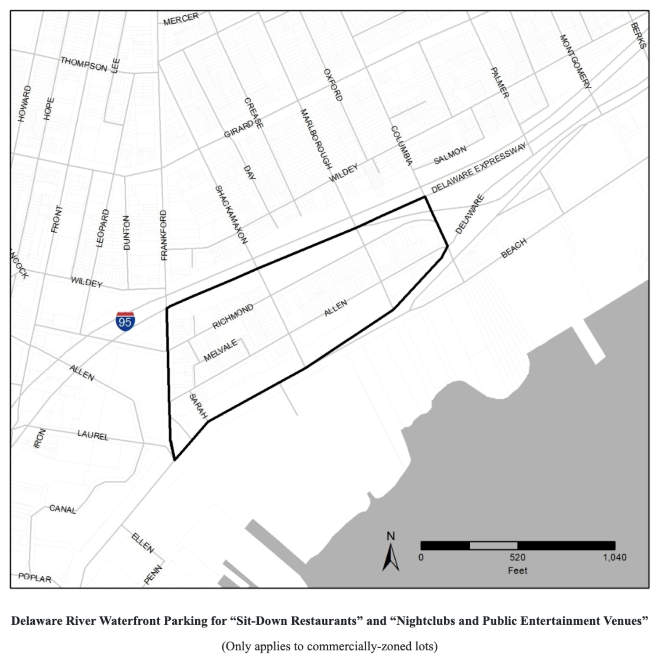
The second of the two overlays in this regulatory stromboli is the Neighborhood Commercial Area (NCA) overlay, which requires a special exception for all food and beverage business uses.
I thought I’d been radicalized on Philadelphia zoning before, but the idea that a small business would have to spend thousands of dollars and delay their opening by several months in order to get parking relief — in a building that wasn’t required to build any parking — really broke my brain that day.
The Vince’s case had not been controversial among the neighbors at the FNA zoning meeting, and I was the only person to speak at the ZBA Zoom meeting. Most people seemed to think it was a foregone conclusion that they’d get approved, given the absurdity of the situation. I did my little 2-minute polite rant about how stupid this all is when it was my turn to talk, and then Vince’s was easily and unanimously approved.
Based on a review of City permits, the whole timeline for the zoning phase of Vince’s permitting journey took about five months — but it took about 15 months between their initial filing and when the City finally issued their business license. Meanwhile, it took only five months to physically build out the space.
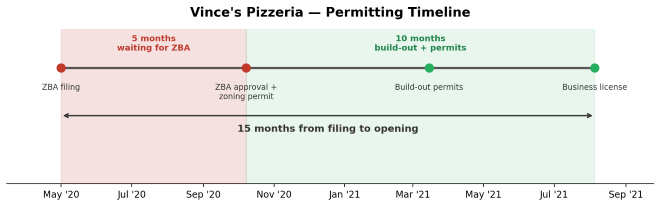
This is a very typical timeline for a hospitality business trying to open in the NCA overlay areas of Fishtown, Northern Liberties, East Kensington and Olde Richmond.
A 15-month opening timeline for a simple pizzeria on an established commercial corridor is a travesty. In a city where our local elected officials talk a big game about wanting to create more small business opportunities, the established processes make it untenable for regular people who can’t afford to invest 15 months of unpaid time into a venture before they make a single dollar. And it’s all because City Council members choose piecemeal zoning over the kind of unbiased administrative approvals that could cut this timeline in half.
What the data shows
Inspired by Jake Blumgart’s recent Inquirer story about the latest NCA fiasco — this time, a couple trying to open a burger shop called Sliders Co. on Frankford Ave in the face of intense resistance from the clothing store owner next door — I analyzed the city’s Open Data records for food and beverage business permits and ZBA cases going back to 2007 to see if there was some evidence of a deterrent effect on the regulated parts of Frankford.
Frankford Ave provides the setup for an almost ideal social science experiment because, in their bountiful wisdom, City Council drew the NCA boundary line right down the middle of the street. The east side has the added regulations; the west side does not. Meanwhile, Front Street, another fast-developing commercial corridor that runs parallel to Frankford, is totally unregulated by the overlay.
“Unregulated” in this case doesn’t mean there’s no zoning regulation at all. Every property gets assigned a zoning category, which comes with a basket of rights spelling out what the City will let you build there, or what kind of business you can open. That’s called the base zoning. For example, properties zoned CMX for commercial mixed-use are allowed to have restaurant uses “by-right,” meaning they get approved through an administrative process at the City’s Department of Licenses and Inspections (L+I), and City Council doesn’t have any role in those approvals.
Overlay zoning districts like the NCA are another layer of zoning that introduces even more rules. A zoning variance is required when someone wants to build something different from what the base zoning allows. And a special exception is similar, but there’s a lower legal bar to clear than a variance. Both of these require a neighborhood meeting hosted by the local Registered Community Organization, and a trip to the Zoning Board of Adjustment. This process more often resembles a popularity contest, even though it’s supposed to be a quasi-judicial decision on the merits of a property owner’s “hardship,” which has a very specific legal definition. The City requires all takeout restaurants to get a special exception already, so NCA properties don’t face any special disadvantages there compared to other corridors. The difference in the NCA is all about sit-down restaurants. And everybody applying for any of these things waits together in the long line for the ZBA.
Contrary to what I would’ve guessed, the regulated east side actually has a higher concentration of food and beverage businesses.
In a city where our local elected officials talk a big game about wanting to create more small business opportunities, the established processes make it untenable for regular people who can’t afford to invest 15 months of unpaid time into a venture before they make a single dollar.
Businesses also don’t have a harder time getting approved on the east vs. the west side because the ZBA approves nearly every single special exception. Out of 48 decided food and beverage cases on Frankford Ave since 2007, 47 were approved. For sit-down restaurants specifically — the category that wouldn’t need ZBA approval at all without the overlay — the approval rate is literally 100 percent: 32 out of 32. For the entire overlay within the Fishtown-Kensington BID’s boundaries, the ZBA has rejected just four food and beverage cases in almost 20 years.
So the NCA does not actually act like a meaningful quality gate for the neighborhood the way some of its proponents suggest.
Fishtown’s dilemma isn’t just about hospitality businesses choosing between the east and west sides of Frankford Ave though. Those businesses might decide instead to open on a competitor commercial corridor like Passyunk Avenue, where they’d never have to deal with the ZBA at all.
To measure that competitive disadvantage, I also pulled every food and beverage business license and ZBA appeal on the commercial corridors in Fishtown, Northern Liberties , and E. Passyunk Ave. from the City’s Open Data going back to 2007, then matched them up with the permitting records to reconstruct opening timelines for businesses. Passyunk Ave makes a good control corridor to compare against since that area has a similar business mix and demographic profile, and all three of these areas are often in competition for new restaurant leases.
The headline finding: On the unregulated west side of Frankford, a typical new restaurant opens about 7.5 months after pulling its first zoning permit, based on 77 restaurants with matched permit and license records. On the east side, that same restaurant faces about a 15-month timeline. This includes the 7.5 months of buildout, plus a median 85-day ZBA queue before construction can even begin, plus the cascading delays that the uncertainty creates for lease negotiations, contractor scheduling and financing.
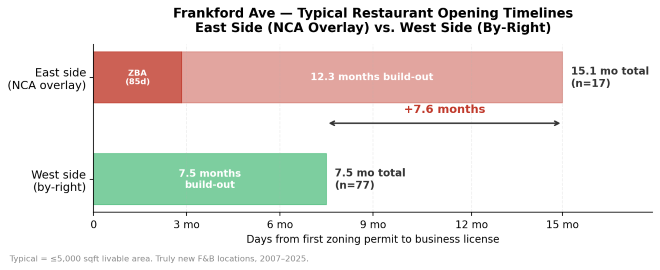
Both timelines include construction buildout time that can’t be cleanly separated from the regulatory process in the data. But east side businesses actually have a higher rate of renovation projects, so construction differences aren’t inflating the gap — if anything, they’re understating it.
That’s 7.5 extra months for a process that, on Frankford Ave, has approved every single sit-down restaurant that has ever gone before it. Across all the corridors I looked at, the ZBA approved 201 out of 207 food and beverage cases. A 97 percent approval rate. The NCA is not functioning as a quality gate. It is a toll booth.
The pattern holds beyond Frankford. I compared opening timelines for food and beverage businesses that went through the ZBA against businesses on the same corridors that opened by-right, using the most recent building permit as a starting point for the by-right group:
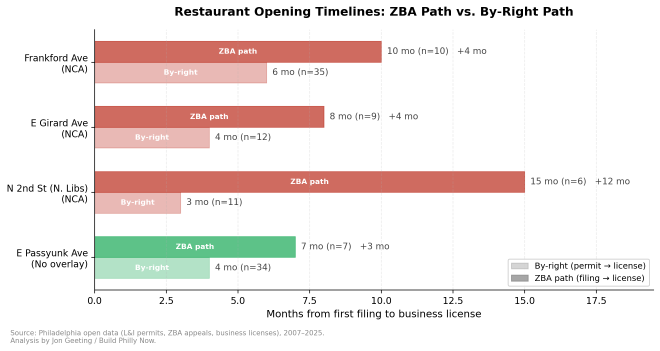
A few observations jump out from this. The ZBA path takes longer everywhere, but the gap is worse on the NCA corridors. Aggregated together, NCA corridor businesses that had to go to the ZBA waited a median of about 12 months from initial filing to receiving a business license, compared with 5 months for businesses that opened by-right on the same streets. That’s a 7-month penalty for a process that almost always ends in approval.
And the overwhelming majority of those ZBA cases — 156 of the 250 food and beverage appeals in the dataset — are sit-down restaurants. Not take-out places or prepared food shops, which require a special exception citywide. Sit-down restaurants in commercial mixed-use zones are permitted by-right everywhere else in Philadelphia besides in Fishtown. The NCA overlay is what sends them to the ZBA, and almost all of them are in zones where the base zoning already allows restaurants.
Each of those hearings costs the business owner somewhere between $3,000 and $15,000 in legal and application fees, on top of the months of delay. That’s real money and time that’s being extracted from small business owners for a review that approves 97 percent of applicants. And it doesn’t count the ones we can’t see in the data — the businesses that looked at these costs and timelines and chose Passyunk instead, or just gave up altogether.
How City Council stacks the deck against change
Obsolete laws and policies sometimes persist long past their sell-by date simply because of inertia. I saw this firsthand when I was president of Fishtown Neighbors Association around 2021-2023, and was part of a multi-party negotiation to amend the overlay.
The catalyst for these efforts was when Northern Liberties, and then Fishtown soon after, created Business Improvement Districts, which are local corridor economic development organizations funded by commercial real estate taxes. The new Business Improvement District (BID) directors immediately recognized that these commercial corridors (Frankford Ave, Girard, and N. 2nd and 3rd streets) are at a real competitive disadvantage owing to the NCA’s requirement that every sit-down food and beverage business inside the overlay must get a special exception from the ZBA.
The Neighborhood Commercial Area is not functioning as a quality gate. It is a toll booth.
The NCA overlay zone falls mostly within the 1st Council District, represented by Councilmember Mark Squilla. As Blumgart reported, Squilla’s position all along has been that he’ll make any changes that have unanimous support from the six affected local organizations — a near-guarantee of inaction given the disagreement between the parties.
Both BID directors started out wanting full repeal, and East Kensington Neighbors Association and Olde Richmond Neighbors Association were willing to support that position. But Northern Liberties Neighbors Association and Fishtown Neighbors Association were both leery of outright repeal, and preferred to amend the overlay in various ways. Northern Liberties Neighbors Association (NLNA) was willing to entertain a fast-track option if the City would institutionalize certain code requirements that NLNA typically asks for: a size limit, a trash plan, no metal dumpsters, and no outdoor speakers. FNA’s zoning committee was open to a carve-out for businesses with a smaller square footage footprint, and agreed with many of the code provisos NLNA wanted, but drew a line at fast-tracking any alcohol-serving businesses.
Negotiations fell apart when two different City validators — the Planning Commission and Squilla — made conflicting claims about what changes were legal and enforceable.
While everyone generally agreed that reform was needed, the structure of the process established by Squilla guaranteed that no reforms would advance. The overlay remains unchanged today.
This critique isn’t specific just to Squilla, though he is ultimately responsible for the problem not getting fixed in this case. At no point did he seem to form his own opinion about what he thought should happen, as the duly elected representative empowered to make these decisions. Without a strong internal compass from the Councilmember on the issue, the status quo had the wind at its back — and it’s hard to imagine any other sitting member of City Council handling this differently. That’s a much bigger Philadelphia political culture problem than this one episode.
Now that the overlay is back in the news with the Sliders Co. controversy, breaking the logjam will require something the last round of negotiations never had: a Councilmember willing to form an opinion and act on it, rather than waiting for neighborhood organizations to achieve a consensus they structurally cannot reach. The data now exists to make the case the overlay is just a toll booth, not a gate. The only missing ingredient is political will.
 MORE FROM JON GEETING
Vince’s Pizzeria, via Google Maps