
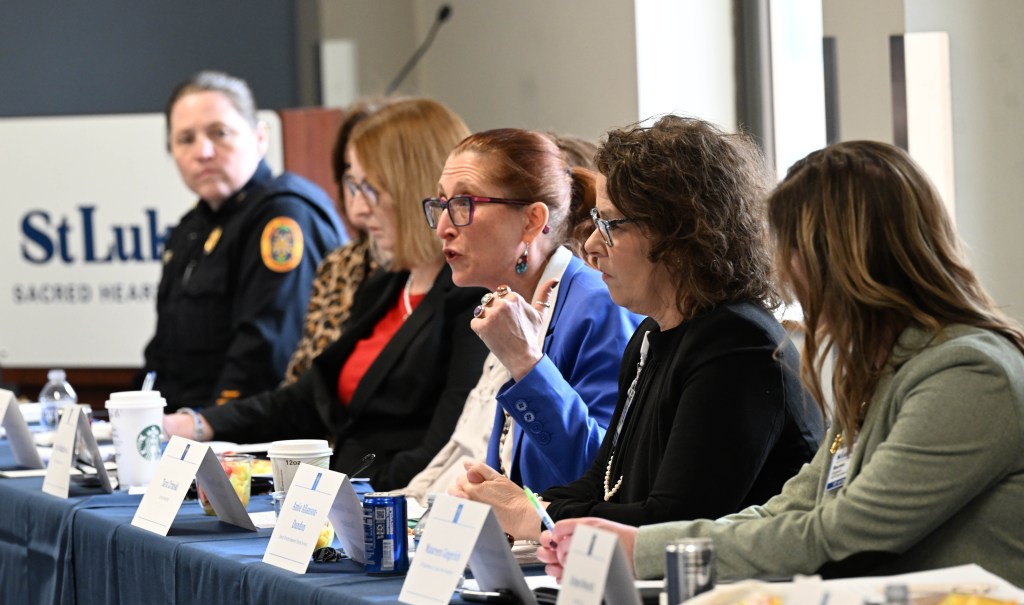
Mental health plays a huge role in the criminal justice system, Pennsylvania Attorney General Dave Sunday said during a roundtable discussion Thursday in Allentown.
Far too often, Sunday said, when you see violent crime, there was probably a point in the perpetrator’s life where a mental health intervention would have made a difference.
“You cannot separate a lot of what happens in the criminal justice system from behavioral health issues and from the mental health crisis,” he said. “I saw people that sat in prison cells that shouldn’t have been there because if they had had some type of treatment way in advance, it never would have come to that.”
Sunday spoke at a roundtable on behavioral health, criminal law and policy hosted by St. Luke’s University Health Network at St. Luke’s Hospital-Sacred Heart.
Though the importance of mental health resources at all levels of the community, including in schools, was discussed, the interaction between mental health and the criminal justice system dominated much of the discussion.
Sunday, a former York County district attorney, highlighted successful programs geared toward prisoner reentry and mental health. Lehigh Valley leaders also highlighted other programs such as Community Connections, where Bethlehem Health Bureau social workers go out on calls with Bethlehem police; or how community intervention specialists are used by Allentown police.
Lehigh County District Attorney Gavin Holihan said thinking about the criminal legal system as a natural access point for mental health is the wrong way of addressing the mental health crisis.
He said there is plenty of funding for behavioral health initiatives, but much of it is misused. Tax dollars are wasted, he said, if they are primarily going to people who are already at crisis level, where there is high utilization and high cost.
“These are people who are in and out of the jails, in and out of the hospitals, the emergency departments, sometimes multiple times a week, some of them multiple times a day,” Holihan said. “So these are incredible expenses that we’re already paying for as a system.”
Holihan said he believes a way to decrease waste would be to lower the standards for mandatory care through the Mental Health Procedures Act so that care interventions have to occur earlier. He added that resources should be shifted away from the criminal legal system and to the mental health care system.
“The criminal justice system was not built, it is not intended as a mental health provider and yet that’s what it has become. And then people criticize the criminal justice system for being a bad mental health provider,” Holihan said.