
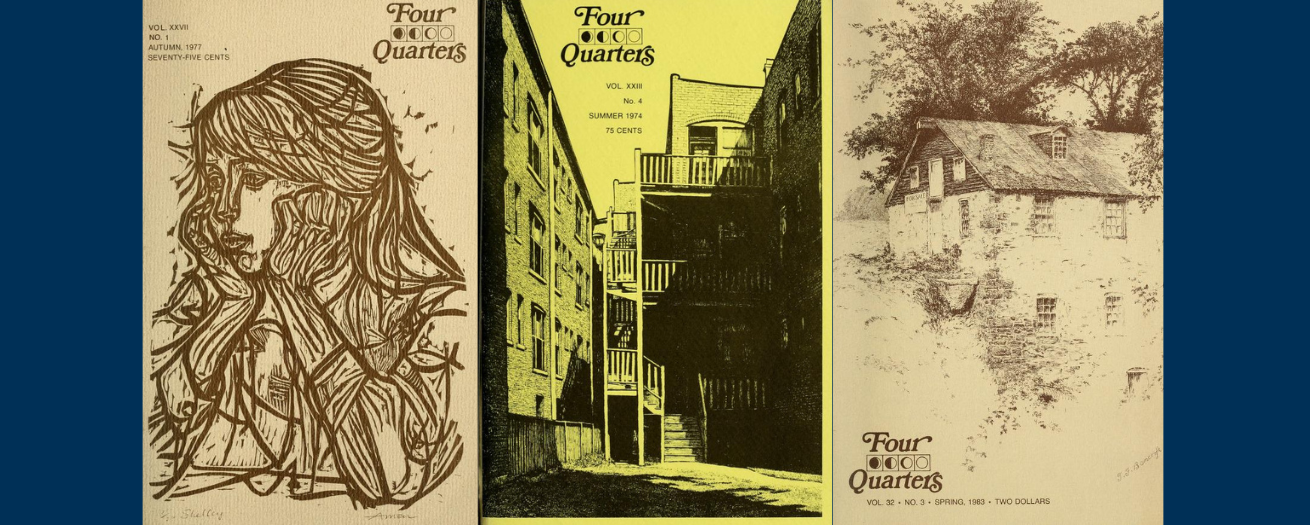
One of the pleasures of my fifty plus years teaching at La Salle College, then University, was the school’s literary magazine, Four Quarters. Four Quarters was typical of the intellectual journals founded in the 1950 in the wake of the influx of GI Bill students to college. It specialized in short stories, poetry and occasional literary essays.
Initially it drew upon faculty contributions but that changed when two members of the English Department, Br Edward Patrick Sheeley and John Keenan became editors. Under their leadership, Four Quarters began to attract talented contributors. The historian Christopher Dawson published parts of his influential book, Christianity and the Rise of the West in its pages. Poets like X.J. Kennedy and John L’Heureux also contributed their work. W.H. Auden contributed a poem for which he was paid $50. (He later published it in another journal where I am sure his compensation was much greater.) On another occasion, Brother Patrick came across a short story by someone named Flannery O’Connor and wrote him a letter requesting a contribution. Ms. O’Connor kindly complied.
Four Quarters’ reputation began to spread in the 1950s. Among those whose work appeared were: Daniel Berrigan, the peace activist priest, Sam Sheppard, Pulitzer winning playwright and actor as well as novelist Robert Penn Warren whose interview by a La Salle student appeared in its pages. The Warren article was the most-requested and -cited of Four Quarters material. The journal charged all of $5 for requests to use.
Four Quarters also was a practical success. Most universities subscribed and collected it including the Library of Congress. When I was doing research at the British Museum, I discovered that they were subscribers. The faculty used to joke that beyond Broad and Olney Avenue, La Salle was known for two things: Tom Gola and Four Quarters. But in 1985, in one of those decisions that institutions like to make, there was talk that Four Quarters would fold and the school would save its approximately $25,000 cost.
Part of the problem was that Keenan’s successor was a poor editor and he let Four Quarters drift. Issues began to appear late and the journal got thinner and thinner. Keenan agreed to return as editor and asked me if I would help. I agreed and spent ten of my happiest years as his assistant.
John and I divided the work. He would handle the short stories and poetry and I would take on the essays and book reviews. He occasionally would discuss the short story pieces with me but kept me away from the poetry, claiming that my favorite poet was probably Edgar Guest of “It takes a heap of living to make a house a home,” or Robert W. Service’s “The Cremation of Sam Magee.” It was actually Kipling but I let it pass.
We made a couple of quick decisions. We decided to run two issues instead of the four of the title but to give the journal greater depth, increase the size to 64 pages. We also planned to turn over all incoming material in thirty days. That proved impossible as after a short time, we were getting over 1000 submissions a year, mostly short stories and poetry.
A typical issue would usually have an introductory piece by Keenan, two or three short stories, five or six poems, an essay and a couple of book reviews. We paid around $100 for a short story or essay $5 a line for the poetry. One chap sent us 30 poems, written in pencil, every month. I thought we should have rewarded him for persistence but we never did. We had to enlist some of our faculty colleagues to help evaluate the material. We didn’t ask for comments — although since we were dealing with academics we got plenty — just a simple yes or no. If a yes, we would review it to see if we agreed. Most of the time the editing process was fun although we occasionally got submissions that were sad, practically begging us to print the piece.
We even got submissions in French and Spanish — I guess we were supposed to translate — and once were sent a novella from Ed McBain, author of the detective series, “The 87th Precinct,” about the gangster Legs Diamond. It would have filled the entire issue but we were tempted because of his name. We turned it down
Despite a careful process of logging in the submissions, in ten years, we misplaced just one. One morning I opened a letter asking for a reaction to a short story sent some six months earlier. We had recorded the submission but it was not assigned to anyone. After a search of the office, we found It had fallen behind one of our file cabinets. Keenan read it and thought it was marginal but we decided out of sense of guilt to publish it.
Over the decade we ran Four Quarters, we published some first-class material. Keenan’s family came from the same town as the poet Seamus Heaney and when Heaney did a reading at LaSalle, he gave us one of his poems. The South African novelist, Alan Paton, when he spoke, also gave us an essay. Two Nobel Prize winners in ten years wasn’t too bad for any journal.
We published historians like John Lukacs, who had taught at La Salle, Wilfred Maclay, and essayists like John Rodden, a La Salle grad and the leading Orwell scholar in America. Our covers were done by local painters like David McShane who did the iconic mural of Jackie Robinson in Philadelphia and we used material from La Salle Art Museum with its holdings of work by Ingres, Eakins, Rembrandt, and Peale, among others.
John and I agreed to limit our contributions. He did a few introductory pieces and I did two book reviews and two short pieces during our decade of editing the journal. We had some talented faculty who contributed also, although we tried to keep Four Quarters from just being a place for people to dump unpublished material.
Eventually Four Quarters, like so many other university literary journals, fell victim to difficult times. In 1995, after 45 years of quality work Four Quarters was cancelled. Keenan and I thought it was a mistake and we made our case but to no avail. Perhaps some day a collection of the “best” of Four Quarters will appear. I hope so.
John P. Rossi taught at LaSalle University for over 50 years.