
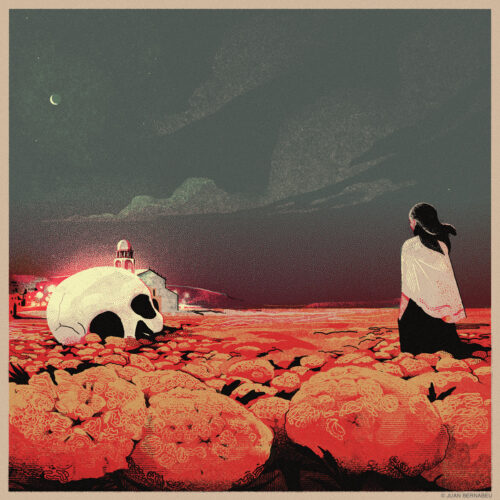
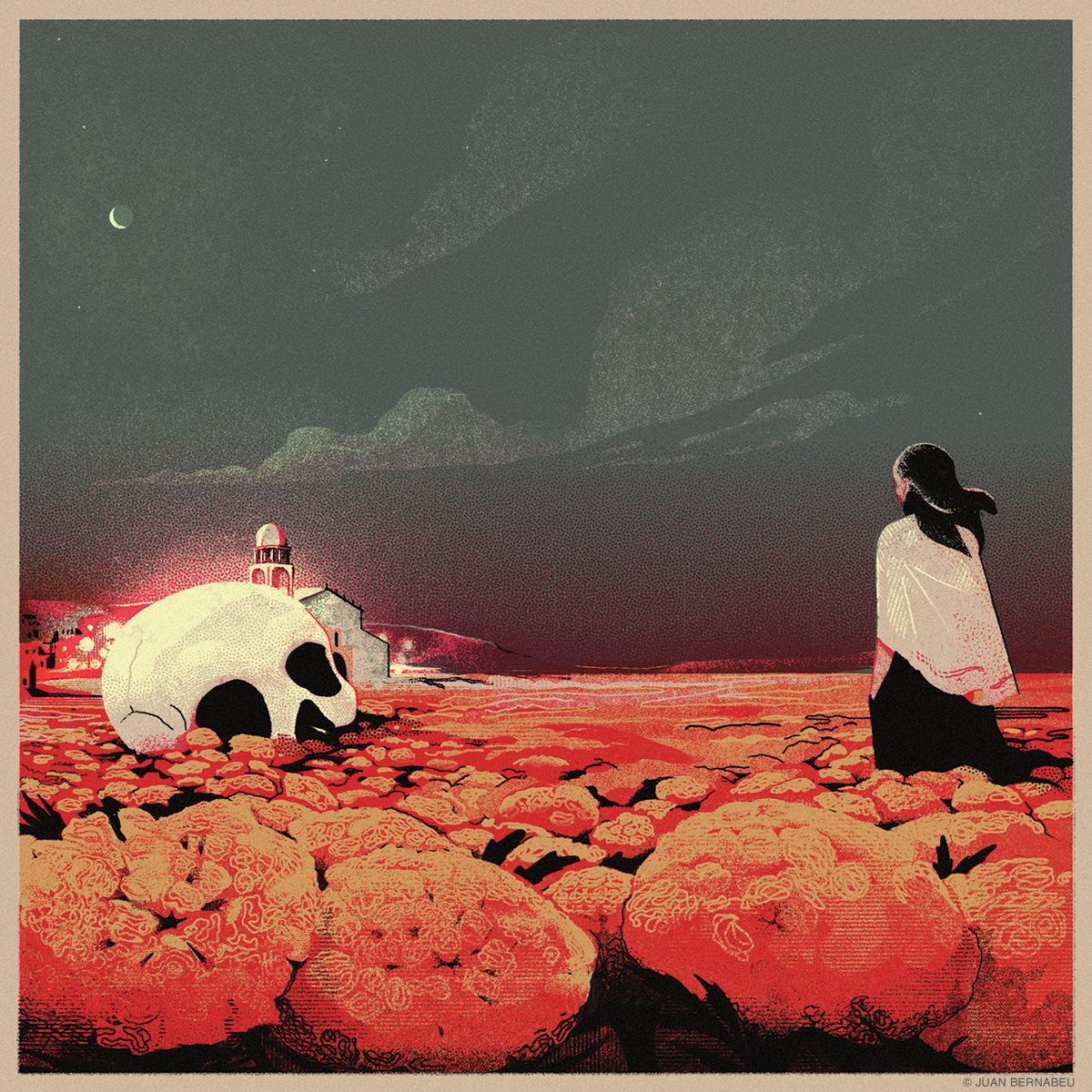
 Illustration by Juan Bernabeu
“The thought I often squelch now surfaced.”
By Joanne B. Mulcahy
An almost-full moon hung low in the sky, illuminating the misty road to Arócutin, a Purépecha pueblo of about 700 people on Lake Pátzcuaro in central Mexico. On the night of November 1, my husband, Bob, and I left the nearby town of Pátzcuaro at 2:15 a.m. Friends had advised us to get to Arócutin’s panteón, or cemetery, around 3 a.m. By then, the main flood of tourists would be gone, while families honoring their dead would remain.
Bob and I had been living part-time in Pátzcuaro for 30 years. Yet this would be our first experience of El Día de los Muertos—an intertwined celebration of life and death that is a cornerstone of Mexican national identity.
Moonlight slanted over Pátzcuaro’s red-tiled roofs as we drove through the nearly empty town. A few celebrants wandered home from bars or the local panteón. We soon hit a wild party at the turnoff for the docks to Janitzio, an island in the center of the lake. The Pátzcuaro region draws Muertos tourists from all over the world, but Janitzio is especially renowned. Hundreds of people milled about, many with painted faces and skeleton costumes. Impromptu stands sold beer and tequila, tacos and carnitas. A mariachi band in red-sequined outfits competed with boom boxes. We crawled through a line of cars so long that we contemplated turning around, but we were loath to give up so easily. Then, as suddenly as a scene change in a theater, the road to Arócutin opened, silent and shadowy.
We passed Huecorio and a few other pueblos, weakly lit by smoldering candles in empty roadside cemeteries. Our headlights probed the unnerving darkness as we crept through the countryside. We’d expected a horde of celebrants at the church of Santa Muerte in Santa Ana Chapitiro. Surely this was a night to honor the folk saint of death! Once the domain of prisoners and outsiders, and long shunned by the Catholic Church, Santa Muerte now draws tourists and locals to the shrine. I scanned the darkened buildings and registered no signs of life.
My anxiety spiraled. What did I fear? We knew that carjackings can happen on deserted roads in Michoacán. Some people worry that an uptick in political violence imperils Muertos traditions here. Drunk drivers threaten in all parts of the world, but we had encountered few cars. A dread of something deeper hovered. I tamped it down.
Arriving at Arócutin, we parked and began the steep ascent to the panteón, huffing our way through silent streets. Even the dogs stayed mute, eyes fixed warily on us. I thought of scenes from Juan Rulfo’s Pedro Paramo, the famous novel said to have launched magical realism. The story follows a man searching for his father in a village inhabited entirely by the numerous and very dead offspring of his papá. The book brims with an eeriness that engulfed me now.
Finally, flickering candles signaled the panteón entrance. An altar at the threshold honored the “animas olvidadas”—forgotten souls. I made the sign of the cross, an automatic response borne of a Catholic upbringing. My mood shifted immediately to reverence.
The day before, I’d helped friends in Erongarícuaro, a larger pueblo on the lake, clean and decorate graves in their panteón. We chatted as we pulled weeds and spread bright orange marigolds, cempasúchiles, the flower ubiquitous during Muertos. Petals fluttered everywhere. A few strays landed on my jacket. I tucked them into a pocket, a shimmering hidden treasure. In Arócutin, the marigolds mixed with purple flores de terciopelo, some woven into the image of Christ on the cross. On each grave, offerings of Coca Cola, mescal, or Negro Modelo rested alongside baskets of fruits covered by bright embroidered cloths. I marveled at the splendor, embellished by a sea of blazing candles.
We joined about 30 other people following the dirt paths snaking through the panteón. Some were Mexican tourists, others clearly foreigners like us. A dozen local families clustered around their grave sites. Two old Purépecha women wrapped in rebozos dozed near a fire; a few men shared a bottle of tequila. Children played in one corner, leavening the solemnity of the scene.
Hybrid forms of indigenous and Catholic symbols adorned the church adjoining the graveyard. A wooden Christ on the cross wore the apron traditional to Purépecha women, embellished with purple and gold sequined flowers. An Indigenous man in a huge wool poncho stood guard, his face serious and his eyes watchful. He nodded when he noticed my tears. Despite my lapsed church-going, the symbols and scents of Catholic churches in Mexico always resurrect childhood veneration. I was now deep into an experience I had not expected or fully prepared for.
I knelt at the altar for a long while, pondering loved ones we’ve lost these past few years. November marked five years since my mother’s death during the COVID outbreak. The pandemic had robbed us of a group ritual for more than two years. Finally, on a rain-soaked July day, we buried her in the small Vermont town where she’d grown up, next to my father who had preceded her by a decade. Now, a fierce grief returned. Had I done enough to show my love and gratitude while they lived? I rarely get across the country from our home in Oregon to visit their graves. I fought tears of regret, longing to slip into communion with the Dead.
Would a collective gathering with my siblings, cousins, and other relatives create solace? What do rituals offer? In Arócutin, I felt connected to some unseen force. The veil between life and death, memory and forgetting, light and darkness felt porous. Cloaked by that sensation, I longed to linger. But I also feared that the gathering light of dawn would dispel the feeling. We left before sunrise.
Everything about Muertos exemplified what we stand to gain by seeking out landscapes and cultures different from our own. An early experience with death in the US remains one of my most indelible childhood memories. One fall day, the nuns gathered our elementary school class to pay homage to a Catholic prelate in downtown Philadelphia. We filed silently past his coffin, his perfectly embalmed body cloaked in white silk vestments and a mitre. He seemed like a wax figure. I don’t remember a single conversation in school or at home about this encounter, or about the passing of our beloved grandparents that followed.
Years later, living with Bob in Derry, Northern Ireland, we attended a wake for a relative of our host, Helena. Bob had recently joined me after helping to care for his mother before she died. That staggering loss was still raw when we entered the Donegal home of Helena’s relatives. The kitchen filled with friends and family laughing, drinking, and sharing the “craic”—that classic form of Irish storytelling. Upstairs, the air was somber, the body of the deceased laid out on a four-poster bed. Bob, unprepared for the sight of this old, white-haired woman, burst into tears. His reaction triggered sympathetic looks—and later, on the drive back to Derry, a lighthearted joke from Helena about “emotional Yanks.”
Though I didn’t know it then, this mix of gaiety and a weighty reckoning with death echoes Mexican attitudes. As in Mexico, Irish traditions blend ancient practices, in this case Celtic, with Catholic beliefs. Sharing the sustenance of stories, food, and drink celebrates Irish lives in ways that resonate with the Mexican experience.
In contrast, denial still dominates in much of the US. We bury consciousness of death long before we entomb our bodies. I hadn’t expected how powerfully our trip to Arócutin would confront me with the inextricability of death from life.
I watched Bob carefully negotiate the dark, misty road back to Pátzcuaro. Joy hummed through me as I pondered our 33 years together. We still map our hopes and adventures side by side, carry them forward, and relive them in story. We do so as though we will always emerge to plan the next phase. The thought I often squelch now surfaced: losing him would shatter me, something I fear far more than my own demise.
Octavio Paz, famously and controversially, proclaimed that Mexicans “laugh at death.” Nothing in that laughter assuages individual grief. Yet the more I acknowledged my fears, the louder the thrum of joy. In foregrounding death and loss, Muertos affirms life.
Rituals often accommodate such contradictions. They highlight but also mitigate suffering. In Arócutin, the flowers spoke for souls otherwise “olvidadas.” He once thrived, they say. She was loved. They are not forgotten.
At home, I placed a few of the marigold petals from the Erongarícuaro panteón in my desk drawer. Sometimes I take them out to ponder how this once brilliant flower now rests desiccated in my palm. A memento mori deepens the wonder.
Joanne Mulcahy C’77 Gr’88 is a frequent contributor to the Gazetteand the author of Marion Greenwood: Portrait and Self-Portrait—A Biography.
