
Love Philly? So do we. Let’s be friends. The Billy Penn newsletter keeps you informed about everything Philly, with a quirky vibe of healthy skepticism and persistent optimism. Join us and sign up today.
The Philadelphia Historic District’s “52 Weeks of Firsts” rounds out February commemorating the nation’s first public protest against slavery in America back in 1688, 88 years before the U.S. was founded and 177 years before the first Juneteenth.
The week will kick off with a Saturday “Firstival” celebration tomorrow at the Historic Germantown Mennonite Meetinghouse, from 11 a.m. to 1 p.m.
It rounds out a month of “firsts” tied to Black History Month, and coincides with a period when African American history has been removed, partially returned and litigated at the President’s House historic site’s slavery exhibit on Independence Mall.
Craig Stutman, a professor of history at Delaware Valley University and one of the firstival’s organizers with the Germantown Mennonite Historic Trust, said the parallels of the two protests, the abolition slavery then and the fight to remember it today, has made the commemoration feel like a pivotal moment to double down.
“It’s not history if it’s not told,” he said. “I think it emboldens us to keep the fight up, that the fact that this has activism at its core is something that I think translates well into this moment and into making sure that history is not erased, that we can try to right those wrongs as well and constantly tell these stories.”
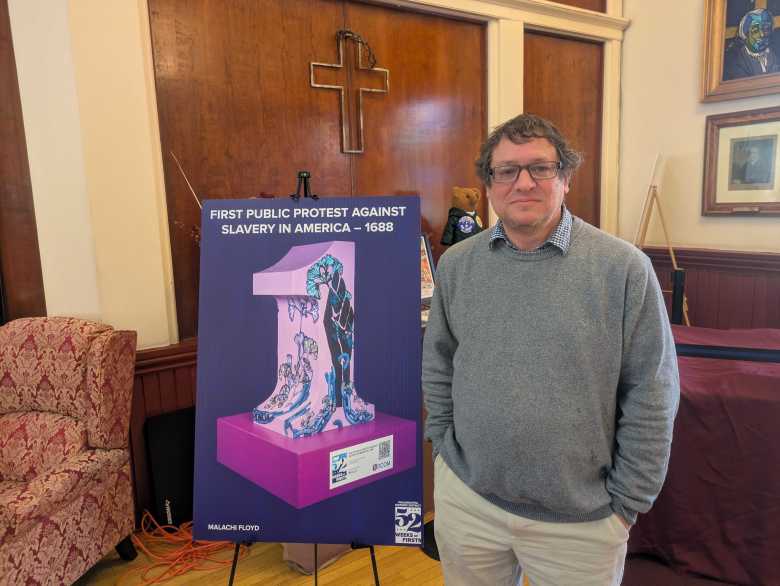 Craig Stutman, a professor of history at Delaware Valley University and board member of the the Germantown Mennonite Historic Trust.(Nick Kariuki/Billy Penn)
The 1688 protest came in the form of a petition signed by Francis Daniel Pastorius, Derick and Abraham op den Graeff, and Garret Hendericks, Mennonites and German and Dutch Quakers who were outraged by the practice of slavery when they arrived in the area five years prior.
It initially was ignored by local leaders, including Pennsylvania founder Willliam Penn, who owned slaves. It took until 1758 for Quakers to formally censor slaveholders from its congregations and 1775 for the first nation’s Abolitionist Society to meet in Philadelphia’s Rising Sun Tavern. The Pennsylvania Abolition Society, which Benjamin Franklin would eventually become a president of, was also recognized in the Historic District’s firsts this month, along with Mother Bethel AME Church, the African Methodist Episcopal congregation.
Saturday’s free event will have music, German folk art, and tables featuring the Germantown Mennonite Historic Trust, author and photographer Tieshka Smith’s coverage of the Philadelphia Juneteenth Festival in Germantown, the Johnson House Historic Site, and other groups linked to Germantown’s history of abolitionism. The event will also include storytelling from Historic Philly’s Once Upon a Nation.
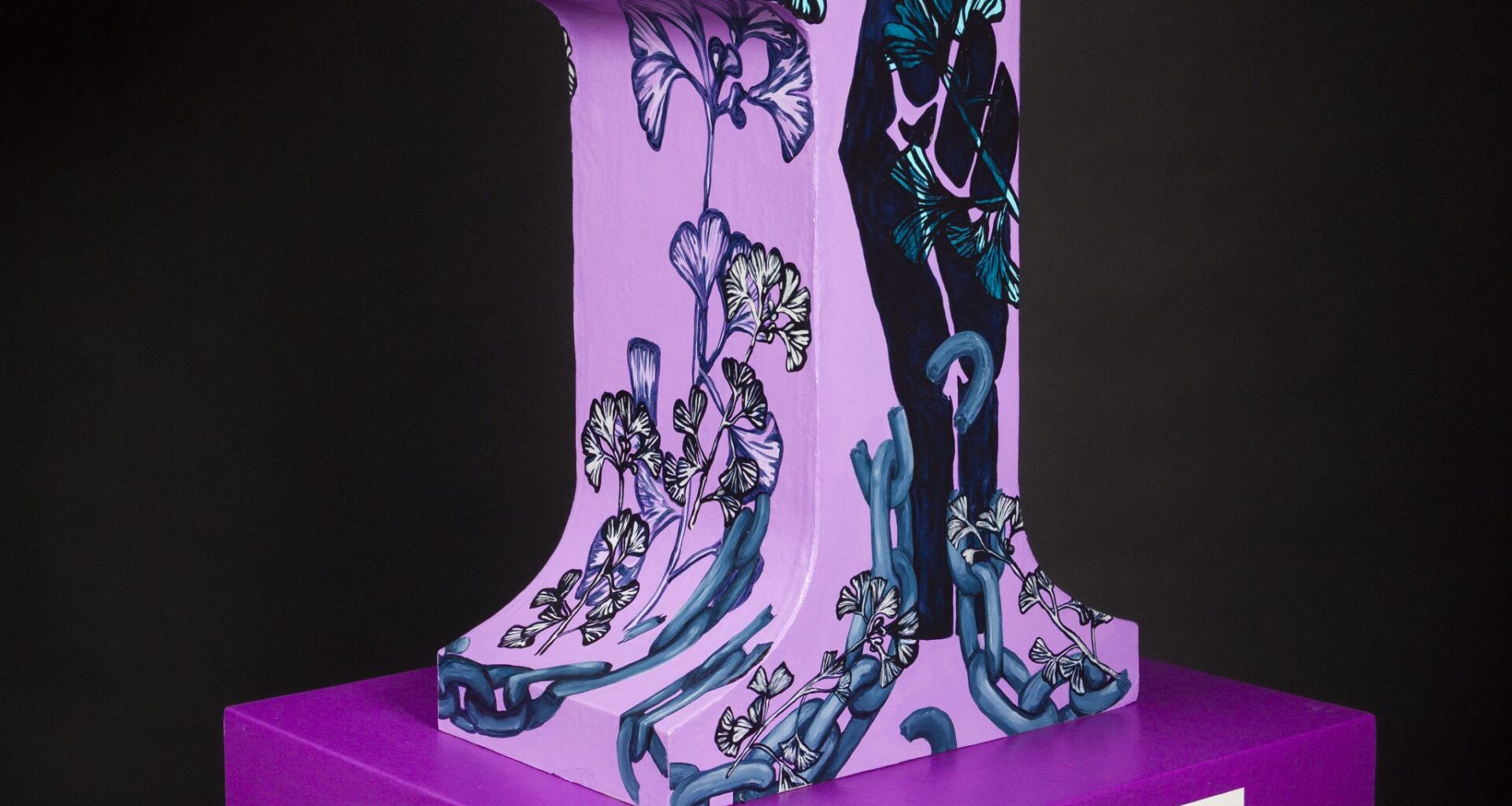
Each “first” celebration is commemorated with a sculpture in the shape of a numeral 1, uniquely painted by one of 25 local artists selected by Mural Arts Philadelphia. Artist Malachi Floyd was assigned the slavery protest sculpture, as well as the ones for the first matchbook and the first Bank of the U.S. He said that this month’s design connected with his personal ties to Germantown and fighting for civil rights and something larger than himself.
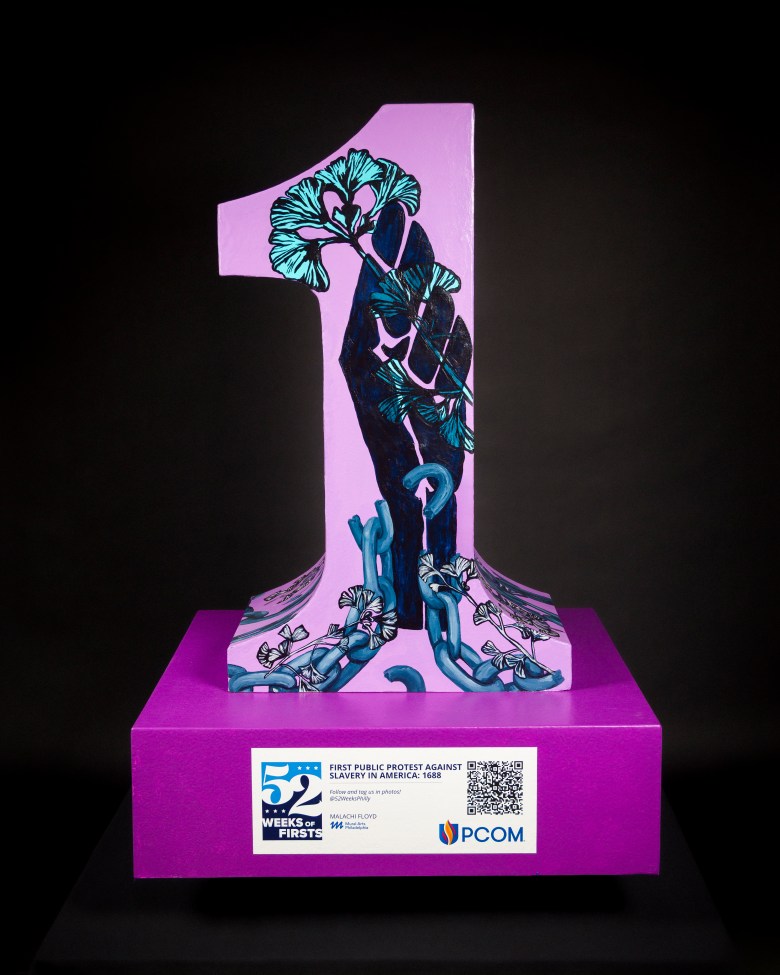 A sculpture, uniquely painted by artist Malachi Floyd for the Philadelphia Historic District’s “52 Weeks of Firsts.” (Gustavo Garcia, Colibrí Workshop)
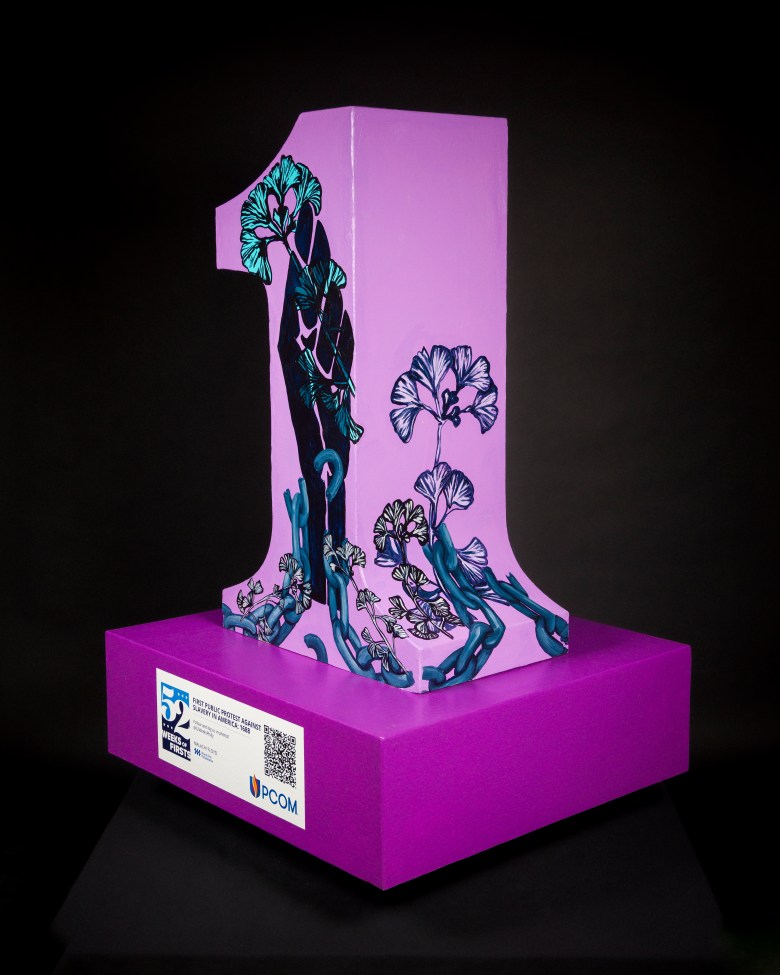 A sculpture, uniquely painted by artist Malachi Floyd for the Philadelphia Historic District’s “52 Weeks of Firsts.” (Gustavo Garcia, Colibrí Workshop)
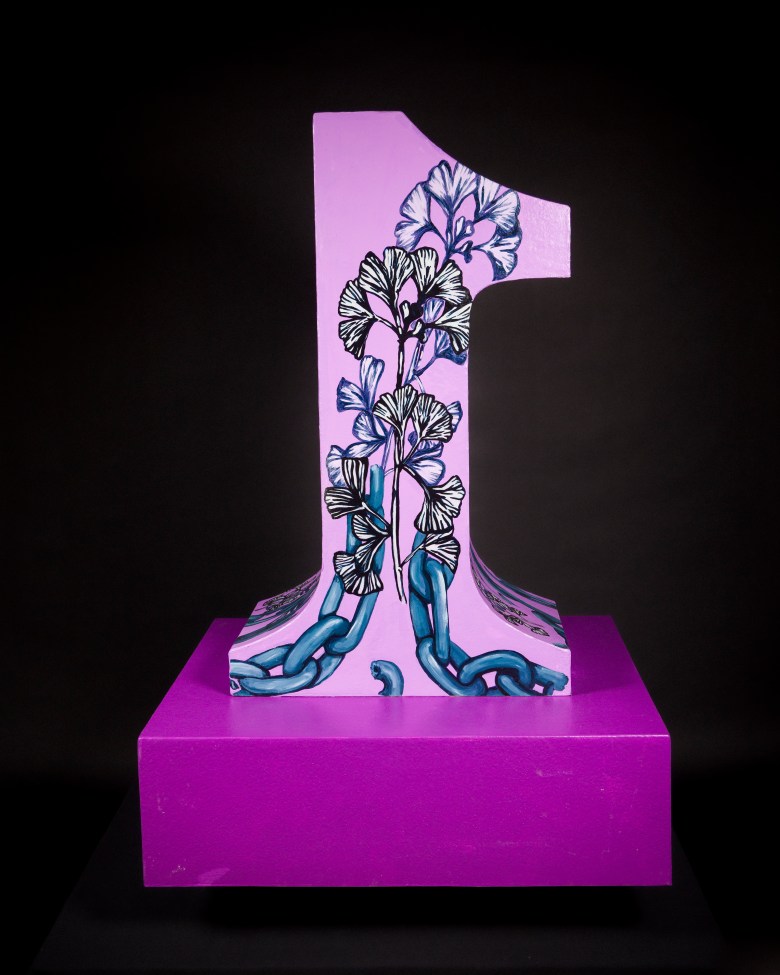 A sculpture, uniquely painted by artist Malachi Floyd for the Philadelphia Historic District’s “52 Weeks of Firsts.” (Gustavo Garcia, Colibrí Workshop)
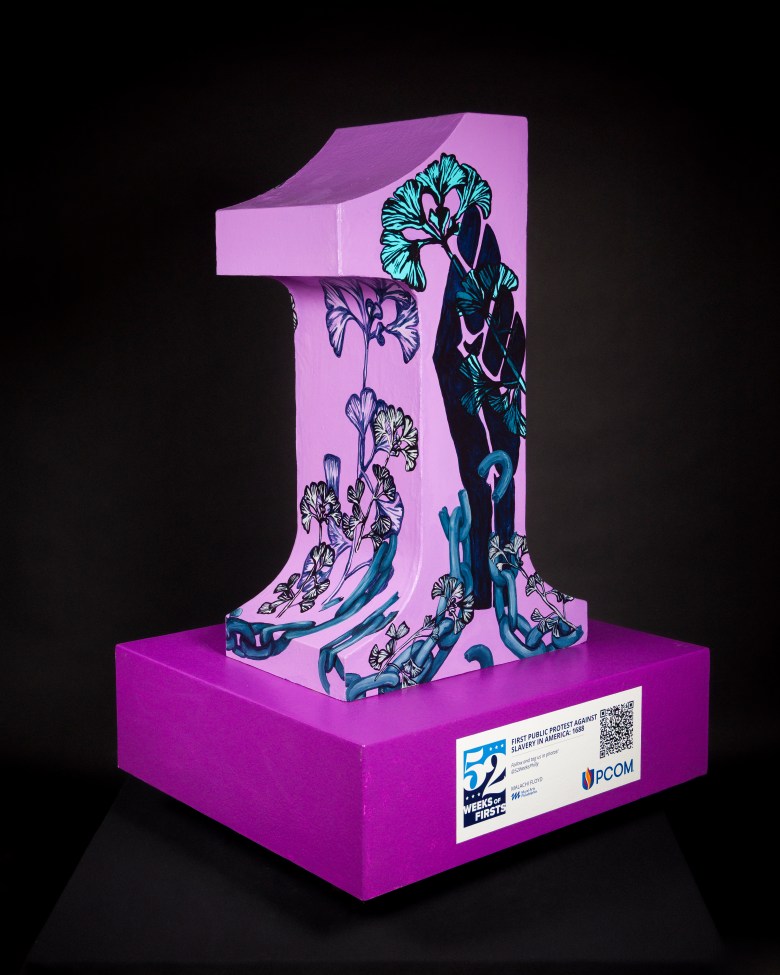 A sculpture, uniquely painted by artist Malachi Floyd for the Philadelphia Historic District’s “52 Weeks of Firsts.” (Gustavo Garcia, Colibrí Workshop)
The “52 Weeks of Firsts” selected marvels, inventions and events that first happened here in Philly. Unlike weeks highlighting the first circus performance and the signing of the Constitution, weeks like the protest against slavery reflect on a more somber subject in the nation’s history.
Stutman said the tone of Saturday’s event will be similar to Germantown’s annual Juneteenth celebrations, balancing respectful remembrance of the horrors of slavery with a celebration of the individuals and communities who fought to end it.
“I think that it is a commemoration, memorialization and a very somber moment, but at the same time it’s a moment of remembering that activism can happen and does happen,” he said. “And I think that activism tradition is part of what we teach as well.”
In the coming weeks
Here is the complete list of other firsts being highlighted this year, along with the upcoming Saturday “firstival” dates and locations.
The first:
Completed
Week 1: Successful balloon flight in America (1793)
Week 2: The Mummers parade, the nation’s first folk parade (1901)
Week 3: Volunteer fire company (1736)
Week 4: Professional basketball league (1898)
Week 5: Public Girl Scout cookie sale (1932)
Week 6: African Methodist Episcopal congregation (1794)
Week 7: Abolitionist society in America (1775)
Week 8: Authentic Chinese gate built in America (1984)
Upcoming
Public protest against slavery in America (1688)
Feb. 28, Historic Germantown Mennonite Meetinghouse, 6119 Germantown Ave.
Flower Show (1829)
March 7, Pennsylvania Convention Center, 1101 Arch St.
Women’s medical college (1850)
March 14, Health Sciences Building, Drexel University, 60 N. 36th St.
Match folder (1892)
March 21, Science History Institute, 315 Chestnut St.
The first medical school in America (1765)
March 28, Perelman School of Medicine, 3400 Civic Center Blvd.
Stadium in America (1895)
April 4, Franklin Field, 235 S. 33rd St.
Circus performance in America (1793)
April 11, Philadelphia School of Circus Arts, 6452 Greene St.
Botanical garden (1728)
April 18, Bartram’s Garden, 5400 Lindbergh Blvd.
Postmaster (1737)
April 25, Franklin Court, 322 Market St.
American-made piano and sousaphone (1775 and 1893)
May 2, Ensemble Arts Philly, 300 S. Broad St.
Mother’s Day (1908)
May 9, Historic St. George’s Museum & Archives, 326 New St.
Hospital in America (1751)
May 16, Pennsylvania Hospital, 800 Spruce St.
World’s Fair on American soil (1876)
May 23, Please Touch Museum, 4231 Avenue of the Republic
Steamboat for passengers and freight (1787)
May 30, Independence Seaport Museum, 211 S. Christopher Columbus Blvd.
American flag (1777)
June 6, Betsy Ross House, 239 Arch St.
U.S. Army (1775)
June 13, Museum of the American Revolution, 101 S. 3rd St.
Annual Reminder demonstration (1965)
June 20, Philly Pride Visitor Center, Lombard St. and S. 12th St.
Paper maker in America (1690)
June 27, Rittenhouse Town, 6034 Wissahickon Ave.
Bank of the United States (1791)
July 4, First Bank of the United States, 120 S. 3rd St.
Organized baseball team (1831)
July 11 (location TBD)
Ice cream soda (Oct. 1874)
July 18, Franklin Fountain, 116 Market St.
American art school (1805)
July 25, Pennsylvania Academy of the Fine Arts, 118-128 N. Broad St.
Scientific Society of Natural History (1812)
Aug. 1, at Academy of Natural Sciences, 1900 Benjamin Franklin Parkway
Zoo in America (1874)
Aug. 8, Philadelphia Zoo, 3400 W. Girard Ave.
U.S. Mint (1793)
Aug. 15 (location TBD)
Selfie (1839)
Aug. 22, Love Park, 1501 John F Kennedy Blvd.
Slinky (1943)
Aug. 29, Philadelphia Art Museum, 2600 Benjamin Franklin Parkway
Signing of the Constitution (1787)
Sept. 5, National Constitution Center, 525 Arch St.
Continental Congress (1774)
Sept. 12 at Carpenters’ Hall, 320 Chestnut St.
Naming of the United States (1776)
Sept. 19, Independence Hall
Ronald McDonald House (1974)
Sept. 26, Ronald McDonald House, 3925 Chestnut St.
Penitentiary in America (1829)
Oct. 3, Eastern State Penitentiary, 2027 Fairmount Ave.
The First Peoples
Oct. 10, Penn Museum, 3260 South St.
U.S. Navy and Marine Corps (1775)
Oct. 17, Arch Street Meeting House, 320 Arch St.
Public showing of a motion picture (1870)
Oct. 24, Philadelphia Film Society, 1412 Chestnut St.
Modern detective story written (1841)
Oct. 31, Edgar Allan Poe House, 532 N. 7th St.
Thanksgiving Day parade in America (1920)
Nov. 7, Benjamin Franklin Parkway
University in America (1740)
Nov. 14, Houston Hall, The University of Pennsylvania, 3417 Spruce St.
Children’s hospital in America (1855)
Nov. 21, Children’s Hospital of Philadelphia, Main Building, 3401 Civic Center Blvd.
Pencil with an attached eraser (1858)
Nov. 28, National Liberty Museum, 321 Chestnut St.
Weather bureau (1870)
Dec. 5, The Franklin Institute, 222 N. 20th St.
Electronic computer (1945)
Dec. 12, The University of Pennsylvania, 3451 Walnut St.
Public lending library in America (1731)
Dec. 19, The Library Company of Philadelphia, 1314 Locust St.
Philly food firsts: Cheesesteaks (1930s), water ice (1932) and bubble gum (1928)
Dec. 26, Reading Terminal Market, 1136 Arch St.