

The club’s financial accounts from the 2024/25 relegation season have been published and they make for stark reading
09:52, 27 Feb 2026Updated 10:00, 27 Feb 2026
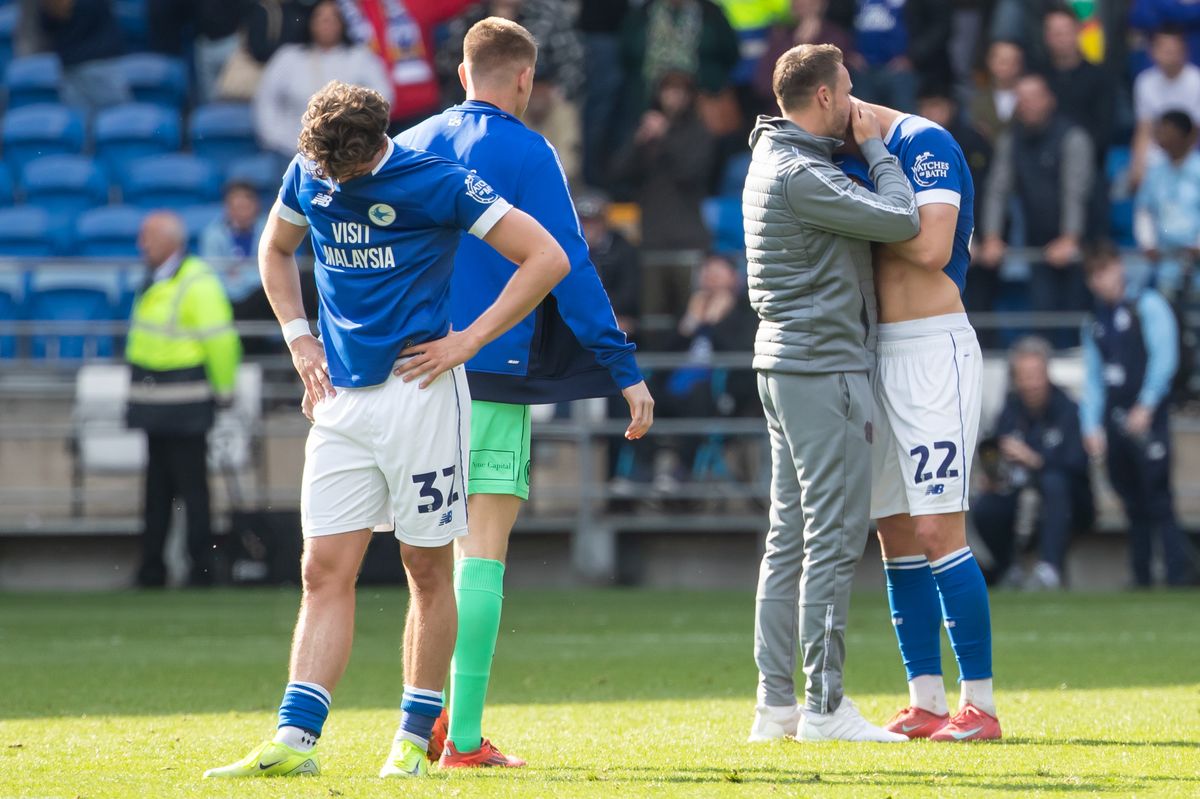
Ollie Tanner (L) and Yousef Salech of Cardiff City after relegation was confirmed last season(Image: Getty Images)
Cardiff City’s latest accounts have revealed a dramatic rise in player wages and laid bare the scale of the financial challenge facing the club following a relegation which “shook the club to its core”.
The figures, published at Companies House for the financial year ending 2025, cover a season in which the Bluebirds finished bottom of the Championship table.
The headline numbers make for stark reading. Ensure our latest sport headlines always appear at the top of your Google Search by making us a Preferred Source. Click here to activate or add us as Preferred Source in your Google search settings.
Revenue rose by 11% to £25.8million, but wages soared by 39% to £39million, meaning the club spent a staggering 151% of their income on salaries alone, up from 120% the previous year. The average first-team weekly wage was £17,480.
It has been suggested that Cardiff had a top-six Championship wage bill last season, but still finished bottom of the league, putting into perspective the scale of their underachievement.
Football finance expert Kieran Maguire highlighted the scale of the losses, noting an underlying loss of £34.2million, up 20%, and a pre-tax loss of £35.1million, a 193% increase year-on-year. Join the Cardiff City breaking news and top stories WhatsApp community.
Borrowings climbed to £134.3million, while total accumulated losses over the years now stand at an enormous £284.9million.
The accounts also show Cardiff made £6.1million in player sale profits, spent £12.5million on new signings and brought in £6.1million in player sales.
Despite the bleak figures, chairman Mehmet Dalman confirmed that relegation wage reduction clauses were in place for most players and insisted the club remains financially supported.
“While undeniably the reality of relegation shook the club to its core and took some time to accept, we then immediately went through an internal process of review as to what went wrong and what actions and changes, we as a club had to make to ensure that we could return to the Championship at the first available opportunity,” Dalman said.
“The immediate challenge we faced as we entered League One was the incredibly significant drop in turnover and the actions that by necessity had to be taken around the club’s cost base to bridge that gap.
“While relegation clauses contained in most of our players’ contracts provided an immediate hedge against the loss of income we still had to look very carefully at the size and structure of our first team squad and reduce costs thereof while maintaining competitive in League One.”
Dalman acknowledged the pain of relegation, describing it as “deeply disappointing for everyone connected with the club”, but stressed that measures had already been implemented to adjust the cost base.
That includes halting work on the club’s proposed new training ground at the Vale of Glamorgan site, with Dalman confirming work would re-commence when – or if – the Bluebirds were promoted back to the Championship.
The chairman reiterated that the club continues to receive financial backing from its ownership and that there is “no immediate requirement for external funding beyond the support already committed”.
“We have and will remain heavily reliant upon the continued financial support of our owner,” he said.
Dalman also pointed to efforts to manage costs more sustainably, highlighting a focus on youth development and trading players more effectively in future windows.
The accounts show matchday income of £5.9million, broadcast revenue of £12.9million and commercial income of £6.9million for the year, modest Championship figures which will inevitably fall dramatically following relegation to the third tier.
Operating losses widened to £28.1m, broadly in line with the £27.7m deficit recorded the previous year. However, the overall loss after tax rose sharply to £35.1m, up from £12.0m in 2024. Sign up to our daily Cardiff City newsletter here.
That swing is largely explained by the prior year’s accounts including a substantial £18.4m exceptional, one-off gain, made up of £12.0m from the sale of a portion of any future recovery linked to the ongoing legal case with FC Nantes, plus £5.7m received from settling a contractual dispute.
The wage-to-turnover ratio of 151% underlines the imbalance between income and expenditure during the Championship campaign, a level widely regarded as unsustainable without owner funding.
Dalman insisted, however, that the club’s strategy is now focused on long-term stability, stating that lessons must be learned from the financial trajectory of recent years. He points to the appointment of Brian Barry-Murphy, and the shift to promoting players from within, as key in shaping the club’s future path.
JOIN OUR CARDIFF CITY FACEBOOK PAGE! Latest news, analysis and much more
Dalman continued: “Brian’s experience at Manchester City with their development squads and academy fitted exactly with our desire to make the CCFC academy the focal point of our strategy for the future.
“Brian’s history of developing a clear path from the academy to the first team has been seen immediately with the number of academy players now forming not only part of our 1st team squad but also appearing as part of the starting 11 on match days. This only bodes well for the future of the club.”
Total net current liabilities as of May 31, 2025 stood at £161.5m, a figure that would ordinarily raise serious concern.
However, the vast majority of that sum relates to funding from within the club’s ownership structure, with £97m owed to owner Vincent Tan and a further £37.3m due to a company in which chairman Mehmet Dalman holds a significant interest, Tormen Finance. By contrast, the remaining liabilities are comparatively modest.
The Bluebirds now face a pivotal end-of-season run-in as they look to bounce back to the Championship at the first time of asking.
Relegation clauses will soften the immediate impact of reduced revenues in League One, but the scale of accumulated losses, approaching £285million, illustrates the longer-term challenge.
—
*Sign up to our daily Bluebirds newsletter here and our WhatsApp channel here. Cardiff City correspondent Glen Williams is also on social media. He can be found on his X account here, on Instagram, on TikTok and on Facebook.