
As broadband providers have been expanding their service areas in recent years, a recent data release from the U.S. Census Bureau shows that a significant number of households in Northeastern Pennsylvania still lack high-speed internet, at least as of 2024.
The Census Bureau released five-year summary American Community Survey results covering 2019 through 2024 on numerous topics in late January, including broadband subscriptions data for municipalities in Lackawanna, Luzerne and Schuylkill counties.
Broadband service includes either cable, fiber optic or DSL. The data reviewed did not include satellite, cellphone or dial-up subscriptions.
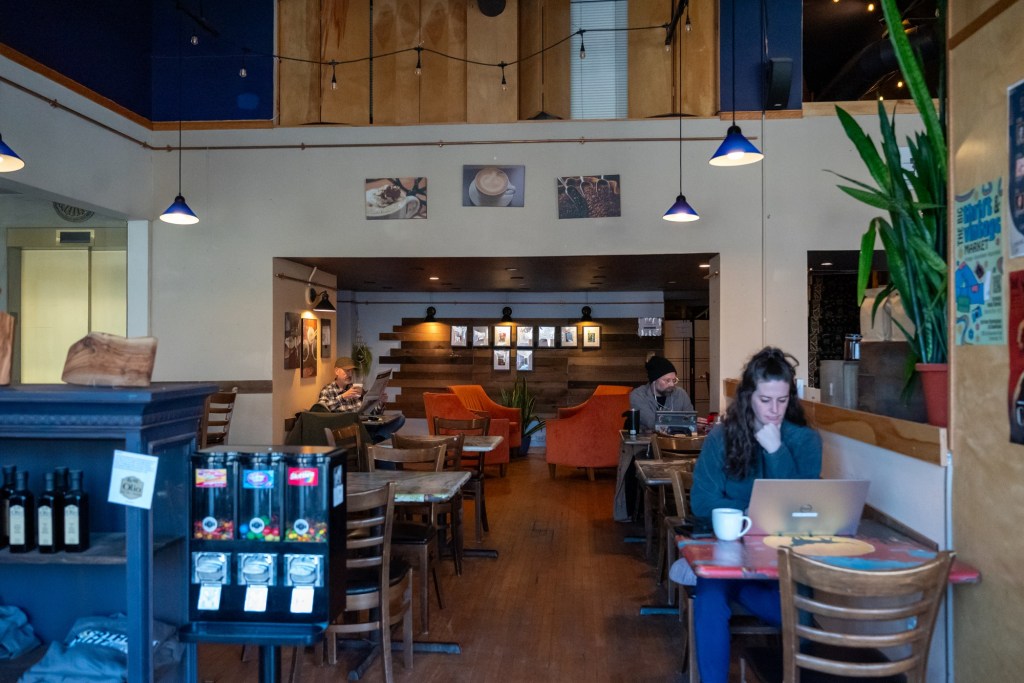
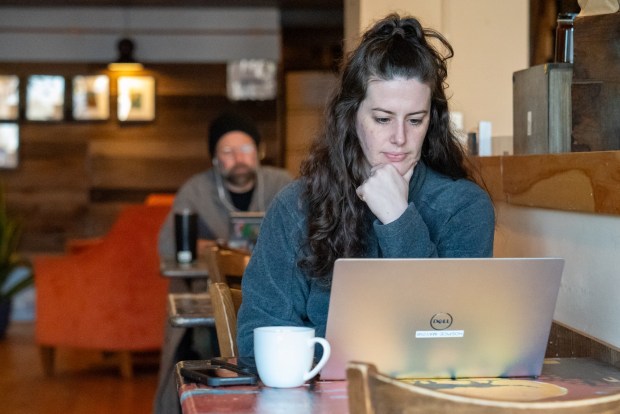 Samantha Knowleton looks at her laptop while grabbing coffee and breakfast at Northern Lights Espresso Bar in downtown Scranton on Friday, Feb. 27, 2026. (REBECCA PARTICKA/STAFF PHOTOGRAPHER)
Small rural communities, mostly in Schuylkill County, fared the worst when it comes to broadband connections.
For example, 82.4% of households in Foster Twp. did not have a subscription to a broadband service in 2024, up from 79.1% in 2019. The decrease could be due to margins of error in the survey or a number of other factors such as affordability.
Data also showed that nearly 30% of households in Foster Twp. had no internet subscription at all. That improved from 39% in 2019.
In Luzerne County, Fairmount Twp. had the lowest broadband subscription rate at 52% of households. About 12% of households there had no internet service plan.
Blakely had the lowest broadband subscription rate in Lackawanna County at 35% of households. About 14% of households there had no internet plan.
Dalton, which is a suburb of Scranton in Lackawanna County, had the highest broadband subscription rate in the three-county area, with only about 8% of households lacking a subscription and less than 3% of households there having no internet.
Bear Creek Village in Luzerne County came in second, with only about 11% of households lacking a broadband connection. About 7% of households there lack any internet connection.
Rural America lagging
Broadband access is increasingly recognized as essential infrastructure in today’s economy, with the ability to connect residents and businesses to economic opportunities nationwide, even in remote rural areas, according to the Center on Rural Innovation, a nonprofit that partners with rural leaders across the country.
Access to reliable, high-speed internet is also essential to education and accessing telemedicine, according to Pennsylvania Gov. Josh Shapiro’s Office.
However, rural America has lagged behind metropolitan areas in broadband investment, exacerbating economic, educational and health disparities between rural and nonrural America.
Pennsylvania was set to receive $1.16 billion in federal funding to expand broadband in unserved and underserved areas through the federal Broadband Equity, Access and Deployment (BEAD) Program, part of former President Joe Biden’s “Internet for All” initiative funded through the Infrastructure Investment and Jobs Act of 2022.
But those funds remain on hold after federal officials failed to meet a self-imposed early December deadline to review the commonwealth’s plan for spending the money, according to a report by Spotlight PA.
Without federal approval, Pennsylvania cannot finalize agreements with the Internet companies that expect to receive the money, and they cannot begin construction. The cause of the delay remains unclear, according to the Spotlight PA report.
Pennsylvania submitted its plan Sep. 4. The federal government promised to review state plans within 90 days, but, the commonwealth is still waiting.
After President Donald Trump took office, his administration issued a sweeping rewrite of the program’s rules and gave states a tight, 90-day deadline to redo the application process.
The changes focused, in part, on lowering costs, which made satellite internet providers more competitive with those offering connections via fiber-optic cable.Pennsylvania’s submitted plan would connect roughly two-thirds of eligible locations to the internet with fiber, while another 18% would be served by satellite providers and 13% would receive wireless internet.
A matter of cost
State Rep. Tim Twardzik, who represents parts of Schuylkill County that are unserved or underserved by broadband service, said his office receives few complaints about the lack of availability.
“There have been a lot of improvements in the last couple of years. The Pennsylvania Broadband Development Authority and the federal program are being used to close a lot of the gaps,” Twardzik, R-127, said on Friday.
He noted that Schuylkill County received $9.3 million in 2024 from the authority toward expansion.
Comcast/Xfinity has expanded service to Blythe and East Norwegian townships and the boroughs of Middleport, New Philadelphia, McAdoo and Tamaqua, he noted.Twardzik said it’s a slow process because installation of new cable or fiber optic lines is expensive and time-consuming. He said new satellite internet can provide relatively high speeds at a much lower cost.
“The good news is that satellite has become more affordable, and investment in that would be a good use of taxpayer money to try to better serve these very rural areas,” Twardzik said.