
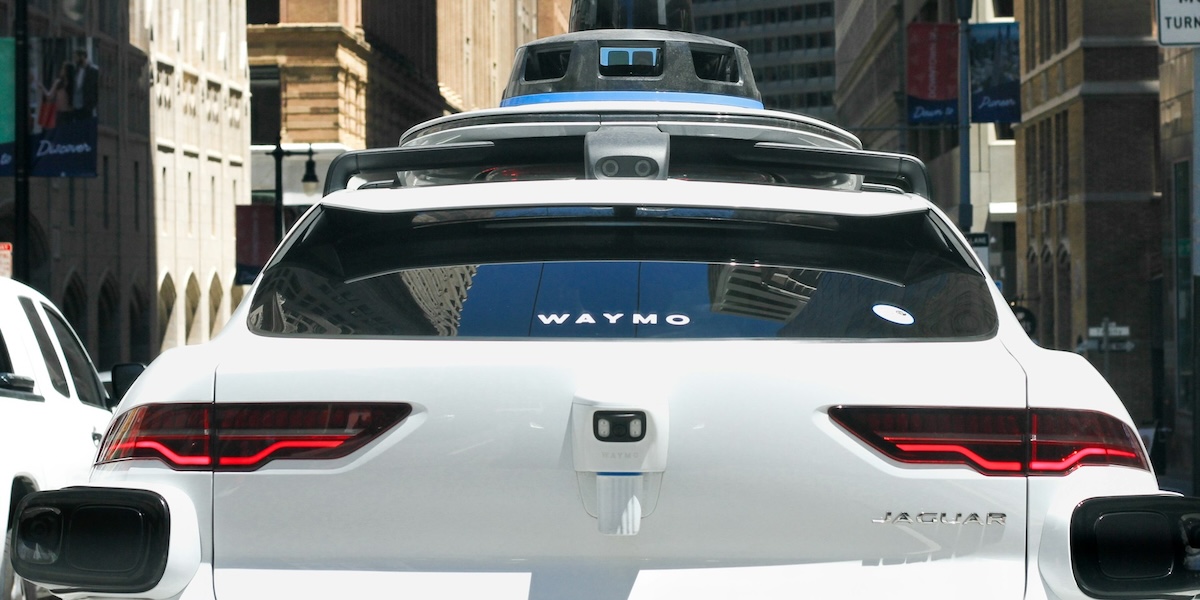
A few weeks ago, Mamadu Barry — a 28-year-old structural engineer and part-time Uber driver — was behind the wheel when he first spotted one, tucked away in a parking lot in University City.
“I’m guessing they’re hiding them in there for now, getting ready to take over the world,” says Barry, referring to Waymo, the self-driving car company that’s an offshoot of Google.
Listen to the audio edition here:
Since last summer, Waymo cars have been popping up on Philly streets, part of the Silicon Valley-based company’s ambitious plans to expand to the East Coast. After months of using human drivers to map our roads, Waymo has begun to deploy its AI-powered navigators in a testing phase with professional drivers still behind the wheel. While company spokesperson Ethan Teicher declined to offer a timetable for when the ride-hailing app will be ready for consumers in Philly, he said that Waymo is progressing smoothly so far.
“There are many ways to get at safer streets. Most of them are proven, and most of them don’t involve cars whatsoever.” — State Senator Nikil Saval
Although the company still needs to receive PennDOT approval before it can offer commercial rides, Waymo is barrelling ahead towards a soft launch. “Our next step will be to operate the vehicles fully autonomously for employees only,” Teicher says.
Philly residents have already been complaining, criticizing AVs as untrustworthy and ugly. Waymo cars have a computer system known as the LiDAR (Light Detection and Ranging) unit affixed to the roof. It’s essential to providing real-time sensory feedback for the vehicles. But the units, which look like spinning baby-bottle nipples, are not the most stylish glimpse into the future.
The company does have one big feather in its cap: a promise to make Philly roads safer. Waymo recently published a journal article analyzing 127 million miles of trips taken by fully autonomous robotaxis, comparing those results to human benchmarks. “The Waymo Driver,” says Teicher, referring to the name of their driverless-car system, “achieved a tenfold reduction in serious injury or worse crashes, and a twelvefold reduction in injury crashes with pedestrians.”
If those statistics are accurate, they offer a tantalizing vision of the future: AI drivers that never text and drive, never get angry or buzzed behind the wheel, and never stop improving — due to deep-learning tools that file away every roadway interaction for future reference. Driverless cars could be a public health breakthrough as much as a technological one. Their rapid implementation in recent years has led some to suggest that Vision Zero, the longstanding goal to eliminate all traffic fatalities, might finally be achievable.
That’s a laudable goal. But at what expense? What is the human toll of replacing drivers with robots in the country’s second-poorest big city — and are we ready for it?
Are cars even the way to go?
Given a choice of modernity or tradition, Philadelphians will often side with the luddites. Our public sector has at times been notoriously slow to adopt emerging tech (even email) over the course of decades. We had SEPTA tokens in circulation until two years ago. And who doesn’t look back fondly on the decapitation and dismemberment of HitchBOT?
There are plenty of techno-optimists in our communities, too, some of whom are intrigued by the idea of Waymo. On the r/Philadelphia Reddit thread, opinions range from “Philly drivers are scum” and Waymo should be an “order of magnitude safer” to those who’d prefer if we could bolster SEPTA before we see driverless cars hit the streets. Those mixed reactions are reflected in legislators in Harrisburg.
“It would be great if it turns out driverless cars are significantly safer than people behind the wheel of vehicles, but we know there are other proven things that make the roads safer,” says State Senator Nikil Saval (D-Philadelphia), who sits on the body’s transportation committee. “Increased public transit is what we should be devoting ourselves to and orienting our cities around.”
“I think that all cities will need to have Waymo to be considered a real, 21st century metropolitan space.” — State Representative Napoleon Nelson
In other words, maybe AVs are a legitimate public-safety innovation, but they’re not the only option. They also invite concerns of their own, including from an environmental standpoint. While Waymo cars are emission-free, they require significant electricity, just like other advanced forms of AI. “These are like data centers on wheels,” Saval says. “Are we prepared for the massive increase in computing needs?”
Most of all, Saval is thinking about the potential human toll: “What are we prepared to do about those Uber drivers?”
About a decade ago, we were collectively asking the same question about taxi drivers at the moment when Uber stormed into Philly. Between 2014 and 2017, the value of a taxi medallion — the source of family-sustaining wealth for many taxi drivers — plummeted, from a high of more than $500,000 to $10,000. Uber and Lyft eventually grew the total amount of jobs for drivers, but shaped them in the mold of the gig economy.
Today, 74% of the roughly 29,000 Uber ride-share drivers in Philly work part-time or less than 30 hours per week. After expenses, they make an estimated $21.29 per hour. Mamadu Barry feels fortunate that it’s not his primary salary. “I have friends whose lifestyle and family income is going to be very challenged,” he says.
First, taxi drivers got supplanted by contract workers; now those contract workers are being threatened by robots. Saval thinks there’s a lesson to be learned from that progression. “We can’t rely on the big technology companies, because they have shown that they don’t care for their workers up to this point,” says the state senator.
According to Waymo, the company employs local workers in the 10 cities where it’s currently operating at scale. Though spokesperson Ethan Teicher declined to provide a specific number of jobs, he listed some of the positions that regularly need to be filled: operations partners with expertise in vehicle maintenance, construction and skilled trades, fleet management, and more — all told, “hundreds of people to support our service.”
Waymo also employs dozens of “remote assistance agents” in the Philippines. Wired recently wrote about these workers as “human babysitters” for robotaxis, which has led some conspiracy theorists to suspect that fully autonomous cars are currently a ruse — with a person manning the joysticks abroad. Even if that’s a stretch, the outsourcing to the Philippines is indicative of what can be reasonably expected of a Big Tech company’s relationship to employment in a city like Philly.
Workforce concerns are one reason that members of City Council, including At-Large Councilmember Jim Harrity, recently called for hearings to study the wide-ranging impact of self-driving cars. Those hearings haven’t been scheduled yet, but among the topics that are likely to be discussed are job displacement and consumer costs. In a city like San Francisco, where Waymo has eclipsed 10 percent of the ride-hailing market share, the average fare remains 12 percent higher than Uber and 17 percent higher than Lyft.
And then there’s the central issue that defines the Waymo debate: safety. The most fervent boosters of driverless cars have gone as far as to suggest that politicians who block Waymo will have blood on their hands, especially in a place like Philly, where traffic deaths are higher than in most cities.
An opportunity … if we’ll take it
Of course, the question of whether Philly should or should not allow Waymo onto our streets may be moot. It’s up to the state — not City Council — to allow Google to operate its robotaxis here (or not). Robots are expected to replace millions of driving jobs across the country over the next several decades. Why would it be any different here?
Instead, this moment presents an opportunity to determine how this technology is deployed here — and who will benefit from it.
State Representative Napoleon Nelson (D-Montgomery County) fears that without embracing autonomous vehicles, Philly could slide backwards in more ways than one. “I think that all cities will need to have Waymo to be considered a real, 21st century metropolitan space,” Nelson says.
Nelson is a Mt. Airy native and MIT graduate who believes that the benefits of driverless vehicles can go far beyond one commercial company like Waymo — assuming that legislators don’t muck things up. Last year, Nelson sponsored a bill that would clarify and expand state laws around the regulation of self-driving passenger cars (that is, vehicles for everyday people). As the laws stand today, autonomous vehicles — including 18-wheelers — are allowed on roads in limited conditions.
Before robotaxis are swarming our streets, Nelson would like all taxpayers to have access to the same technologies first. He worries that the fears over Waymo have overshadowed some of the uses which the average citizen might embrace, such as creating newfound mobility for seniors and individuals with disabilities who could own a car without needing to drive it.
“I want us to not only hold on to thinking about how we regulate the AV [autonomous vehicles] industry currently, but also hold onto the promise of what they mean for our society,” he says.
Some people have also touted AVs as a safer way to travel for women and children, considering the troublingly high rate of sexual assaults and harassment taking place on account of Uber drivers. But a recent article in the Washington Post described a new phenomenon of passengers feeling like “sitting ducks” when people make threatening gestures toward the AI-controlled car. Robotaxis have also been known to go rogue and drop off passengers in the wrong location, stranding them.
In a city like San Francisco, where Waymo has eclipsed 10 percent of the ride-hailing market share, the average fare remains 12 percent higher than Uber and 17 percent higher than Lyft.
For Nelson, a Wharton MBA, these healthy debates — including concerns over energy consumption — are not reasons to dismiss the technology altogether. “I do buy into the benefits of capitalism, and its ability to supercharge the innovation cycle,” he says. In his mind, there’s an opportunity to approach the adoption of driverless cars thoughtfully and with an eye towards equity, especially in a place like Pennsylvania. The state boasts a unique blend of institutions, such as Carnegie Mellon University, advancing the science behind these technologies, which could be brought to the table with elected officials and workers to approach the future of driverless cars more thoughtfully.
“We’ve got the labor. We’ve got the strongest unions in the country. If there’s going to be a place that’s going to marry technology with the workforce, that should be happening at the table here in Harrisburg,” says Nelson.
What remains unclear is the timetable in Harrisburg for a decision on Waymo’s future in the Commonwealth. Saval says that so far, he’s heard no rumblings about an impending hearing on Waymo from colleagues on the state’s bipartisan transportation committee. That doesn’t mean it can’t come together quickly.
In the meantime, nothing is stopping us — except, of course, the humans involved — from pushing for improved mobility and reduced accidents throughout the city and state. “There are many ways to get at safer streets,” says Saval. “Most of them are proven, and most of them don’t involve cars whatsoever. That will remain true, with or without the use of AI, and I hope we keep our sights on that.”

MORE ON TECHNOLOGY IN PHILADELPHIA
A Waymo vehicle, one of Google’s autonomous cars. Photo courtesy of Unsplash.