
NAZARETH, Pa. – You won’t find a village named Dexter on any present-day Lehigh Valley maps.
But, take a drive along a winding Route 248 out of Nazareth borough and you’ll pass the spot where it used to be.
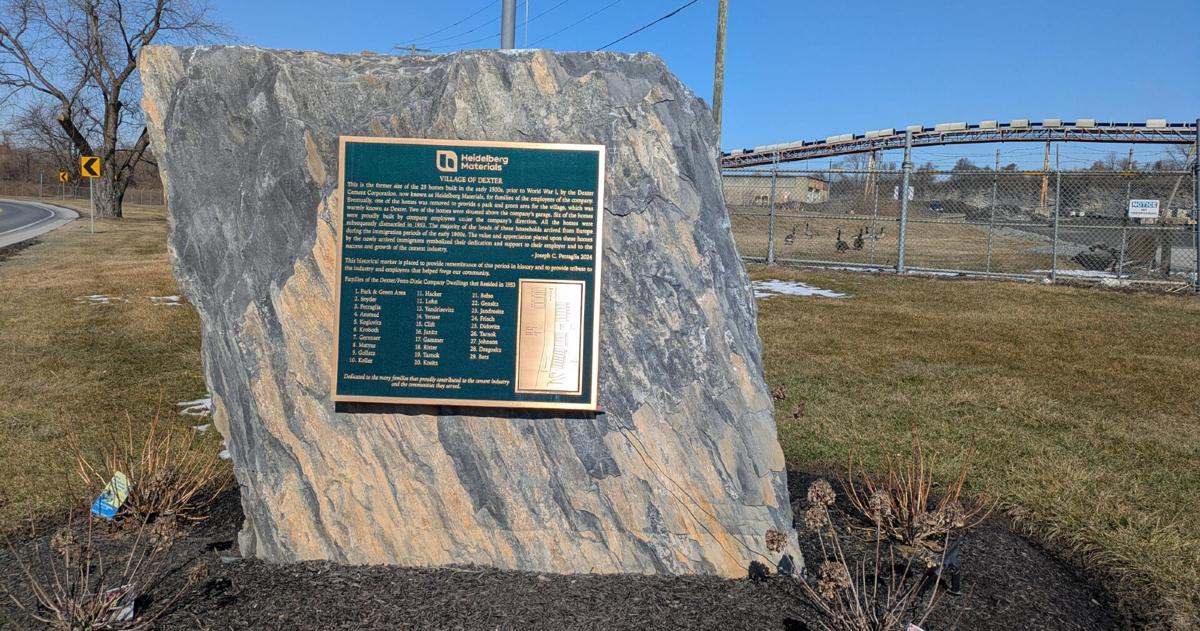
Recently, Heidelberg Materials installed a small monument on the property, honoring the more than two dozen families who once helped lay the foundation for the area’s fledgling cement industry.
Fittingly, the monument is made out of locally sourced limestone. It’s just down the road from the entrance to Heidelberg’s Nazareth Plant II Quarry.
Ed Pany, founder of the Atlas Cement Company Memorial Museum in Northampton, remembers driving past the village as a boy. “I could see the homes on the righthand side of the road. They were cozy places.”
The Nazareth Cement Company opened in 1899, Pany said, and the Dexter Cement Company wasn’t far behind. The Dexter plant on Route 248 operated nine rotary kilns that pumped out thousands of barrels of cement every year.
Dexter wanted to provide homes for some of the many European immigrants who were coming to the area to work in its plant. “These were more than cement companies,” said Pany. “They were magnets to bring people to America. They were laboratories of democracy because you had people coming in from all over.”
29 homes went up before World War I, all for Dexter employees and their families; six of the homes were built by the workers themselves, under the company’s direction.

Eventually, one of the homes was removed to make space for a new park.
In the years that followed, the Dexter company changed hands and names many times as the cement industry grew.
According to Pany, the plant was purchased by Penn Dixie Cement, which had a pair of plants in Bath, in 1926. Later, in the 1970s, Coplay Cement was the owner of both the old Dexter site and Nazareth Cement. Coplay later became Essroc Cement.
Heidelberg Cement bought Lehigh Cement Company in 1977. It later acquired Italcementi, Essroc, and Lehigh Hanson. Lehigh Hanson became Heidelberg Materials in North America in 2023.
By the time all of those deals were going down, Dexter Village was long gone. The homes were torn down in 1953.
But Pany is thankful that Heidelberg thought it important to single out Dexter, more than seven decades later. “This company agreed to put up a sign so we would remember all those people and the hard work and dedication they did for the local cement industry. It’s beautiful story.”