
From Philly and the Pa. suburbs to South Jersey and Delaware, what would you like WHYY News to cover? Let us know!
Late last year, restorative justice organization Let’s Circle Up gathered community members in West Philadelphia for a two-day workshop to explore alternative approaches to punitive models of criminal justice.
The event comes as lawmakers, prosecutors and advocates across Pennsylvania debate whether restorative justice practices should play a larger role in the state’s legal system — and whether healing, accountability and repair can coexist with public safety.
Encounter, repair, transform
A concept dating back to an experiment in Canada in the 1970s, restorative justice is rooted in an empathetic and comprehensive approach to criminal behavior that is more solution-based than standard approaches. According to the First Step Alliance, the process requires three key principles: encounter, repair and transform.
“Encounter” refers to a setting that brings together everyone affected by the crime. “Repair” refers to the need to address the needs of each person involved, such as the victim’s need for healing and the offender’s need to make amends. “Transform” refers to the intended final result of this restorative mediation, where victims and offenders alike can heal and move forward.
One key factor in the process is that participation is wholly voluntary for all parties.
On day one of the Let’s Circle Up workshop, attendees examined “justice” from several perspectives. Felix Rosado, co-founder of the organization, and Raymond Tucker facilitated the evening’s activities.
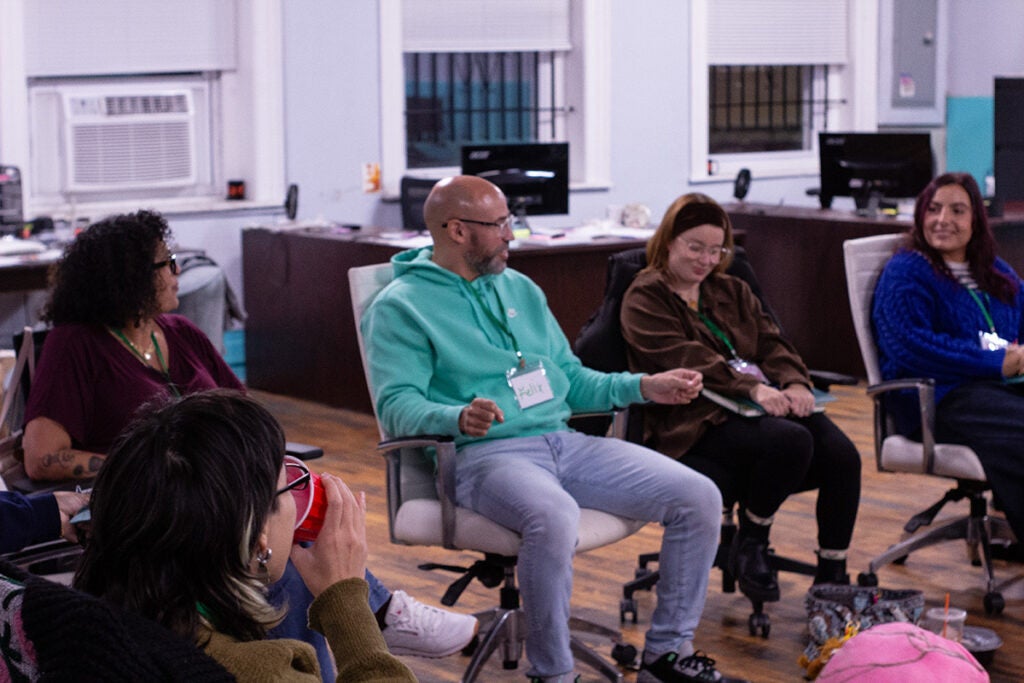 Felix Rosado, co-founder of Let’s Circle Up, explaining the activities of the evening and sharing his story. (Eric Nixon/WHYY News)
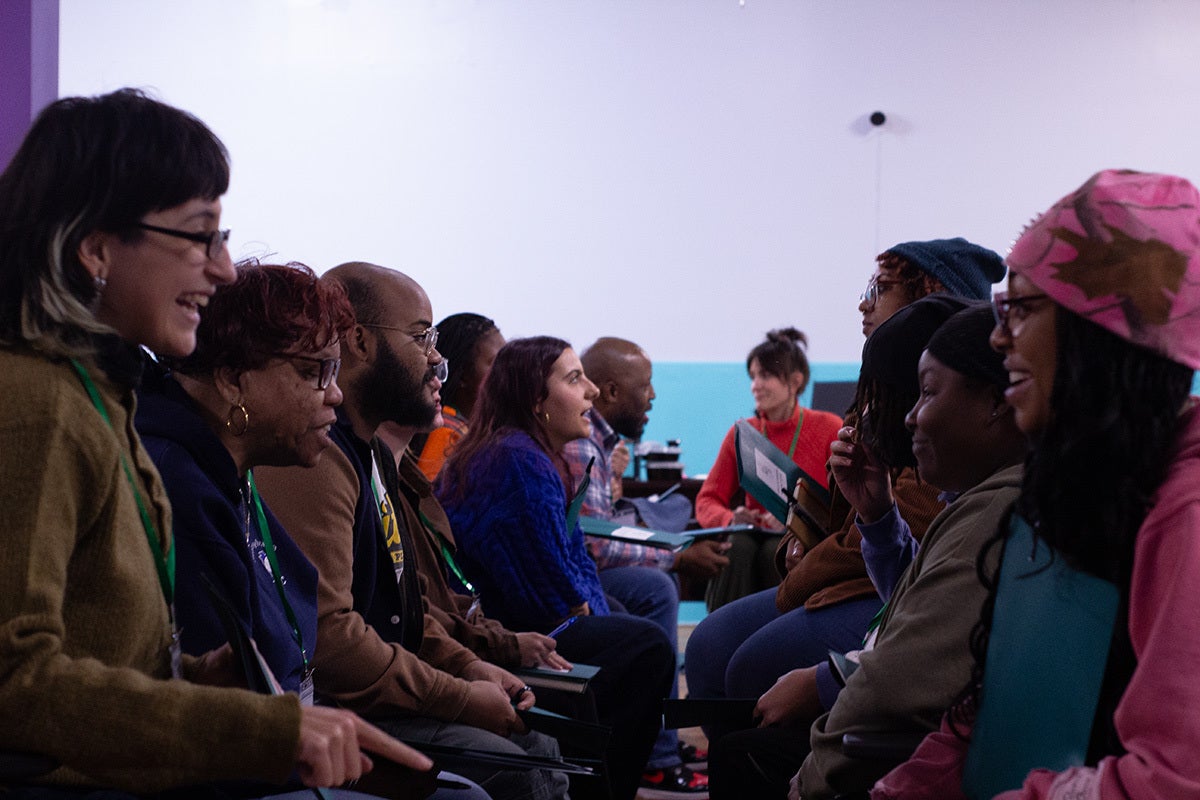
First, to connect everyone personally and to encourage friendships, Tucker led participants through an activity similar to speed dating. Everyone sat across from each other for a short time and, following his prompts, asked probing questions back and forth.
Then, the group did a word-association exercise. Rosado wrote the word “justice” on a large sheet of paper on the wall, and asked the group to call out whatever related words that came to mind, with participants saying “power,” “supremacy,” “system,” “racist,” “fairness” and “punishment.” As various words rang out, he recorded each one on the paper, completely filling the remaining space.
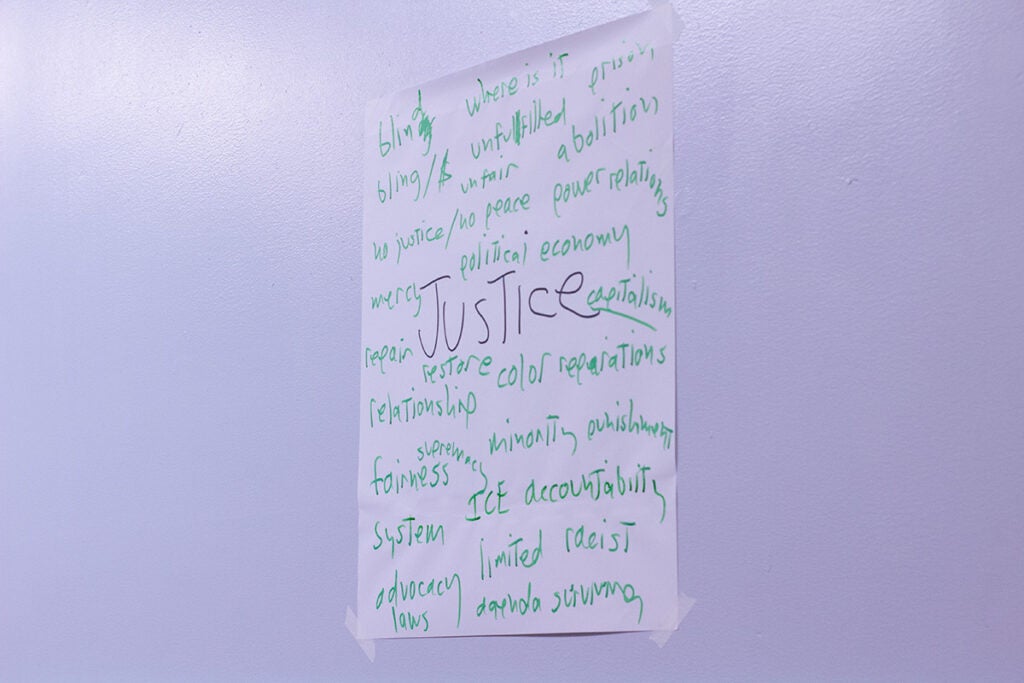 Result of the “Word Lightning” exercise, with all of the words shared by the workshop attendees that represented the word “justice” for them (Eric Nixon/WHYY News)
The exercise revealed some divisions among participants in how they saw justice playing out in the world, with some saying that justice is not equal and others seeing “harmony” as a goal.
Next, attendees split up into four groups. Each group was given 20 minutes to create an image of “Lady Justice” before presenting the result, and the reasons behind it, to the room.
On day two, the focus of exploration shifted to “harm,” its causes and people’s experiences with it. The group discussion dug deeper into the values and principles of restorative justice, including an emotionally charged video of a facilitated conversation between a victim and an offender. Such “victim offender dialogues” demonstrate the restorative justice model in practice.
To close out the session, the facilitators and attendees circled up for an activity derived from Indigenous healing circle practices. Everyone sat in a circular formation, with one person acting as a guide for the discussions. An item called a “talking piece” was passed from person to person, giving each participant the floor to speak while others listened.