
By Jack Tomczuk
It’s in the Board of Education’s hands now.
School District of Philadelphia Superintendent Tony Watlington Sr. presented his decade-long, $2.8 billion facilities master plan Thursday to the Board of Education. In the parlance of Board President Reginald Streater, the “football has been handed” to the nine-member BOE, all of whom were selected by Mayor Cherelle Parker.
Any further changes to the plan, which recommends the closure of 18 schools, would be expected to spring from the board. The body has not set a date for a final vote.
Streater asked members to “keep an open heart, an open mind” as the BOE begins deliberations.
“We want more quality, in addition to the quantity,” he added, following Watlington’s address. “But I think if we’re willing to sacrifice one, our children deserve quality.”
Board members weigh in
Board members commented on the recommendations Thursday — for the first time since Watlington unveiled them Jan. 22 — and asked the superintendent questions.
“Doing nothing is not responsible leadership,” BOE member Wanda Novalés said. “However, I see the plan that includes data, but I am struggling to see the heart, the heart that considers the lived realities of our neighborhoods.”
Watlington characterized the need to consolidate the district’s footprint as an “unfortunate reality,” driven by lower enrollment and chronic underfunding.
“In an ideal world, I never believe in closing schools,” he said during his presentation. “And to be frank, I would never want that to happen to my child’s school.
Board member Crystal Cubbage told Watlington that she is interested in a more aspirational vision that incorporates more new schools and attracts investment.
“We need a bolder plan. This is a false choice that we have here,” she added. “The buildings are not the point. The children are the point.”
Steps to develop a district-wide facilities strategy began four years ago, and BOE member Joyce Wilkerson warned her colleagues that “we can’t afford to be locked into inaction.” Streater stressed the need to address building issues to further academic improvements.
The board is organizing a dedicated facilities town hall meeting March 12, solely for the purpose of hearing public comment on the plan. BOE officials also launched an online portal to accept feedback.
School reassignments
Two of the 20 schools slated to shutter under Watlington’s initial proposal were removed from the closure list Thursday.
Kensington’s Russell Conwell Middle School and Southwest Philadelphia’s Motivation High School would continue to serve students under the updated plan.
Lankenau Environmental Science Magnet High School will still close; however, students will now be diverted to Walter B. Saul High School of Agricultural Sciences instead of Roxborough High.
Pairing the schools’ missions and continuing to provide Lankenau students access to nature on Saul’s 130-acre campus is a “win-win,” Watlington told reporters at a briefing Thursday.
Paul Robeson High School, which had been set to move to William L. Sayre High, will now be merged into Motivation as “Robeson-Motivation,” district officials said.
Students from Lewis Elkin Elementary School will be fed into Conwell to boost enrollment, and other children from across Philadelphia will still be able to apply to the middle school’s magnet program, according to Watlington’s team.
“We believe this is the best possible plan to present, given our limited resources,” he said.
Watlington added that the changes “reflect robust community input.” His office has held more than 40 in-person and virtual community meetings since the facilities proposal was released.
In addition to Lankenau and Robeson, Robert Morris in Brewerytown, Samuel Pennypacker (West Oak Lane), John Welsh (North Philadelphia), James R. Ludlow (North Philadelphia), Laura W. Waring (Spring Garden), Overbrook Elementary, Martha Washington Academics Plus (West Philadelphia), Rudolph Blankenburg (Mill Creek), Fitler Academics Plus (Germantown), Wagner Middle School (West Oak Lane), Stetson Middle School (Kensington), Tilden Middle School (Elmwood), AMY Northwest (Roxborough), Harding Middle School (Frankford), Parkway Northwest High, Parkway West and Penn Treaty High are designated for closure.
In some cases, schools will be co-located in a facility, sharing a space but with a distinct programming and admissions process. Building 21 is set to be moved inside Martin Luther King; the Workshop School is going to Overbrook High; and the U-School will be located inside Edison High.
Students speak out
Dozens of students from the impacted schools testified in-person and over Zoom at Thursday’s BOE meeting, which began in the afternoon and, the Inquirer reported, did not wrap up until after midnight.
“Stetson had been neglected for decades,” Alejandro Alvarado, a Stetson student, told the board. “Don’t punish students for building neglect we didn’t cause.”
Students came equipped with facts and data about their school’s achievements and enrollment. They also spoke about how teachers and staff have helped them ‘come out of their shell’ and blossom.
“Waring is more of a family than a school,” Khloe Polite, an 8th grader there, said. “This school has helped me in ways I cannot explain.”
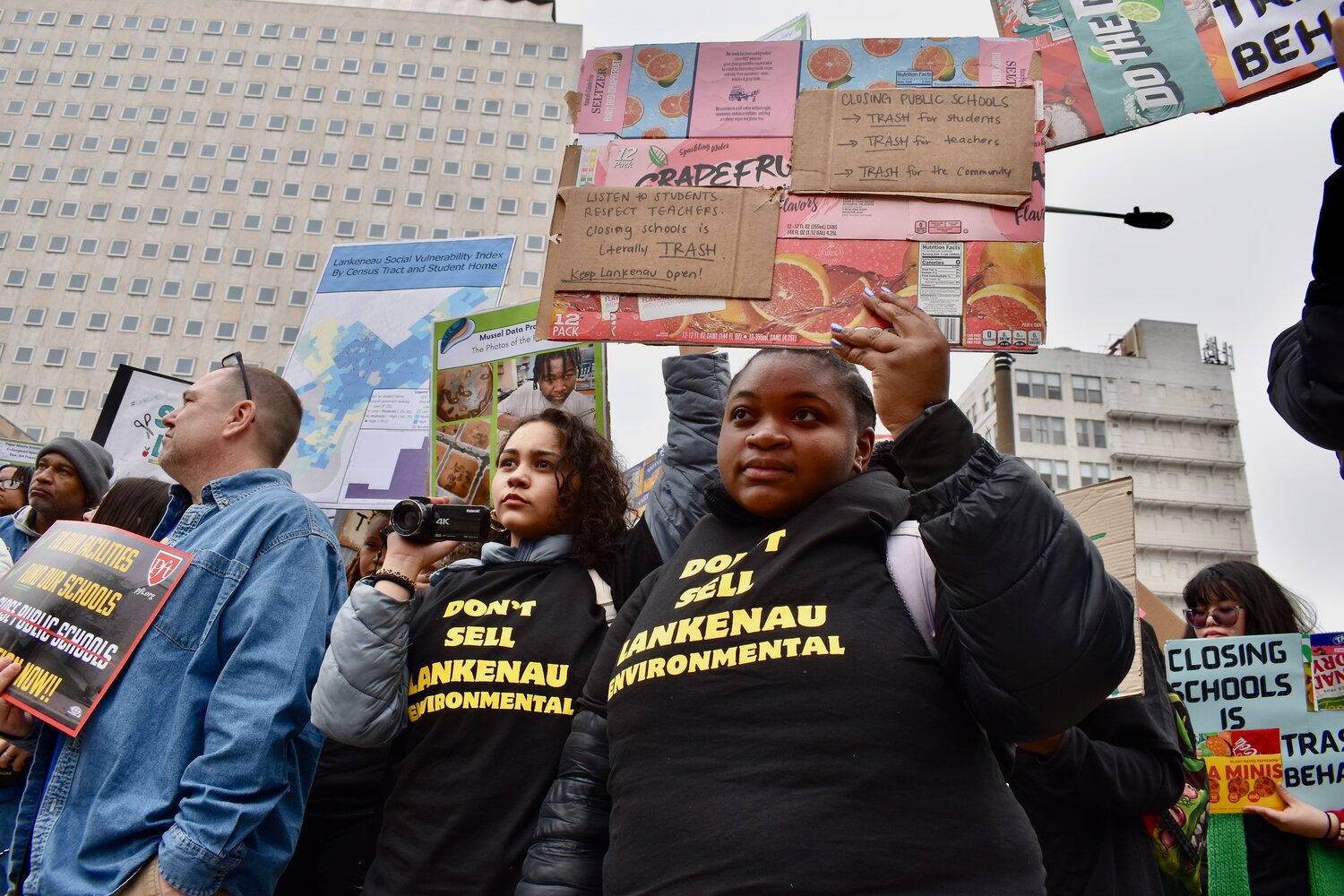
Before the meeting, middle schoolers from Stetson gathered outside the district’s North Broad Street headquarters, holding signs, encouraging passing drivers to honk and chanting “save our school.”
They joined a rally in opposition to the facilities recommendations sponsored by the labor unions representing public school educators, cafeteria employees, administrators, maintenance staff and safety officers.
“We’re here today to tell them to share your data and show your work,” Philadelphia Federal of Teachers President Arthur Steinberg said. “If the Board of Education rubber stamps this radical plan… mark my words, students and families will flee this district.”
City Councilmember Jamie Gauthier, of the 3rd District, told attendees that the district’s plan “misses the mark by a mile.” Some City Hall lawmakers have threatened to hold up education funding over the planned closures.
“It is a bad deal for young people, especially in West and Southwest Philly, where resources are being sucked out of our neighborhoods,” Gauthier said.
Goals of the master plan
No closures or other major shifts related to the plan would be undertaken until the 2027-28 school year, with the exception of a new, optional year-round K-8 school that will be co-located at Bethune Elementary as part of the North Philadelphia Promise Zone initiative.
Ten of the shuttered properties would be repurposed for use by the school district, while the other eight would be conveyed to Mayor Cherelle Parker’s administration for use as housing or to host workforce development programs.
Watlington said his team has consulted demographers to get enrollment projections for the next 20 to 30 years, and they are confident that the buildings set to be transferred to the city will not be needed for K-12 education.
The facilities master plan is the culmination of a yearslong effort to address low enrollment at some schools, overcrowding in others and concerns about aging facilities and limited resources.
If fully funded, the initiative would reduce the number of school buildings rated unsatisfactory or poor from 85 to 0, district leaders have said. It would also provide access to Algebra 1 for all middle grade students (up from 53%) and double the number of slots in district-operated pre-K programs, according to Watlington’s team.
It would represent the first round of closures for the district since 2012-13, when two dozen schools were ultimately shut down.
Keywords
Philly school closure,
Philly school,
school closure,
Board of Education,
Philadelphia School District