
When college students are asked what they would do to try to use AI to build a more ethical world, what happens?
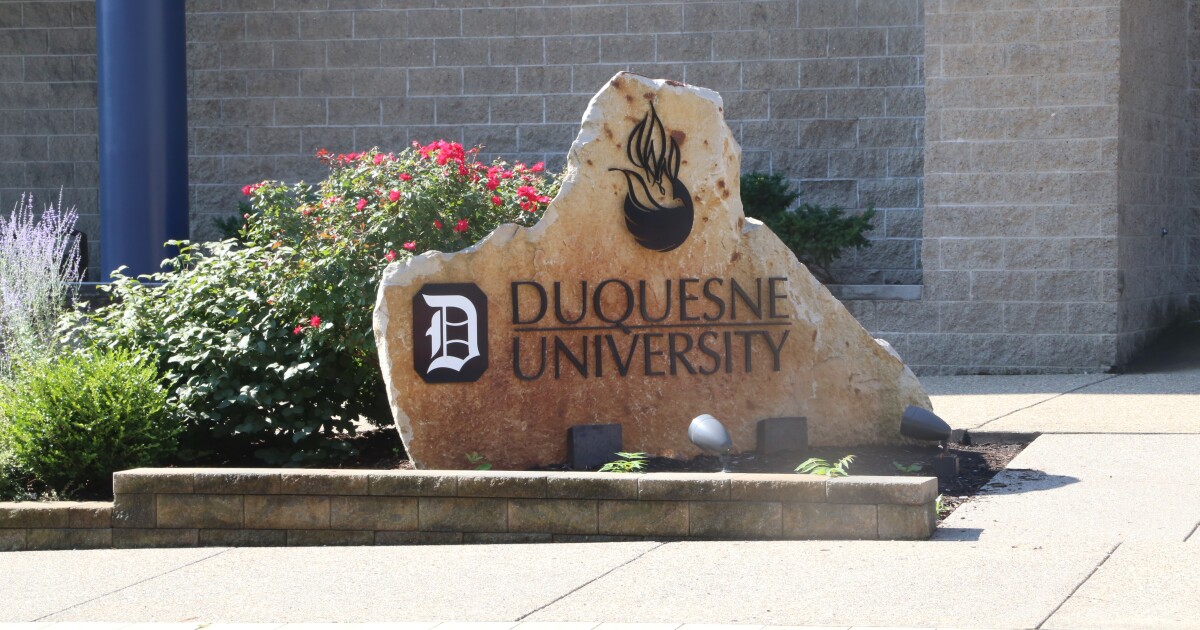
It’s the question put to students during this year’s “Hacking4Humanity,” an annual event hosted on Duquesne University’s campus with the goal of solving tech problems.
The hackathon started in 2019 with Pitt Cyber, but John Slattery, executive director of the Carl G. Grefenstette Center at Duquesne, said it eventually “died off.” The Uptown-based university picked it back up in 2022, reframing the event as one big Pittsburgh student hackathon open to college students from schools throughout the region.
“Traditionally, hackathons are largely sort of corporate and everything’s about making a startup that’ll get bought by one of the big tech companies — hopefully Google sees it and buys it for a million dollars,” Slattery said. “We want to do something different.”
This year, the theme was Challenging AI Injustice, Building Ethical Futures and the hackathon had two competition “tracks”: one for policymaking and another for developing technology, such as an app.
Nathan Reynolds, a Duquesne student who was part of “Team W9,” proposed a statewide policy that would standardize AI-use practices throughout K-12 schools to make AI access equitable and require educational programming for students and educators. He was inspired by his mom’s stories as a database administrator for a Chester County school district about the effects of unchecked, poorly understood AI usage.
“They’re already dealing with the adverse effects of kids using artificial intelligence to cheat, using artificial intelligence to think critically for them as opposed to thinking critically by themselves,” Reynolds said. “We want to provide a basis for them to understand what AI is.”
Reynolds said he also wanted to address the problem of smaller schools not having the budgets to give students equitable access to technology in the classroom, which his team’s proposed policy would hope to change.
The hackathon is held every year at Duquesne University in partnership with the University of Pittsburgh, Carnegie Mellon University and the Community College of Allegheny County, which Slatter said is the most universities to work together on the hackathon since its inception.
While Slatter said the main point of the hackathon is to see what ideas students can come up with, there is another incentive: a cash prize of $1,000 and the chance to compete at a mini-hackathon at Gov. Josh Shapiro’s residence.
The winning policymaking team, “Team TBD,” was led by John Rice, Noah Spicer and Jack Stonesifer — all Duquesne students. They pitched a labor-focused tech policy titled “Universal Wage Replacement and Just Transition Act,” federal legislation that would protect workers from “dislocation events” caused by anything from AI to trade wars, plant closures, climate change or other disasters.
“For over 40 years we’ve gone through turmoils for economic change; we’ve gone through industry restructuring, we’ve gone through global trade crisis, and now we have AI and automation,” Stonesifer said during his pitch. “ AI right now is a general purpose technology and it creates an unprecedented risk right now … and it will, if unplanned for, erode the whole of the tax basis.”
The policy proposes a temporary wage assistance program with the goal of providing wage insurance and paths to re-employment for workers displaced by defined structural shocks or policies beyond their control.
On the tech track, Kris Rockwell, a PhD student from RMU, won. He pitched a tool that would require credentialing, and data validation and verification to guard against “sci-slop” — or low-quality, AI-generated content produced in high volume.
“We do know that AI is being used more for scientific and medical purposes,” Rockwell said during his pitch. “I’m not sure about you but I’m not really comfortable getting my diagnosis from a machine that’s been trained on reddit and X.com data.”
Rockwell’s model would allow research cited by large language models to always have an original author credit to refer back to and would prevent AI-generated research papers with false information from being published.
The question posed for participants changes each year, but it always relates to students having an incentive to try to build real world solutions to difficult problems, with the help of technology.
While next year’s theme isn’t confirmed yet, Slatter said organizers from each university hone in on several major issues regarding technology to keep the hackathon fresh every year. He expects planning to be done in December for Hacking4Humanity 2027, which will take place next spring.