
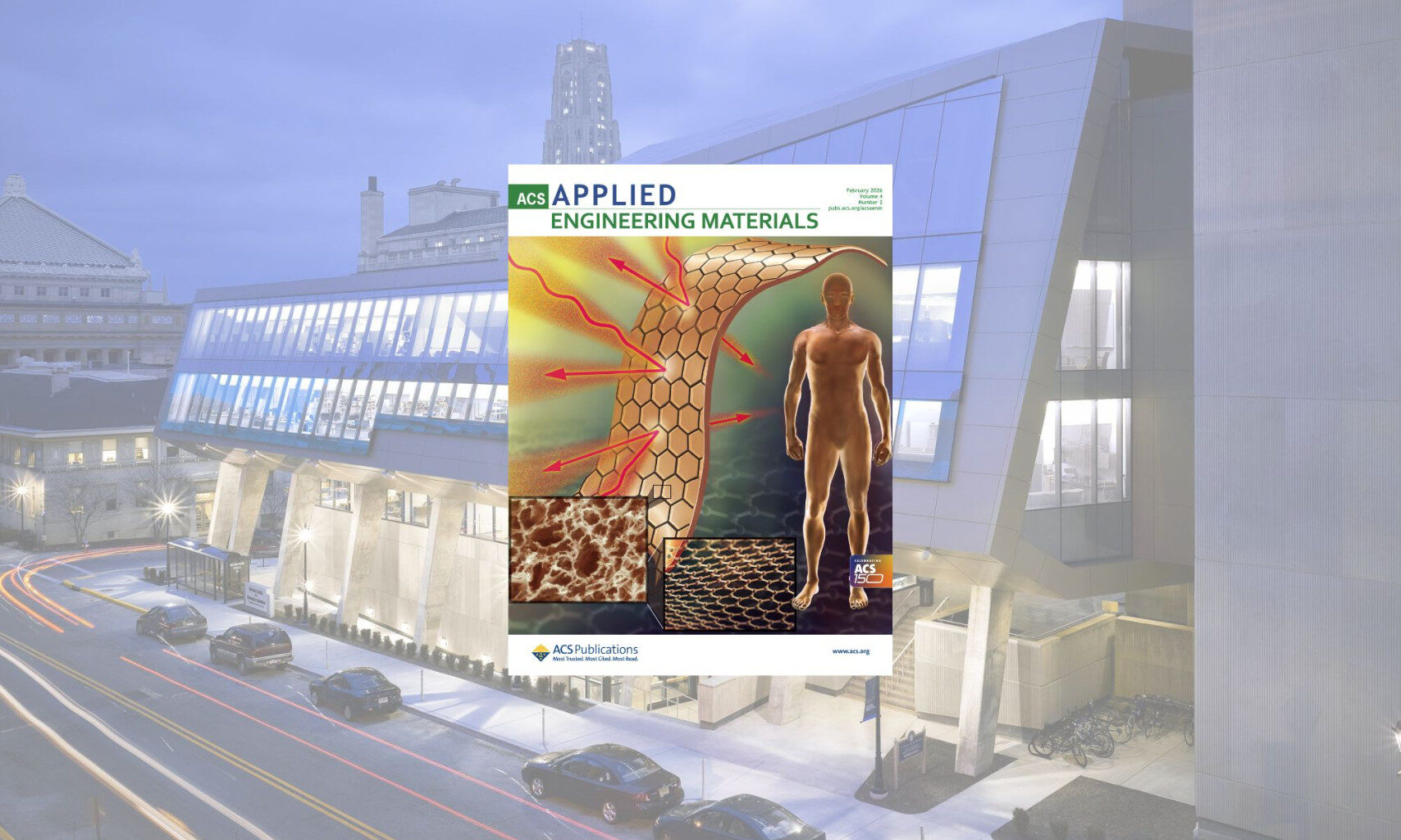
Using a technique inspired by kirigami, the Japanese art of paper cutting, engineers at the University of Pittsburgh have created transparent barriers that block and absorb electromagnetic interference (EMI) while remaining flexible enough to fold. The researchers have harnessed the power of a single laser to both carbonize and cut polymer films, patterning laser-induced graphene (LIG) into intricate honeycomb designs.
The breakthrough, detailed in the recent article “Combining Laser-Induced Graphene with Kirigami for Transparent Flexible Electromagnetic Interference Shielding” (DOI: 10.1021/acsaenm.5c00861) and featured on the cover of ACS Applied Engineering Materials, could protect the next generation of connected electronics and medical sensors from the invisible electromagnetic noise and harmful radiation that increasingly fill our wireless world.
“Our work shows how laser processing of materials and nanocarbon synthesis can intersect beautifully,” said Mostafa Bedewy, associate professor of mechanical engineering and materials science and principal investigator of the NanoProduct Lab at Pitt.
“We use precise laser energy to convert everyday polymer films into porous networks of conductive graphene right where we want them, without additional chemicals or complex vacuum systems,” Bedewy added. “This research opens doors for scalable manufacturing of next-generation polymer-based shielding materials.”
The research demonstrated that the patterned graphene films could maintain over 80 percent transparency while still achieving adequate shielding efficiency. These EMI shielding capabilities are typically seen in opaque metallic coatings.
Importantly, the team shows that when folded into multilayer configurations, the polymer-graphene films exceeded 50 decibels of EMI shielding efficiency, which is comparable to dense metal foils but with a fraction of the weight.
“It’s exciting to see that a simple, one-step laser process can make something both elegant and functional,” said Mirza Sahaluddin, a PhD student in Pitt’s Department of Mechanical Engineering and Materials Science, and first author of the paper. “Our kirigami patterns let us tune transparency and shielding by design, almost like engineering origami for electromagnetic waves.”
This project represents an interdisciplinary collaboration at Pitt, with researchers from three engineering departments in the Swanson School working together to design, manufacture, and characterize these novel materials.
“Electromagnetic interference is becoming a hidden but serious issue as electronics multiply in our daily lives,” said Paul Leu, professor in the Department of Industrial Engineering and co-author of the study. “Transparent shielding materials like these could be critical for protecting sensors, medical devices, and communication systems from cross-talk or radiation exposure.”
“This study, featured on the cover of a high-impact journal, reflects the interdisciplinary strength of our department, combining advanced manufacturing, materials science, and design innovation,” said William Clark, professor and interim chair of the Department of Mechanical Engineering and Materials Science. “It’s an excellent example of how fundamental research can lead to practical impact.”
‘;