
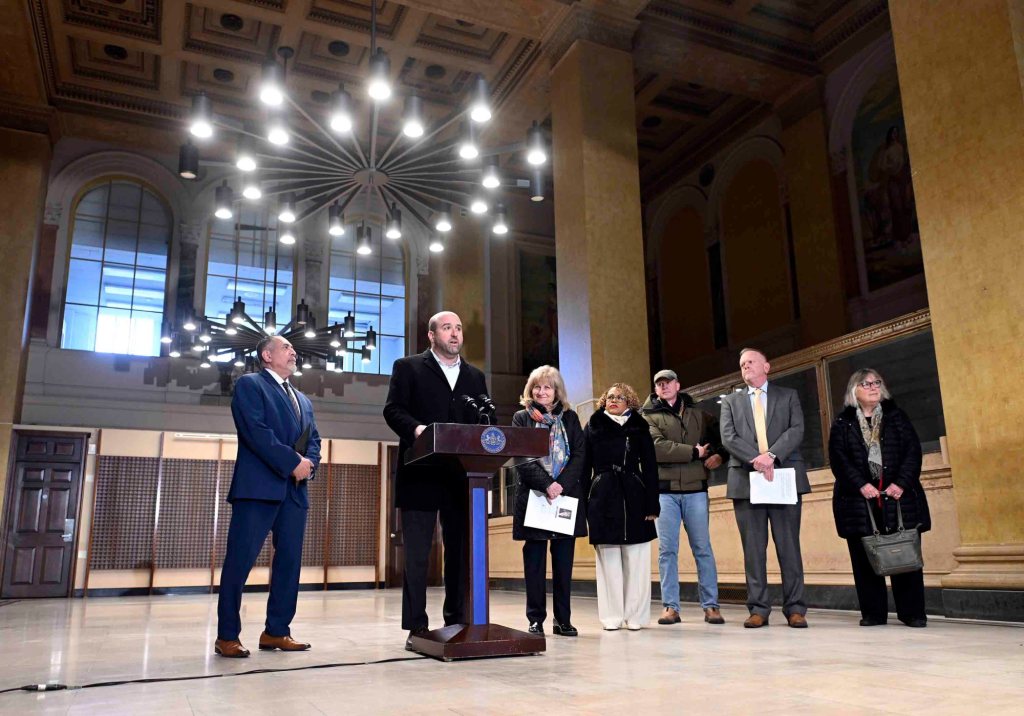
With its stately pillars guarding its front door, its soaring, intricately molded ceiling, and the brass details scattered about inside of it, the former bank building that sits on the northwest corner of Fifth and Penn streets is a tangible reminder of a Reading that once was.
And on Monday, as state and local officials gathered there, it also served as a symbol of what Reading can be.
The cavernous space was the kicking off point for a tour by state Department of Community and Economic Development Secretary Rick Siger of housing projects through the city.
The secretary’s visit was celebration of the Shapiro Administration’s recent unveiling of the first-ever Housing Action Plan, which aims to address what Siger called Monday a growing housing crisis.
Making brief remarks before the tour, Siger said the state is in need of 450,000 housing units by 2035, but is projected to fall short of that number by 185,00 homes.
More than half of the current housing is over 50 years old, Siger said, more than 1 million households are spending over 30% of their income on housing and housing instability and homelessness are rising.
“It’s clear what we’re doing now is not meeting the moment,” he said, adding that much of the existing housing stock is old and expensive. “We’ve got to act.”
The new action plan, he said, does just that.
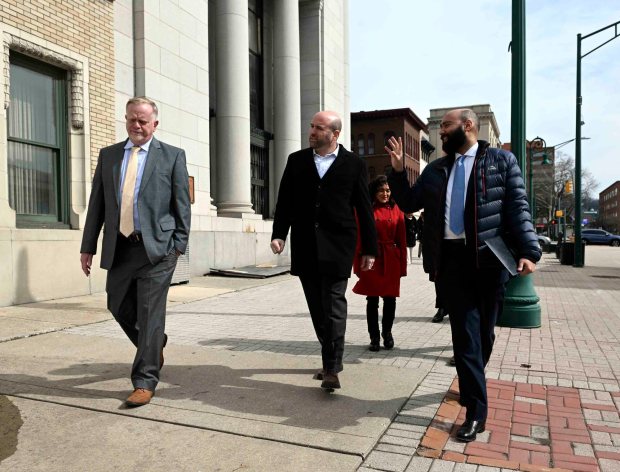 Pennsylvania Department of Community and Economic Development Secretary Rick Siger, center, walks down Penn Street with Habitat for Humanity development director Doug Long, left, and Reading Managing Director Jack R. Gombach following a press conference in the former bank at Fifth and Penn streets on Monday, March 2, 2026. (BILL UHRICH/READING EAGLE)
“It’s a blueprint for action, and we plan to be aggressive,” he said.
The plan is based upon five strategic goals: building and preserving the state’s housing stock; expanding housing opportunities; providing pathways to housing stabilization and sustainability; modernizing the state’s housing development regulations; and achieving operational excellence across state and local government.
To support the plan, the governor is calling for the state’s next budget to create a new $1 billion initiative to provide flexible funding for major infrastructure projects across the state.
That includes projects like the $52 million transformation by developer Alan Shuman of a series of buildings in the 400 block of Penn Street, which includes the bank building, into a mixed-use space featuring 150 housing units.
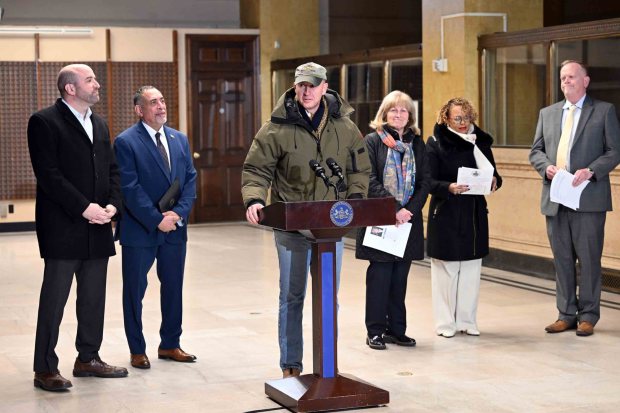 Reading developer Alan Shuman speaks about creating housing opportunities in the city during a press conference at the former bank building at Fifth and Penn streets on Monday, March 2, 2026. (BILL UHRICH/READING EAGLE)
Or the ongoing building of homes by Habitat for Humanity of Berks County in the Buttonwood Gateway neighborhood, which Siger also visited Monday.
“These are the kinds of examples of what we can do when we work together,” Siger said.
Reading Mayor Eddie Moran said Siger’s visit was meaningful, with cities like Reading on the front lines of the housing crisis.
Families are working hard, Moran said, but often find themselves unable to keep up with the rising costs of housing. But the city has “good bones,” he said, with historic buildings, walkable streets and opportunities for economic development.
Projects like the one at the bank and Buttonwood Gateway, Moran said, aim to turn the possibilities those good bones provide into realities.
“Our goal is simple, folks,” he said. “If you work in Reading, you should be able to live in Reading. If you grew up here, you should be able to build a life here.”
State Sen. Judy Schwank thanked Siger for visiting Reading, commenting that the Shapiro administration not only doesn’t forget about the city, but makes an effort to highlight it.
But the new housing plan, she said, isn’t just about cities.
She pointed out that the housing crisis is hitting all kinds of areas, from urban to suburban to rural.
Across Berks County, she said, the median list price for a home is $290,000. And, she said, she recently saw one-bedroom, one-bathroom apartments in Spring Township renting for $1,800.
“That’s almost unattainable to many of our young families,” she said. “How can we expect young people to pay that and be able to save up to buy a home?”
State Rep. Johanny Cepeda-Freyitz applauded the Shapiro administration for not just talk about the housing crisis but actually taking actions to solve it. And that is important because housing is such a crucial topic, she said.
Cepeda-Freytiz said many of her constituents are working hard, sometimes at multiple jobs, but still struggling to keep up. They’re having to choose between paying rent and buying groceries, or between making needed repairs and buying medicine.
“Housing isn’t just policy, it’s personal,” she said.