
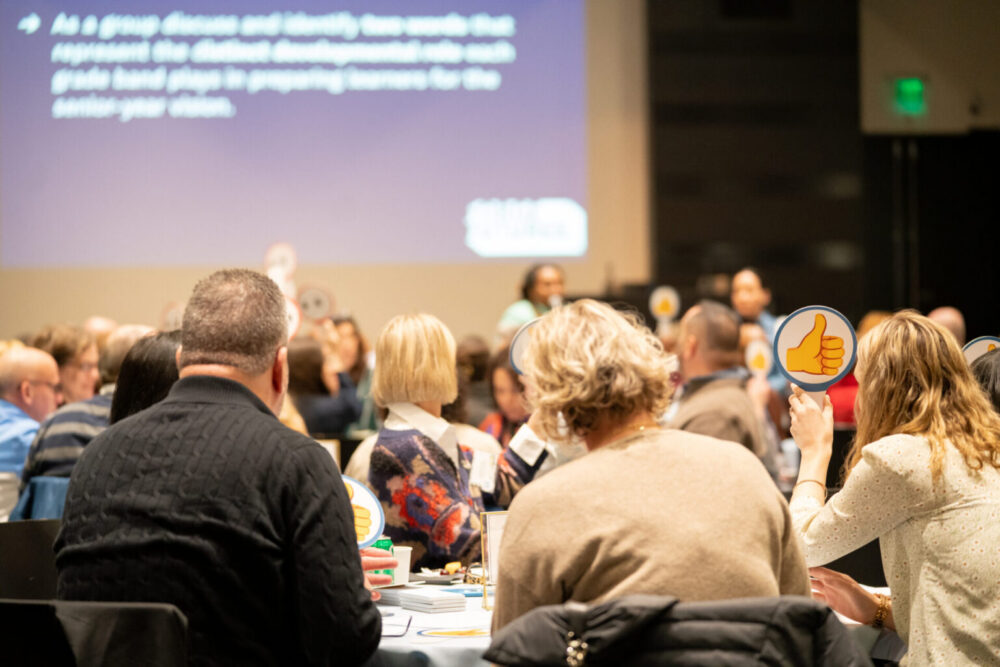
By design, the Forge Futures convening that took place on Feb. 11 at Nashville’s Frist Art Museum wasn’t nearly as large as the massive conference gearing up nearby. At the sprawling Music City Convention Center up the street, a team from AASA, The School Superintendents Association, was preparing to host more than 5,000 visitors at their annual National Conference on Education (NCE).
But the cross-sector group of about 150 innovators invited to Forge Futures — a thoughtfully curated mix of superintendents and leaders from national think tanks, philanthropies, museums and others who are shaping the future of learning — spent their day immersed in hands-on brainstorming that is poised to elevate teaching and learning nationwide for years to come.
Like the first Forge Futures, which Remake Learning hosted in Pittsburgh in May 2024, the goal in Nashville was to work in cross-disciplinary teams to explore bold visions for the future of learning. The collaborative teams at Forge Futures were charged with developing promising insights and shaping them into bold, testable initiatives brought to life through National Moonshot Grant funding.
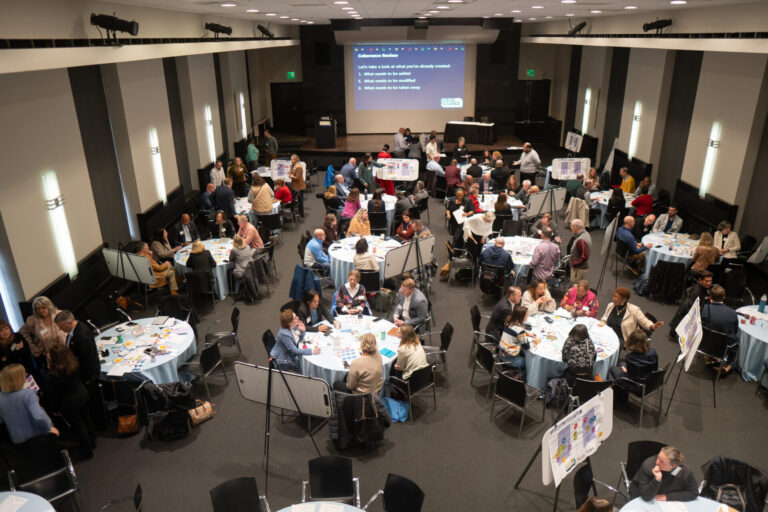 Photo courtesy of Remake Learning.
COLLABORATION AND AUTHENTIC CONNECTION
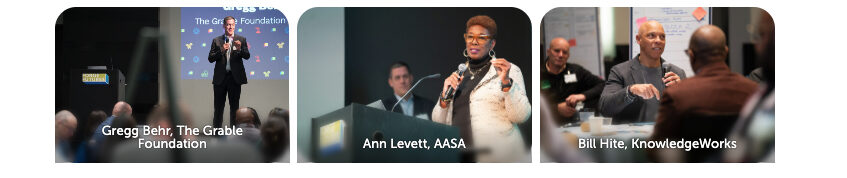
Kicking off this year’s Forge Futures, AASA’s Chief Leadership & Learning Officer Kristine Gilmore spoke about the unique opportunity for connection and vulnerability that this full day of face-to-face interaction offered attendees.
“Be curious today. Keep your mind open, your heart open,” Gilmore said. “Put your guard down. Try things.”
That’s exactly what took place as Michelle King, the dynamic “learning instigator” who emceed Forge Futures, led the group through a range of interactive, collaborative exercises. King’s energy was exactly what the moment called for: an inspiring cocktail of authentic warmth and joy combined with unapologetic honesty about the challenges that schools and their students are facing.
King was joined on stage by several creative partners, including two strategic foresight experts from KnowledgeWorks, Jason Swanson and Maria Crabtree, along with John Balash of Carnegie Mellon University’s Entertainment Technology Center.
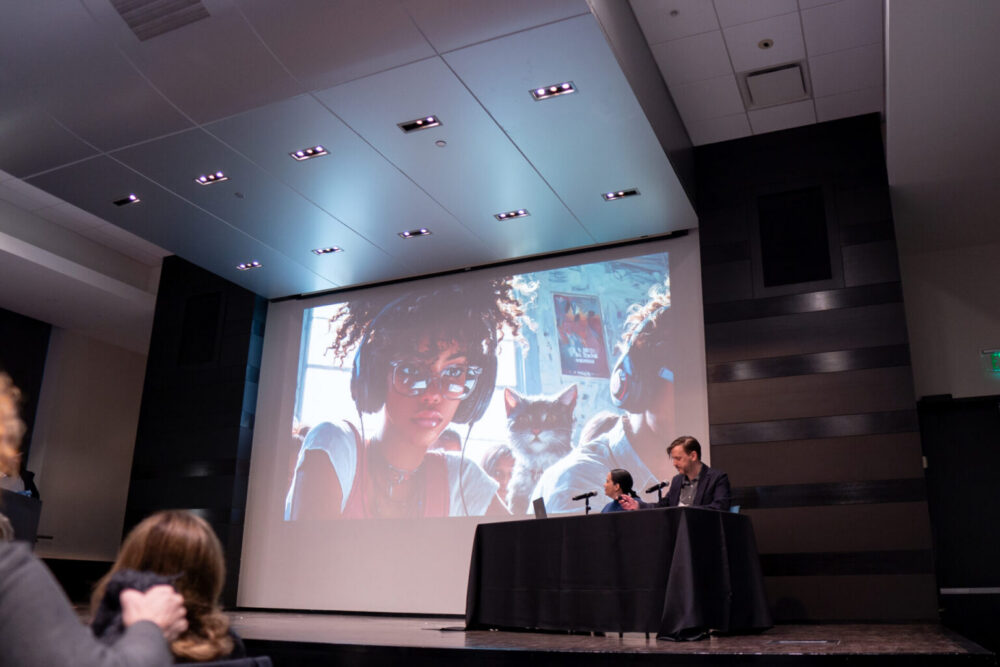 Photo courtesy of Remake Learning.
Their contributions included a futuristic, tongue-in-cheek “news report,” beamed in from the year 2031, exploring the pitfalls and possibilities of our tech-infused, disruption-laden future.
As attendees were promised, this was definitely not a sit-and-get conference.
“I deeply appreciate that you showed up, that you are willing to be courageous and you are willing to be curious and see where this road would take us,” King said. “I would invite you to be wild again, to be bewildered. And I’m wondering if you could ask yourselves, did I create something that inspires awe within me? And can I do that for another? I don’t think we can create what we do not habitually practice.”
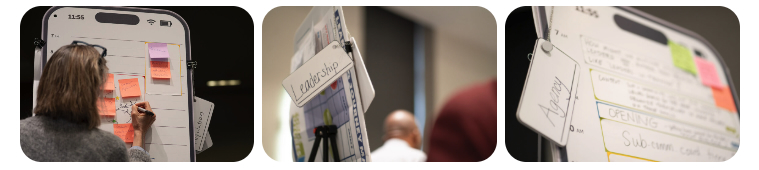
Clustered at round tables, the participants worked closely together in small groups — up and out of their seats, using Sharpies and Post-It notes to capture, organize and build upon ideas throughout the day. Amid heavy conversations, there was laughter and encouragement.
Their goal? To envision a truly valuable senior-year experience for 21st-century learners and to ask: If we want learners to graduate ready for what comes next, what must be true of the journey that leads them there?
The groups were assigned pairs of grade bands (6th/7th, 8th/9th or 10th/11th) and given opportunities to ask how these grade bands can contribute to the best possible senior year. What could a truly effective launch pad or ladder into a thriving adulthood look like in schools across the country? What future-ready skills and experiences are vital on a learner’s journey? What kind of daily schedule might best serve learners at these stages?
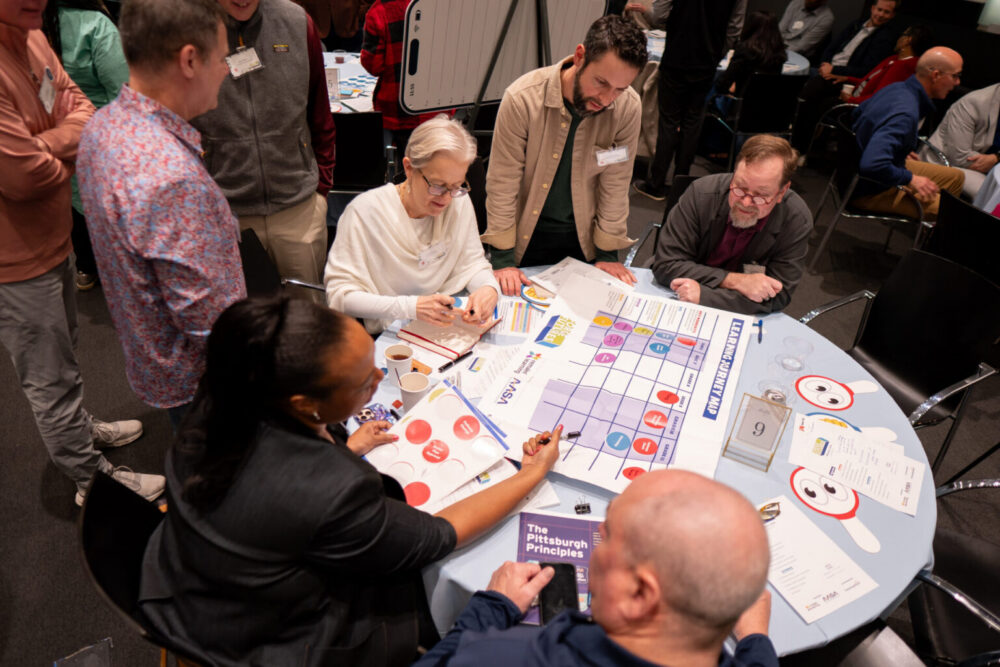 Photo courtesy of Remake Learning.
VISIONING AND VULNERABILITY
Collective visioning sessions led to some fascinating conversations. At one point, participants shared words describing their preferred future for students, then critiqued their own resulting “word cloud.”
Purposeful. Relevant. Connected. Meaningful.
“I’m noticing that so many of these adjectives are connecting the young person or a human with other humans,” one participant said. “Whether it’s about purpose or about connection or about engaging. All these things are about becoming a public person. You’re a human who is there — in, and for, and with others.”
They also noted which words didn’t crop up: “I don’t see the word ‘outcomes,’ which I think is important, because that’s been a code too long in the education system for 10th grade English and math scores,” one participant pointed out.
“We know that an outcome isn’t just, ‘Do you graduate high school after that 12th grade year? … Longitudinal studies, qualitative and quantitative, talk about the relational connectedness between people as the single greatest predictor of long term health and flourishing,” he continued. “We’ve built a system that’s willfully blind to, and does not value, that relational connectedness. And I think that’s what we have the potential to change.”
The vulnerability that AASA’s Gilmore had encouraged was authentically on display.
Participants discussed the need to ambitiously rethink the years leading up to senior year. Implicit in that was the realization that schools’ traditional approaches haven’t necessarily prepared students for the real world as well as they might have.
Among the thoughts that participants shared related to this:
We’ve traditionally set up structures for young people to pass or fail — not to let them struggle and make sense of things.
Systems built to measure students’ knowledge don’t necessarily help them learn to actually become learners and develop mastery.
We need to operate as curious learners ourselves, open to testing ideas, making discoveries and failing in the short-term as we seek long-term success.
Another topic that surfaced repeatedly through the day: The importance of authentically involving students as we shape the future of learning.
“Could we ask the students the same questions we ask ourselves today, and let them lead this work? Because real change rarely comes from us telling communities what they need. … I worry that we are not asking our most valuable asset in a way in which we could really engage in transformation,” one participant said. “I think the students could be where we need to lean in the most right now.”
The mood throughout the day was equal parts unvarnished honesty and genuine hope.
“It feels like we’re in a dark and stormy time right now,” one participant said. “I’ll mix some metaphors and say that the education system has sort of felt to me, for a while, like a sort of old, creaky house. It’s the thing that we live in, and there’s stuff that we wish was better, but that’s the way it was built.”
We lack the resources to do a full remodel, he continued. “That’s where we’ve kind of got to live. And what’s happening right now is like, part of that house is getting torn down, and I want to celebrate that that’s scary and terrifying, but it also creates this opportunity. … We’re in a place right now where we’re part firemen and trying to save some of the important things that are there, and part architects and engineers building something new at the same time. We have to be able to hold those two.”
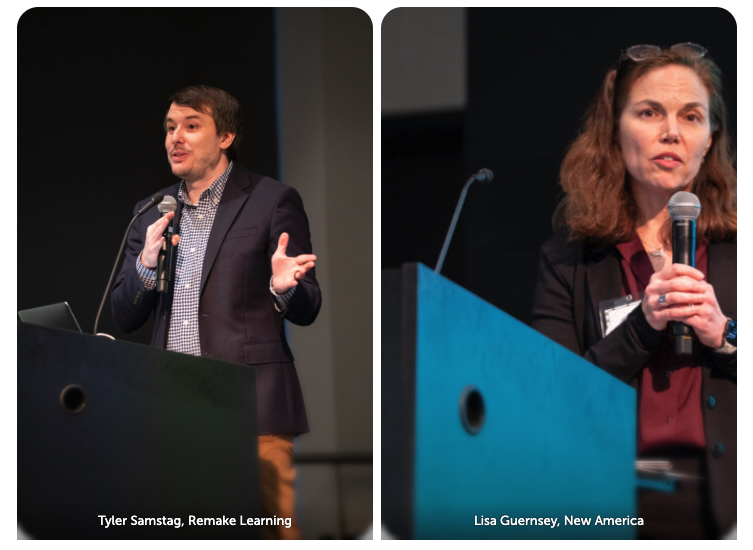
With that in mind, Remake Learning’s executive director Tyler Samstag announced that a next round of National Moonshot Grants will be awarded in the coming months. A total of $775,000 will be granted toward groundbreaking, collaborative projects led by Forge Futures participants.
Lisa Guernsey of NewAmerica.org also announced the formation of a new National Commission on Learning Ecosystems. This collaborative, two-year initiative will bring together a wide range of education and community leaders, all sharing lessons about what works and interrogating what doesn’t as communities look to grow and leverage their own learning ecosystems.
“Two years ago at Forge Futures, there was such a spark that came out of the learnings and the convenings. And at New America, we were watching. Like, ‘Wow, this is important work. How do we ensure that this is happening in many more places around the country?,” Guernsey said.
“There’s so much momentum out there,” she told the Forge Futures participants as their day was ending. “What you all have been designing and thinking about — there’s just a hunger for this right now, and it’s incredibly exciting.”