
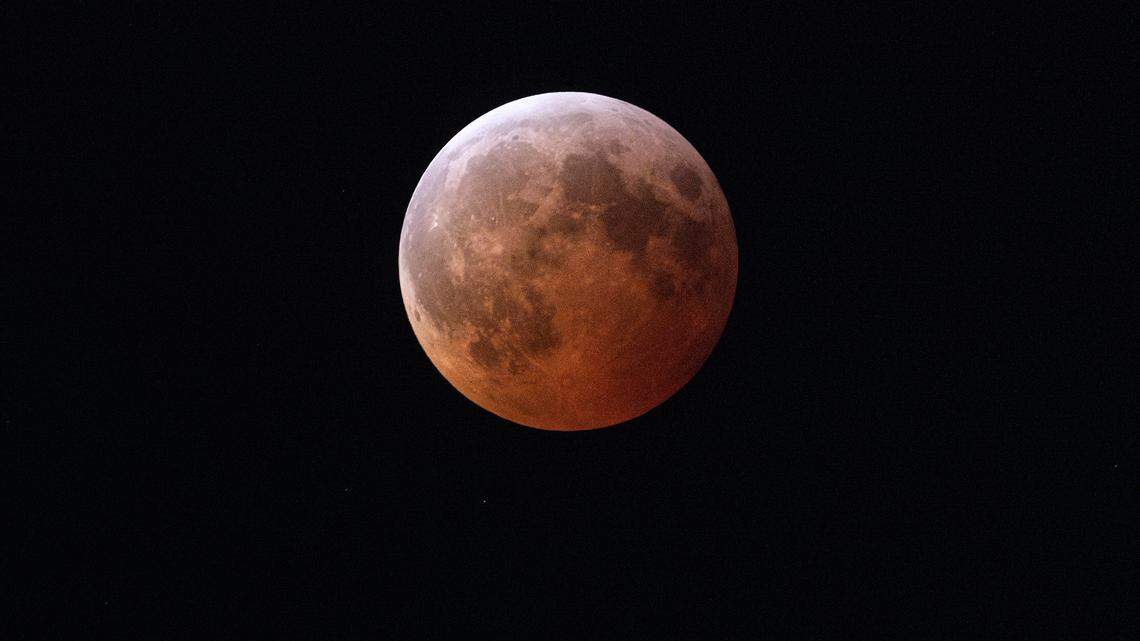
The full moon peaking Tuesday, March 3, will bring a “blood moon” or total lunar eclipse to Pennsylvania stargazers.
“Blood moon” is the popular term referring to a total lunar eclipse, and the name is used because the moon appears orangish or reddish during a total lunar eclipse, according to NASA.
“This is because our planet blocks most of the Sun’s light from reaching the Moon, and the light that does reach the lunar surface is filtered through a thick slice of Earth’s atmosphere,” NASA’s website reads. “It’s as if all of the world’s sunrises and sunsets are projected onto the Moon.”
A total lunar eclipse occurs when the moon moves through the inner part of Earth’s shadow. You can see a total lunar eclipse without any special equipment, NASA says, although your view can be enhanced by a dark environment, binoculars or a telescope.
A partial lunar eclipse will be visible before and after, but the period of totality will be 6:04 a.m. to 7:03 a.m. Eastern Standard Time Tuesday.
If you want to take a photo of the total lunar eclipse, NASA recommends using a camera on a tripod with exposures of at least several seconds.
“The more dust or clouds in Earth’s atmosphere during the eclipse, the redder the Moon appears,” NASA’s website reads.
March’s full moon is also referred to as the “worm” moon. Possible explanations for the name’s origins include earthworms appearing as the soil warms or beetle larvae emerging from thawing tree bark, according to the Old Farmer’s Almanac.
Full moons have multiple names, and many come from Indigenous cultures. The almanac uses Indigenous moon names, along with monikers from colonial America and other North American sources.
The full moon will peak at 6:38 a.m. EST Tuesday, according to astronomy publication Space.com, during the total lunar eclipse. The moon will set at 6:44 a.m. in State College that day, online clock Time and Date reports.
Just a few days after the total lunar eclipse, Pennsylvania residents will “spring forward” and move their clocks ahead one hour for the beginning of daylight saving time at 2 a.m. Sunday, March 8.
The first day of astronomical spring will come with the spring equinox Friday, March 20.
More full moons in 2026
After the snow moon, stargazers will have 10 more opportunities to see a full moon this year. Here’s when to look, from Astronomy.com:
Wednesday, April 1: Pink moon Friday, May 1: Flower moon Sunday, May 31: Blue moonMonday, June 29: Strawberry moon Wednesday, July 29: Buck moon Friday, Aug. 28: Sturgeon moon and partial lunar eclipse Saturday, Sept. 26: Corn moon Monday, Oct. 26: Hunter’s moon Tuesday, Nov. 24: Beaver moon (supermoon) Wednesday, Dec. 23: Cold moon (supermoon)
For those looking to gather with other stargazers this spring, the Central Pennsylvania Observers have several skywatch events on the calendar, including one from 8:30 to 10:30 p.m. Saturday, April 4 at Penn State Arboretum. The skywatches are free and open to the public.
Related Stories from Centre Daily Times

Belleville News-Democrat
Meredith Howard is a service journalist with the Belleville News-Democrat. She is a Baylor University graduate and has previously freelanced with the Illinois Times and the Pulitzer Center on Crisis Reporting.
Support my work with a digital subscription