
Reassessment is a dirty word in some parts of Pennsylvania.
It describes the process of valuing property for taxation purposes. Some counties across the commonwealth are so opposed to it that their officials have not done one since the 1960s.
More: Many Pa. counties haven’t updated property assessments in decades
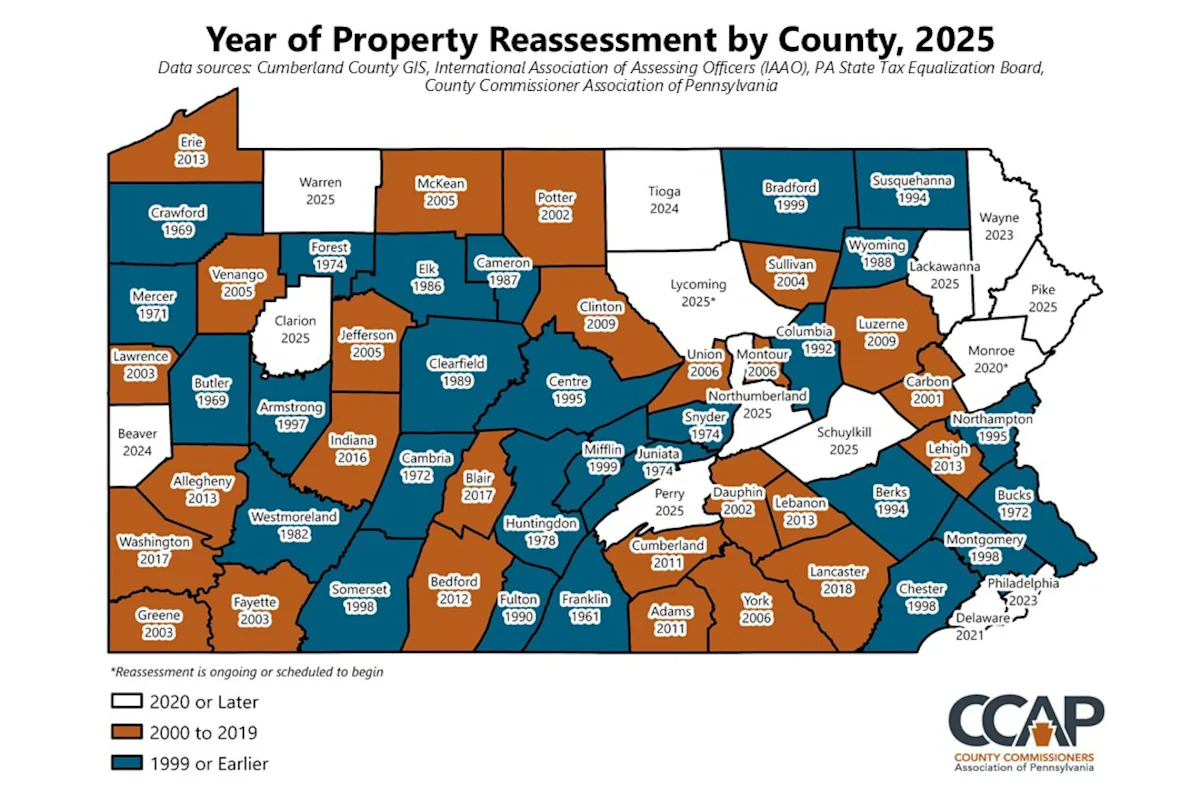
In fact, more than a third of Pennsylvania’s 67 counties have not performed a full property reassessment since 2000, leaving around 40% of the state with antiquated data that is used to tax it. Since 2020, just 14 counties have either completed or begun a reassessment.
Used to balance local governments’ real estate tax revenues for uniformity, reassessments are crucial for the real estate market’s stability.
Without a requirement for Pennsylvania counties to conduct them regularly, officials are left to essentially eye it up based on different intricate mathematical formulas. While those metrics are reliable, they hinge on real estate valuations changing at the same rate.
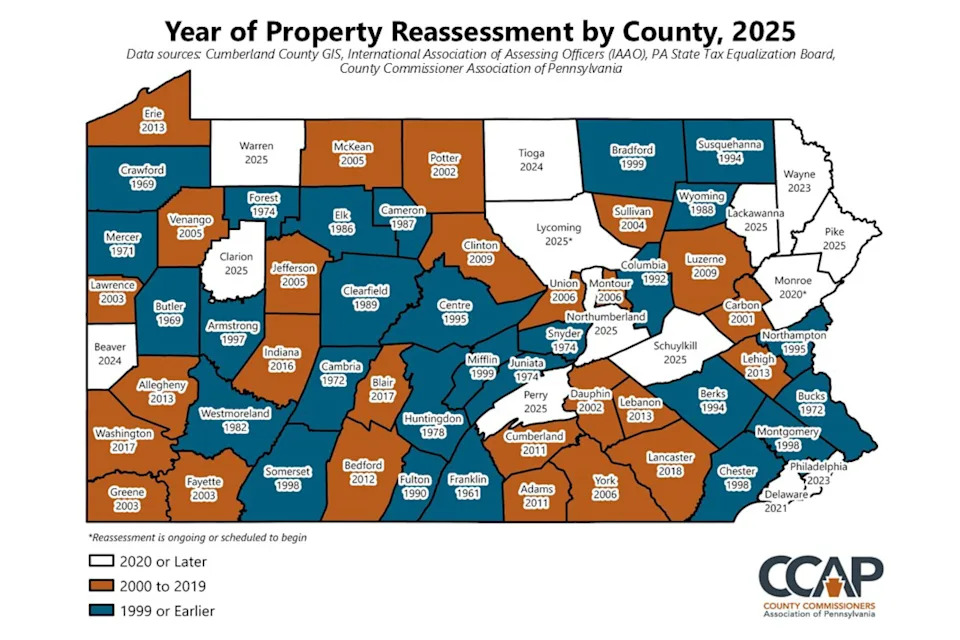
This graphic provided by the County Commissioners Association of Pennsylvania shows the last time each county had a countywide property reassessment.
A former Tioga County commissioner, Roger Bunn, entered office in 2012 after running a campaign that opposed a reassessment, mostly because of a failed attempt by the previous board that was ultimately canceled.
More: Some Bucks County homeowners may be paying too much property tax: Here’s why
Within three years, Bunn was sold on doing one, and by the time he left office, he had commissioned that dirty word, sullied further when uttered after the word “countywide.”
“I came to realize during assessment appeal hearings that there were a lot of people who were paying way too much and a lot of people getting away scot-free,” he said.
Bunn’s turnaround symbolizes what assessors in the state said can prevent a countywide overhaul of tax data from becoming political suicide.
More: Monroe County conducting property reassessment using satellite technology
Commissioners in both Perry and Cumberland counties won re-election after conducting reassessments, recalled Randy Waggoner, chief assessor for Perry County, who also worked for Cumberland.
“In my opinion, the key to any reassessment is public relations and education,” Waggoner said.
Lancaster County is doing a reassessment, done every eight years since a 1990s court order required officials there to reassess regularly. An informational flier on the county’s website explains why.
Several other counties have had reassessments triggered through litigation. That puts the burden on the taxpayer to prove that a property is unfairly assessed, said Josh Zeyn, chief assessor for Tioga County.
And the longer counties go between reassessments, the further imbalanced a county’s assessed values grow. As county officials continue to pass the buck, seeking fair assessments becomes a citizen’s task.
“It shouldn’t be their burden to get a county to do a job they should already be doing,” Zeyn said.
2024 assessment: Beaver County mails property value change notices
Pike County officials are also reassessing, with new numbers slated to be effective in 2029. An informational brochure online helps educate people about the process.
“When you haven’t done one for 30 years, many people don’t understand it,” said Matthew Osterberg, Pike County commissioner chair. “It’s to make it a more equitable process. The valuations get totally out of whack.”
Pennsylvania’s property assessments are really uneven, said Joel Berner, senior economist for realtor.com. It creates a scenario where people in newer homes assessed when they were built are essentially subsidizing people who have been in their homes for decades.
Some counties have municipalities that are up against their tax ceiling, meaning the millage rate is nearly at the maximum allowed by law. A tax hike in those municipalities would require a court order, Osterberg explained.
“You stand a chance the judge could say, ‘OK, here you go. Now you have to do a reassessment,’” he said. “If not now, then when? Eventually it needs to get done. The longer we wait, the more out of balance it’s going to become.”
Pennsylvania does not traditionally get good grades for its property assessments, Zeyn said. But one area the state has right, he said, is the law capping new millage rates. Once a reassessment’s values are assigned, taxing authorities must adjust their millage rates to make the new assessed values bring in no more revenue than the year before.
From there, a municipality is allowed to increase its millage rate by no more than 10%.
While many states have routine reassessments, not all have that equalization process, Zeyn said. “If we move to a cyclical system, I’d advocate that we need to keep it in place. We want a fair and equitable process.”
Mark Walters is the USA TODAY Network Pennsylvania statehouse reporter. Reach him at mwalters@usatodayco.com.
This article originally appeared on Erie Times-News: Reassessments in Pennsylvania don’t have to mean political surrender