
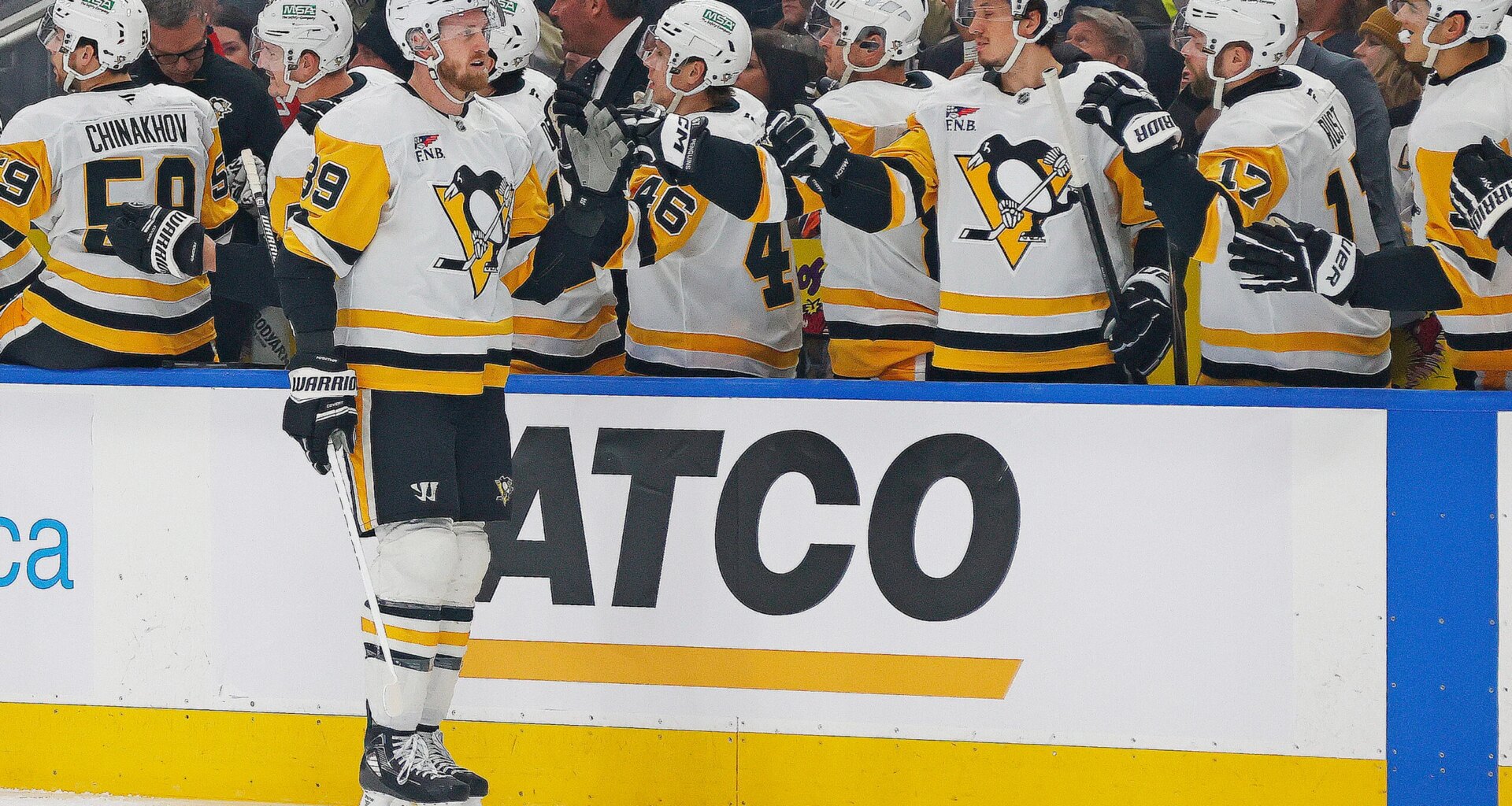
Believe it or not, the Pittsburgh Penguins are closing in on a playoff spot, and doing so quickly. After coasting past the Vegas Golden Knights on Sunday, the Penguins have a three-game points streak in the post-Olympic break, and it seems very few realize just how tangible a playoff berth has become.
The Penguins have 75 points with 23 games remaining. They have the sixth-best winning percentage in the NHL. A nine-point lead on their most plausible pursuer, the Columbus Blue Jackets, and a six-point lead with three games in hand on their closest points pursuer, the Washington Capitals.
About the only advantage that Washington has over the Penguins is that with more games played, Washington’s March schedule isn’t quite as brutally hectic.
The important number is generally 95 points. Teams need 95 to secure a wild-card spot or playoff berth. This season, the Atlantic Division has six teams in the hunt, and it’s quite possible that five make the playoffs by taking both wild cards.
However, the Penguins also have a four-point lead over the second wild-card holding Boston Bruins, just in case Columbus or Washington goes on a ridiculous heater to close the season.
For the grand finale, all of the above can be condensed into this: The Penguins need just 10 more wins to get to 95 points. Ten wins in 23 games. Or nine wins and two loser points. Even a disappointing sub .500 run, such as 8-11-4, would get it done.
In fact, with 16 games remaining in March, in theory, a good streak could put the Penguins firmly in command of their fate by mid-March.
The Penguins’ floor also looks good. If they were to play merely .500 hockey for the remainder of the season, they would finish with 98 points, forcing Columbus to roll off a streak akin to 14-4-4 to tie.
For the Penguins, their hard work and post-holiday surge are paying off. It’s all coming up Millhouse.
Penguins Trade Needs?
Define need.
The customary question applies to teams chasing the Stanley Cup. Of course, the Penguins players will leave every bit of themselves on the ice in that pursuit, but the converse is true of Penguins management.
The NHL trade deadline is Friday, March 6, at 3 p.m.
But Penguins general manager Kyle Dubas has already shown that he will not sacrifice the larger plan for a better result this season.
The Brett Kulak for Sam Girard (and a 2028 second-rounder) trade quickly became obvious proof. It’s debatable if the Penguins got better through that trade, but they acquired a future asset and a player who might become a valuable piece for the future, or might not, in exchange for a pending unrestricted free agent.
By trading Kulak, who had developed a good working rapport with Kris Letang, Dubas loudly signaled that he remained focused on the future, and there could be some short-term subtractions in that pursuit.
“Our goal isn’t just to make the playoffs,” Dubas has said and paraphrased numerous times over the past 18 months.
Of course, the Penguins have already acquired and may continue to acquire more draft picks than every other team. Over the next three drafts, the Penguins have seven second-round picks and two more in 2029, upping the total to nine over four drafts.
The Penguins also have two third-round picks in each of the next three drafts. No, they will not use ALL of those picks. Dubas has also clearly implied that.
But what will the Penguins do at the 2026 NHL trade deadline?
The answer for that should also come with caveats. No one knows. Understand that Dubas pursued Egor Chinakhov intensely for months, and no reporter had a whisper. The Penguins targeted Sam Girard for a year, and again, no one outside the management bubble had any idea.
Also note, in Elliotte Friedman’s latest 32 Thoughts podcast Friday, he noted that GMs believe the market is saturated, so buyers are holding their fire, waiting for sellers to panic and move players at lower prices.
That becomes important for the Penguins because players such as Anthony Mantha and Noel Acciari would conceivably hold a lower value and could tempt Dubas to hang on rather than moving on.
The one thing that never seems to go on sale is young players. So, those youngsters and younger players needing a new home whom Dubas is looking to acquire will still come at full price.
Of course, lower prices also create an opportunity to buy, and perhaps Dubas would drop a draft pick on a second-tier rental from a team that is desperate to sell or a player who wants to play in Pittsburgh.
Side note: Vincent Trocheck does not fit that scenario unless he were to block all other trade offers, and New York would sell him on the cheap, and, of course, the Penguins would want him.
Sure, Brad Marchand used some of his leverage to go to the Florida Panthers last season, and the Boston Bruins received only a conditional second-round pick, but Marchand was a pending UFA. Trocheck is 32, and far from a pending UFA. On July 1, his 12-team no-trade clause becomes a 10-team no-trade list. So, the Rangers have no reason to sell on the cheap at the deadline because they can wait. It’s all theoretically possible, but it seems unlikely, or in that same vein, Dubas would have kept Brett Kulak, too.
The simplicity of the Penguins’ situation is that they are playing with house money. While the GM builds for the future, the team is playing for the present, and neither has any immediate pressure. The team is already good enough to win a playoff round, or even two. And if they don’t, no one will think any less.
So, any moves will be for want, not need.
Perhaps a young center who might join Ben Kindel as the new flag bearers? There are a few out there who haven’t yet reached their potential at age 23, such as Matt Beniers in Seattle or Mason McTavish in Anaheim.
Perhaps solidifying the blue line beyond this season?
The unique situation Dubas finds himself in means he has one thing so many GMs crave: time. It might be pretty quiet on Friday as a result.
Tags: kyle dubas nhl trade Penguins Trade Pittsburgh Penguins
Categorized:Penguins Trade Talk