
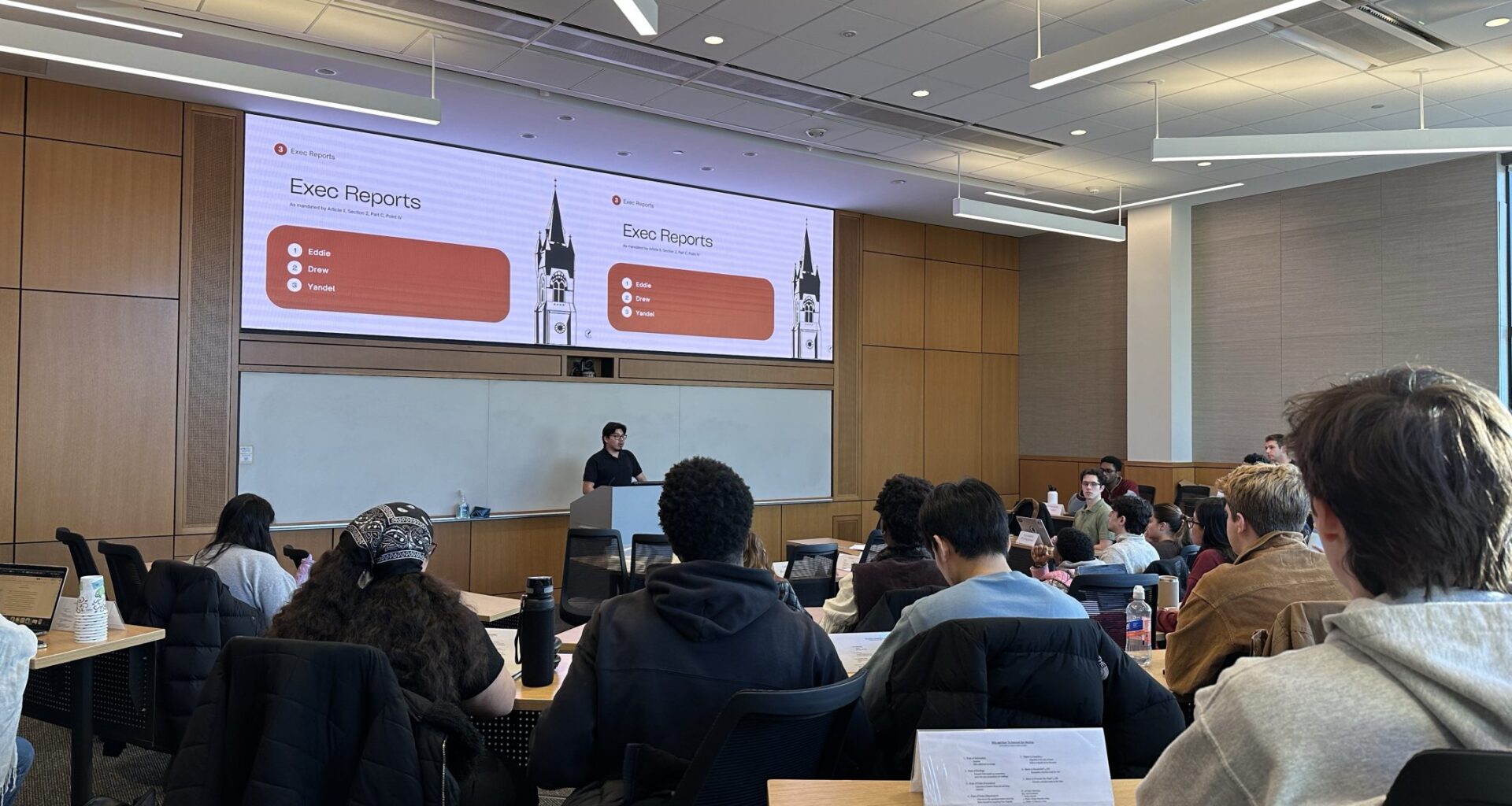
The future of Lehigh’s Student Senate will be decided on March 24, when senators vote on whether to dissolve the organization after nearly 28 years. The vote follows months of internal and external dissatisfaction with the senate’s effectiveness in addressing student concerns.
The proposal, introduced by Drew Smith, ‘27, the vice president of internal affairs, would dissolve the Senate and create a reformed student government with a new name, constitution and bylaws. A potential name that’s been discussed is “Lehigh Student Government,” though Smith emphasized that neither the dissolution nor the proposed name is official until the vote.
During Tuesday night’s meeting, Student Senate president Edward Lopez, ‘27, said dissolution appears to be the direction the body is heading.
“We’ve come to the conclusion by surveying students and surveying ourselves that we’re not really satisfied with the job that’s being done,” Smith said. “There’s been lots of conversations of dissolution — not a reorganization, restructuring or rebranding, but just dissolving and reforming from there.”
Senator Avery Eskin, ‘28, said the Senate is composed of passionate students who want to make an impact, but structural issues prevent it from operating at full capacity.
She said the most persistent problems are spending more time discussing ideas than implementing them and a lack of connection between senators and the students they represent.
“I think the biggest thing that other senators are concerned about is that most people don’t know what Student Senate does, and there’s not really a true connection between the Senate itself and the students,” Eskin said. “Some of us also feel that the administration does not really value us as much as I think that we’d like to be valued.”
Former student senator, Julie Wright, ‘25, ‘26G, said the Senate’s challenges stem from a lack of engagement, accountability and communication.
“I think (the proposal) is a big undertaking, but I agree with the logic and reasoning behind it, because the Student Senate absolutely needs to work like a more unified body, and the current way it’s set up isn’t conducive to that,” Wright said. “I think finding a way for Senate to operate as a more intentional and focused group would be really great.”
Wright said the Senate’s fractured committee structure contributes to its ineffectiveness. With around five to 10 students per committee, senators focus on specific issues, but balancing committee work with full Senate responsibilities can make it difficult for the body to unite behind common goals. She said there were times when, in a committee of five senators, only two regularly attended meetings.
She said a lack of collective action was especially apparent when the College Democrats sought Senate support to create a new polling place on campus following long lines at the Banana Factory during the 2024 presidential election.
To increase accountability, one proposed change would allow the new government to operate as a co-curricular class, giving members the option to receive academic credit. The course would be housed in the political science department and carry the weight of a Creative Inquiry-level class. Students could earn zero or two credits, with a three-credit option for executive board members.
“Making student government an accredited course would allow for some form of incentive for people to stay and would create some form of accountability as a pass-fail course,” Smith said. “I think by making it a class, that adds a level of senator accountability that unfortunately we just didn’t have in my time in Student Senate.”
According to the American Student Government Association, 77% of colleges and universities nationwide offer some form of compensation for elected student government leaders, but Smith said Lehigh no longer does. The university previously provided a $600 dining dollar bonus for Student Senate executive board members, but the benefit was removed last year.
“I think having a co-curricular class would make people more committed because now not only are you doing it because you have a passion for it, but it’s also going into your schoolwork and GPA,” Eskin said. “I think it can only improve how people go about leading in Senate.”