
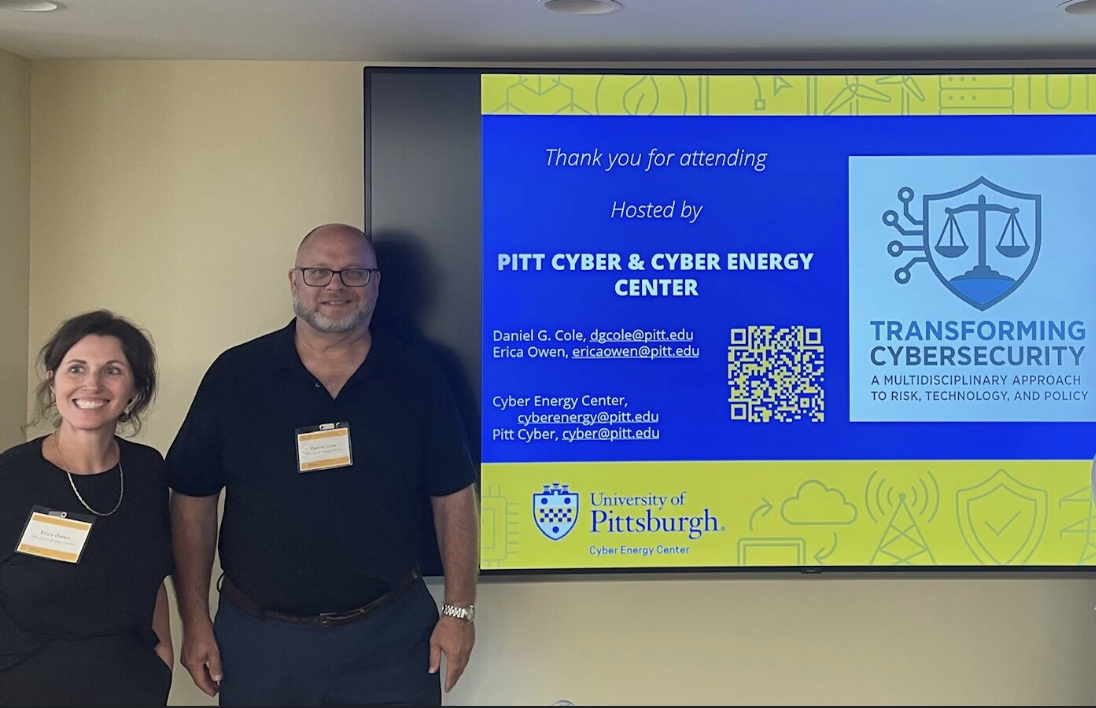

Owen and Cole at the Pitt Cyber Energy Center’s Transforming Cybersecurity Workshop last fall.
When cyberattacks target energy systems, the consequences ripple far beyond the grid, often affecting public safety, economic stability, and environmental health. That urgency is driving the next phase of work at the University of Pittsburgh, where the Cyber Energy Center has received Phase Two funding from the U.S. Department of Energy (DOE).
Launched in 2024 with a $2.2 million DOE award, the Cyber Energy Center unites Pitt’s engineering, computing, energy, law, and public policy communities to address vulnerabilities in critical infrastructure and cultivate a workforce ready for a rapidly evolving cyber threat landscape.
“Since launching the Center, we’ve developed viable, lab-tested cybersecurity solutions as well as a model that highlights the barriers to the adoption of safety measures,” said Daniel Cole, associate professor in the Department of Mechanical Engineering and Materials Science and Director of the Cyber Energy Center.
The new award advances the Center’s mission to strengthen the cybersecurity of America’s critical energy infrastructure through interdisciplinary research that connects engineering innovation with governance and policy solutions. Phase Two funding will expand the Center’s ability to test, evaluate, and refine cybersecurity solutions that integrate technical innovation with policy and societal needs. For SPIA, this work underscores the essential role of public policy in safeguarding energy systems.
“Cybersecurity is essential to the functioning of our society,” said SPIA associate professor and Center member Erica Owen in a previous story announcing the founding award. She noted that disruptions to energy infrastructure can affect “health, the environment, the climate, and the safety of the public.”
With Phase Two funding secured, Owen emphasized the importance of deepening the policy dimension of the research.
“I’m especially looking forward to advancing the policy side of this work—understanding the barriers to cybersecurity investment and identifying the regulatory and governance tools that can strengthen the resilience of the energy sector,” she shared. “And I’m grateful to industry partners and collaborators who have shaped this research.”
The second round of funding will support expanded real-world testing and cross-sector collaboration, building on the Center’s initial federal investment. Beyond technology, this next phase will broaden policy research to inform adoption, governance, and risk management strategies. For SPIA, it represents more than a research milestone—it is an opportunity to translate scholarship into practical governance tools that help institutions anticipate risk, invest wisely, and protect communities.
As cyber threats evolve, so too must the policies that shape infrastructure resilience. With DOE backing and interdisciplinary leadership, Pitt’s Cyber Energy Center is positioning public affairs scholarship at the forefront of national energy security.