
Jon Marks
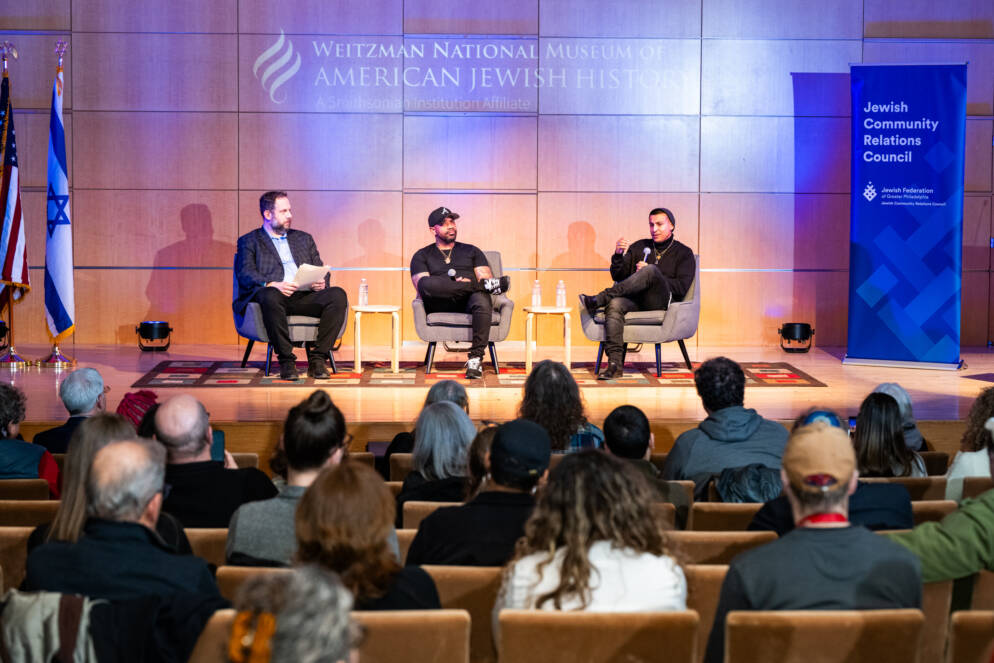
 The panel featured, from left, Jason Holtzman, Pastor Carl Day and Yirmiyahu Danzig. (Courtesy of Jason Holtzman/Jewish Community Relations Council)
How big a hit was the Feb. 16 “Bridging Black and Jewish Communities: Leadership in Complex Times” event at the Weitzman National Museum of American Jewish History? Big enough that they had to literally throw them out of the place.
“It was a really good discussion, and we created a good space for people to network and build relationships to the point that we actually got kicked out of the museum,” said Jason Holtzman, chief of the Jewish Community Relations Council of the Jewish Federation of Greater Philadelphia, who moderated the event. “They got pushed out around 9:15 and told us we had to leave.”
“For a cold winter Monday night, we had over 150 people there and went into a lot of different issues, including the history of the Black-Jewish alliance and where things have gone wrong, as well as some of the current challenges of rebuilding the alliance,” he added.
They called it a “fireside chat” between Yirmiyahu Danzig, an Israeli educator who’s been making the rounds throughout the country the past few years, and Pastor Carl Day, who’s based in North Philadelphia and has been involved with a number of local projects.
They’re also founders of the New Golden Age Coalition, working together over the past three-plus years to educate the Black and Jewish communities to gain a better understanding of each other.
“Generally speaking, a lot of our tension that exists between the Black and Jewish communities is that we really don’t understand each other’s experiences,” said Danzig, who has a better understanding than most, with an Israeli father and a mother from the Caribbean country of Guyana. “And so, I think there’s a lot of ignorance.
“We hear about each other, but we don’t hear so much from each other. And I think that what was really powerful about this event was it was an opportunity to hear from a Jewish American and Black American about how we’re experiencing our communities right now in this moment, and how we can acknowledge the tensions that exist.
“We can acknowledge the pain that exists, but with a desire to learn from each other and develop. I would say it was very positive.”
One thing they learned is that Blacks and Jews share a lot of common ground. “You don’t have two communities that exist in the United States of America that have similarities and parallels the way that our two communities do,” said Holtzman. “Both will talk about homeland. Both will talk about diaspora experience.
“For the Jewish community, we have Zionism. For the Black community, there’s Pan-Africanism. Both the Jewish community and Black community recount experiences with slavery.
“And definitely, both communities right now are under assault. So, this is a time to reestablish that common ground. That’s why it’s so important to create these relationships, because there are a lot of stereotypes, a lot of tropes out there.”
That’s in part because until fairly recently, many Blacks viewed Jews as white adversaries. “To the average African American, most Black people don’t know the difference between a Jew and a German at all,” said Pastor Day, who, besides working with Danzig on the coalition, has dined together and even traveled together on a tour of Israel. “Growing up in our communities and not having proximity to Jewish people, you don’t understand Jewish problems.”
“Some of those takeaways were very alarming. In a similar fashion, you know, that’s every day as an African American, where racism is always a thing,” he added. “We know what it feels like when you know you’re being prejudged. When people already feel like they’ve made their mind up about you before they even get to know you. That’s been the history of the Black and Jewish experience here in America.”
Since Oct. 7 it’s only become more intensified.
“I think Oct. 7 was the straw that broke the camel’s back on decades worth of repositioning Jewish interests and the interests of people of color in America as being diametrically opposed,” said Danzig, who’s visited Philadelphia four times — usually partnering with Day — while also speaking in New York, Chicago, Los Angeles and Atlanta. “That rhetoric was not born overnight.
“It positioned Israelis and Jewish Americans as being on the side of white supremacy and against the interests of brown and Black people. But there are many people within the Black non-Jewish community and brown Jewish and non-Jewish community that have said that doesn’t really make sense,” he said. “It doesn’t comport with what they know about Jewish people and history. They realize the interests of Jewish Americans are deeply interlinked with the interests of Americans of color.”
Day wholeheartedly agrees and says going forward, the goal is to build on what they’ve started.
“While we honor the past, we certainly want to create new history together, and we understand that it’s very much needed,” said Day, who’s also been to Auschwitz, where he spoke with a Holocaust survivor.
What’s next?
“We’ll be creating some events where everybody can get involved and put their hands to work and take ownership because I truly believe in creating movements, not moments,” he said.
According to Danzig, there’s no better place to make that happen than here.
“Philadelphia is a city that is majority Black and brown and where the Jewish community and the Black community are not so physically distant from each other,” said Danzig. “There is a lot of interaction. And because of that, there’s a little bit less of an echo chamber effect in the Philly community. So, I think that the emotions are a little bit less high, as opposed to other cities in America right now.”
“One of the most important goals for me is that people understand that Jewish people and people of color in America really do have a joint interest,” he added. “All these communities are deeply interlinked.”
And now that joint interest is to see that bridge they’re starting to build get finished.
Jon Marks is a freelance writer.