
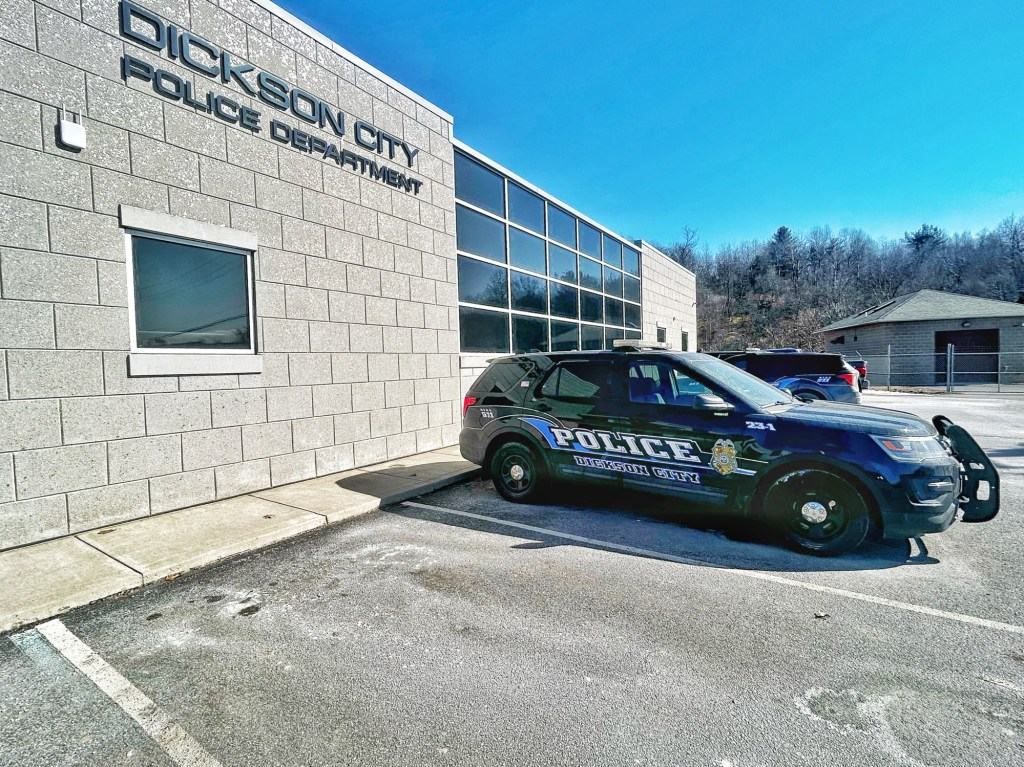
Dickson City Mayor Bob MacCallum walked back his Monday claim that borough police Chief William Bilinski is rescinding a recent agreement with U.S. Immigration and Customs Enforcement allowing borough police to perform certain functions of federal immigration officers.
Pressed on that point Tuesday morning, MacCallum said the controversial agreement between the Dickson City Police Department and ICE was “basically in a holding pattern right now” but would not say the agreement is being rescinded.
It comes a day after the mayor said he didn’t realize Bilinski had signed the 287(g) agreement with ICE — making Dickson City police the first law enforcement agency in Lackawanna County to do so — and that the chief was pulling the department out of the pact pending additional discussion and a legal review.
“Unfortunately he recently signed it and I didn’t realize,” MacCallum said Monday. “I thought we were going to discuss it and then get some legal advice to look at it, so I just called him now … and he’s calling them up to rescind it.”
Reached after, Bilinski said the agreement is “paused” but noted he wanted to speak with MacCallum again before commenting further. That conversation hadn’t happened as of Tuesday morning, MacCallum said, noting he was likely to speak with the chief Wednesday.
Multiple efforts to reach Bilinski on Tuesday were not immediately successful.
Bilinski signed the agreement on behalf of his department Feb. 19 without seeking borough council’s approval. It establishes his department’s participation in ICE’s 287(g) program, specifically the program’s task force model, effectively allowing trained and authorized borough police limited immigration enforcement authority while conducting routine police business, such as a DUI stop or retail theft investigation.
Under the pact, ICE would certify in writing the names of borough police who successfully complete training and pass required testing. Upon certification, the agency would provide those officers with a signed authorization to “perform specified functions of an immigration officer for an initial period of two years,” the agreement says.
Emphasizing “we’re not looking to be ICE,” Bilinski said Monday that his officers would not actively seek out undocumented individuals to arrest for immigration violations.
But officers operating under the agreement would be authorized to detain people with federal immigration warrants if they encounter them during their normal police work, he said. In those cases the department would contact ICE, which would determine next steps.
The agreement, however, grants broader enforcement authority.
Among other examples, it provides authorized borough officers the “power and authority to interrogate any alien or person believed to be an alien as to his right to be or remain in the United States … and to process for immigration violations those individuals who have been arrested for State or Federal criminal offenses.”
It also authorizes officers “to arrest without a warrant … any alien in the United States, if the officer has reason to believe the alien to be arrested is in the United States in violation of law and is likely to escape before a warrant can be obtained,” per the agreement. “Subsequent to such arrest, the arresting officer must take the alien without unnecessary delay for examination before an immigration officer having authority to examine aliens as to their right to enter or remain in the United States.”
Moreover, officers operating under the agreement could “take and maintain custody of aliens arrested pursuant to immigration laws and transport … such aliens to ICE-approved detention facilities.”
Program grows
Use of the 287(g) program has dramatically expanded during the second Trump administration, with the number of 287(g) agreements nationwide increasing from less than 150 at the start of President Donald Trump’s second term to about 1,500 as of Tuesday, according to a scathing American Civil Liberties Union research report on the subject and figures published by ICE.
Among other local examples, the Luzerne County District Attorney’s Office signed on to participate in the program’s task force model last summer. The Schuylkill County Sheriff’s Office did so in January.
There are also financial incentives for participation in the task force model, as participating agencies “may receive” $7,500 for equipment per trained officer and $100,000 for new vehicles, as well as salary and benefit reimbursements and “overtime funds up to 25% of salary,” according to ICE. It was not immediately clear if local participating agencies had realized any of those benefits.
“By paying state and local law enforcement to participate in the 287(g) program, ICE is essentially using federal taxpayer money to redirect state and local agencies from local missions to the Trump administration’s deportation agenda,” the ACLU report charges.
ICE’s website says the program “benefits state and local law enforcement agencies in several ways — but most notably, it helps you keep your community safe from potentially dangerous criminal aliens.”
County ordinance
Bilinski signed the Dickson City agreement amid debate at the county level over an ordinance Democratic Commissioner Bill Gaughan proposed early last month prohibiting Lackawanna County’s cooperation with ICE in most circumstances. The so-called “Protect Our Neighbors Act” would not and could not prevent federal agents from enforcing immigration law in the county, but would prohibit the county and its employees from cooperating in that enforcement unless presented with a valid judicial warrant signed by a judge.
While passionate discussion and debate about the ordinance and immigration issues more broadly have dominated recent commissioners meetings, it’s unclear if and when commissioners might move to advance and ultimately adopt it. A county legal review of the legislation apparently remains ongoing.
County ordinances require two readings, with introduction at one meeting and a vote at another, and commissioners have yet to formally introduce the ordinance in question.
It did not appear on the agenda for Wednesday’s commissioners meeting as of Tuesday afternoon.