
By Jack Tomczuk
Nine months after shelving two-thirds of Nicolas O’Rourke’s Safe Healthy Homes Act, a City Council committee on Wednesday advanced the remainder of the renter protection legislation.
It did not happen without controversy. As tenant organizers celebrated the results of the preliminary vote, a couple of landlords angrily yelled at lawmakers, who made their decision before taking public comment.
The two bills moved out of committee expand the city’s good cause eviction law and direct the Department of Licenses and Inspections to launch a proactive inspection program for rental units, among other provisions.
“Tenants in Philadelphia have long had to fight for the right to dignified living, and I believe the bills passed in committee today have made measurable progress toward that goal,” O’Rourke, an at-large Council member, said in a statement after the hearing.
While O’Rourke’s office adopted some of the amendments proposed by landlord organizations, the changes did not go far enough, according to Steve Chintamen, of the Pennsylvania Apartment Association. He testified that PAA still has “serious and unresolved concerns” and asked the committee to again hold the legislation.
“We’re not opposed to the concepts of safe, healthy homes,” said Paul Cohen, general counsel at HAPCO, which advocates for landlords. “We have two laws that are trying to be introduced that are 23 pages long. They are very, very complicated.”
Other property owners said unscrupulous tenants would use the new regulations to avoid paying rent or leaving their unit.
O’Rourke committed to continued discussions with all stakeholders beyond Wednesday’s meeting, suggesting further changes could be made before final passage. He said his team has been in frequent communication with HAPCO, PAA and others since the legislation stalled in committee last summer.
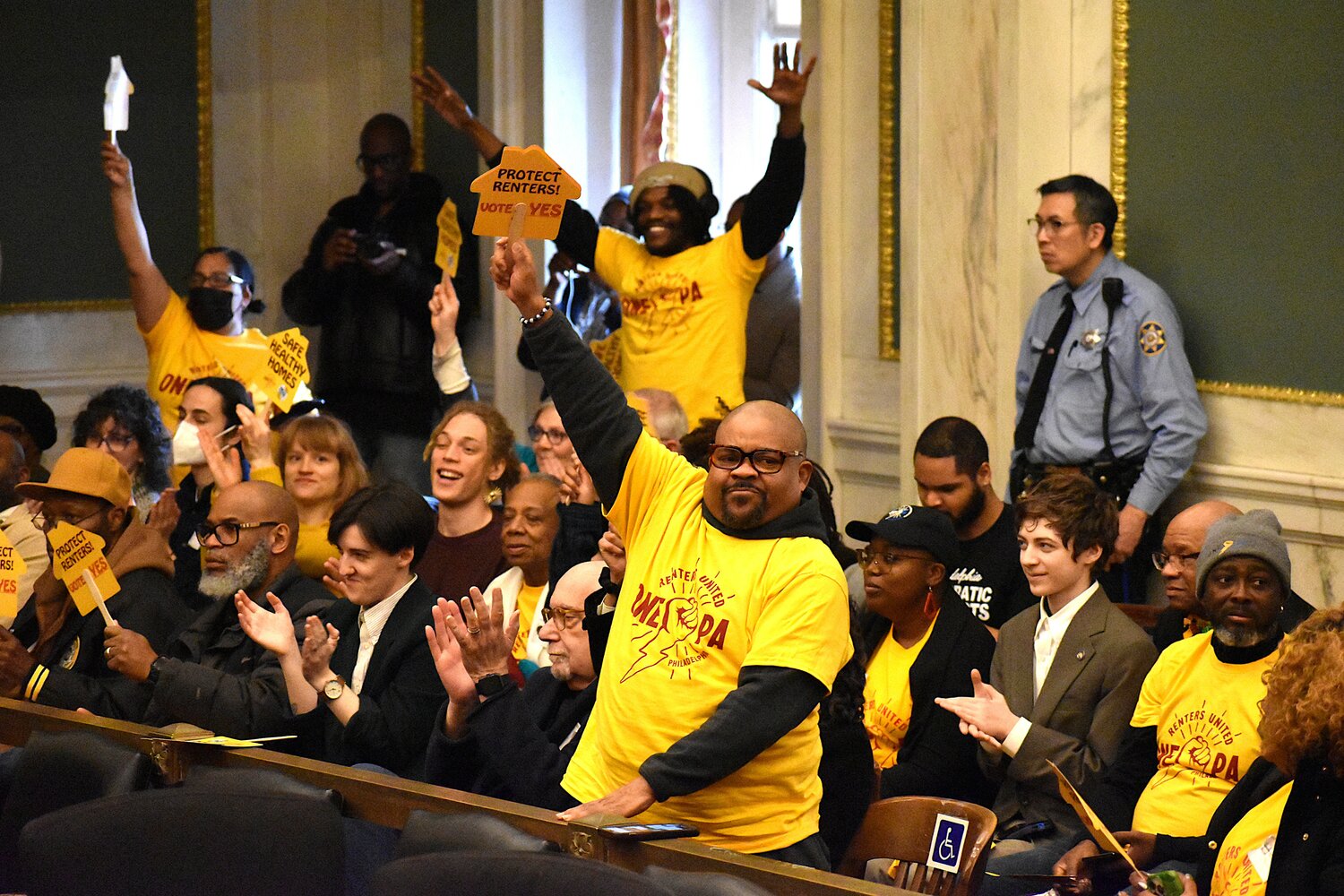
Although landlords were grouped together in a section of Council chambers, the crowded room was predominantly occupied by members of One Pennsylvania Renters United, who wore bright yellow shirts and waved house-shaped signs.
“I support this legislation because I’ve lived it,” said Cincere Wilson, who resides at Upsal Garden Apartments in West Mount Airy.
Wilson told lawmakers he noticed a crack in his ceiling and reported it to property managers. Less than 12 hours later, the entire living room ceiling collapsed, he said.
Renter’s insurance paid for him to stay at a hotel for more than a week; however, the building’s owner continued harassing him for rent, even as the apartment remained uninhabitable, according to Wilson.
That would not be permitted if the Safe Healthy Homes Act is passed. The legislation includes stipulations that landlords must notify tenants that they cannot collect rent if their properties are deemed imminently dangerous or if they do not repair issues in a timely manner.
Beyond basic comfort, poor conditions that go unrepaired can trigger asthma symptoms and other health problems, testified Dr. Tyra Bryant-Stephens, medical director of the Community Asthma Prevention Program at the Children’s Hospital of Philadelphia.
In the more than 25,000 home visits the program has conducted, 70% to 80% have been to rented properties, she added. Remediating mold and other issues has led to a 40% reduction in pediatric asthma-related emergency room visits and a 70% drop in hospitalizations, according to Bryant-Stephens.
“This evidence proves the value of doing everything we can to make sure children with asthma – and all children – live in safe, healthy housing,” she said.
O’Rourke’s bills would also safeguard a renter’s right to organize with their neighbors or advocate through a tenant’s rights organization.
Philadelphia’s ‘good cause’ eviction statute prevents landlords from terminating a lease or providing a notice of non-renewal without a valid reason, such as repeated failure to make rent payments, nuisance activity or substantial property damage. However, the law only applies to month-to-month agreements.
“As it stands, most Philadelphia tenants do not enjoy the protection of good cause for eviction,” explained Jackie Zaneri, supervising attorney at the Senior Law Center. “Although the law was a great idea, landlords are contracting around it.”
The Safe Healthy Homes Act would extend the provision to cover all leases, including those lasting a year or longer.
Bridget Collins Greenwald, commissioner of L&I’s Quality of Life division, told Council that concerns expressed by Mayor Cherelle Parker’s administration at a June 2025 hearing on the legislation have been addressed.
The component of the package that did advance over the summer created a fund to aid renters who need to relocate because a city inspection found their home could no longer be safely occupied. It was funded through the first-year budget for Parker’s Housing Opportunities Made Easy, or H.O.M.E., plan.
Both of the other bills have undergone extensive amendments. Barring any other alterations, the legislation could come up for a final vote before the full Council as early as March 19.