
SCRANTON — Lackawanna County Commissioner Bill Gaughan failed Wednesday to convince his colleagues to waive attorney-client privilege and release a “confidential” legal analysis of his proposed ordinance prohibiting county cooperation in federal immigration enforcement.
Then he released it anyway.
“Attorney-client privilege belongs to the clients, and I’m one of the clients,” Gaughan said shortly before emailing county Solicitor Paul James Walker’s analysis of the so-called “Protect Our Neighbors Act” to several local journalists. The document — marked confidential and intended for “internal deliberative purposes only” — “examines the potential consequences of adopting the sample ordinance provided for review” and warns that its adoption “carries significant risks.”
“These include limited commissioner authority to enact such measures, inability to bind independently elected Row Officers, exposure to litigation, potential criminal prosecution of officials, redundancy and conflict with existing laws, operational confusion, and ineffectiveness due to the absence of enforcement mechanisms,” Walker wrote in the internal memo dated Wednesday.
It comes a month after Gaughan proposed and provided a sample version of the ordinance, which could not prevent federal agents from enforcing immigration law in the county. It aims instead to prohibit the county and its employees from cooperating in that enforcement, be it through information sharing or other means, unless presented with a valid judicial warrant signed by a judge.
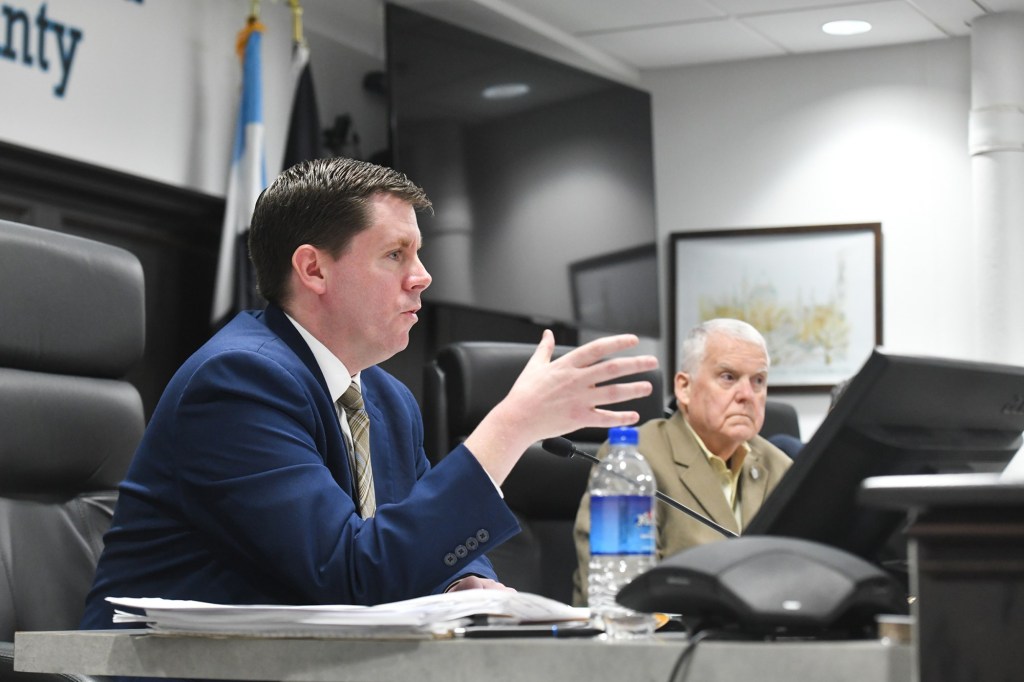
 Lackawanna County Solicitor Paul James Walker speaks during the commissioners meeting held in the county government center in Scranton Wednesday, March 4, 2026. (SEAN MCKEAG / STAFF PHOTOGRAPHER)
Commissioners have not formally moved to introduce the legislation amid Walker’s legal review, but it has been the subject of extensive commentary at recent commissioners meetings. That commentary continued at Wednesday’s meeting, with public speakers overwhelmingly backing Gaughan’s proposal, often on moral or religious grounds, while urging commissioners to pass the ordinance.
Gaughan, a Democrat, made a motion that commissioners waive attorney-client privilege and publicly release Walker’s legal analysis after public comment concluded. His motion died when neither Democratic Commissioner Thom Welby nor Republican Commissioner Chris Chermak offered to second it.
In releasing it anyway Wednesday afternoon, Gaughan said the public has a right to review the legal analysis being used to shape public policy and that “the public interest requires transparency.” He also provided a Feb. 11 analysis by Walker responding to questions Gaughan posed about the county’s legal obligations regarding ICE.
Among issues it raises, Walker’s more-recent analysis says commissioners lack the authority to dictate policy to elected county row officers. It also warns the proposed legislation could result in civil litigation, as recent cases elsewhere “show the U.S. Department of Justice (DOJ) aggressively challenging ‘sanctuary’ policies.”
Moreover, Walker warns that “recent developments indicate that the DOJ is considering or directing criminal penalties against politicians and officials who enact or enforce ordinances limiting local cooperation with federal immigration enforcement.”
“These efforts frame such policies as potential violations of federal statutes, including harboring illegal aliens (8 U.S.C. § 1324), obstruction of justice (18 U.S.C. § 1501 et seq.), conspiracy against the U.S. (18 U.S.C. § 371), or racketeering (18 U.S.C. § 1961 et seq.),” the solicitor wrote. “A DOJ directive issued in January 2025 instructs federal prosecutors to investigate and potentially charge officials in ‘sanctuary’ jurisdictions for obstructing immigration enforcement, emphasizing noncompliance as a basis for prosecution under harboring or withholding provisions.”
When Gaughan made his ultimately unsuccessful motion at Wednesday’s meeting to release the confidential memo, Walker advised “that we have internal discussions on that rather than take up a vote on that particular issue now.”
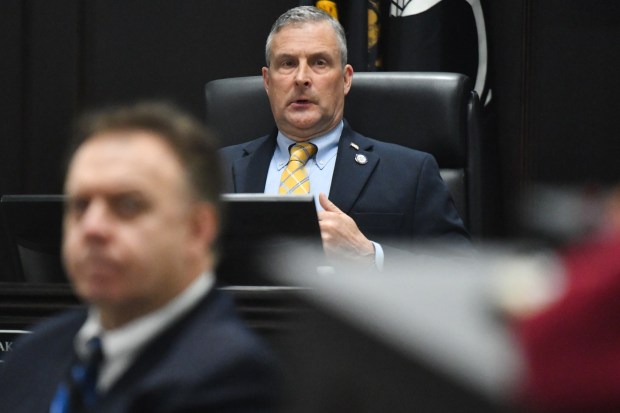 Lackawanna County Commissioner Chris Chermak looks on during the commissioners meeting held in the county government center in Scranton Wednesday, March 4, 2026. (SEAN MCKEAG / STAFF PHOTOGRAPHER)
Efforts to reach Chermak after Gaughan released the document were not immediately successful, but Welby said it demonstrates a “lack of respect for anything other than himself.”
It “also speaks volumes as to our ability to share anything in confidence with him in the future,” Welby said.
Walker explained his rationale for not releasing it when reached by phone Wednesday afternoon.
“The memo is analyzing the framework of the proposed Protect Our Neighbors ordinance, and … doing so with a critical view in order to protect the whole county from the pitfalls that are addressed within it,” Walker said. “The reason that I wanted to keep it confidential is because, if this was passed as written by the board, the memorandum provides a very very clear roadmap for challenges and criticism.”
“I think that any member of this board that is serious about attempting to introduce laws or policy or procedure as it relates to how the county interacts with ICE, would not have shared this memorandum with the public,” he said.
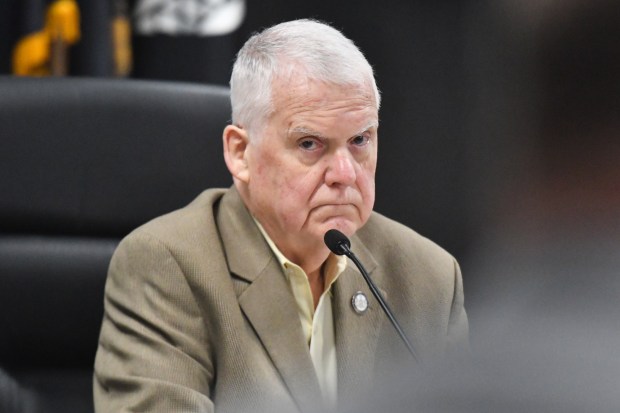 Lackawanna County Commissioner Thom Welby looks on during the commissioners meeting held in the county government center in Scranton Wednesday, March 4, 2026. (SEAN MCKEAG / STAFF PHOTOGRAPHER)
During the meeting, Gaughan disagreed the analysis should be confidential and highlighted its “extremely aggressive section that raises the specter of criminal prosecution for local officials.”
“I am not aware currently of a single elected official in this country who has ever been criminally prosecuted simply for … setting local policy boundaries on ICE cooperation,” he said. “And I don’t believe that legal risk should stop policy debate, and I believe even the solicitor acknowledges that ICE cooperation is voluntary under federal law.”
Walker wrote in his Feb. 11 analysis that the 10th Amendment “prohibits the federal government from compelling state or local governments to enforce federal regulatory programs,” and that Pennsylvania counties “have discretion regarding cooperation with ICE detainers.”
Commissioners took no official action on the ordinance Wednesday, but both Welby and Chermak said discussions about it will continue.
“It has to be done right the first time as far as I’m concerned,” Chermak said. “And we need to look at what we can legally do, what we legally can’t do, and … whatever we can do, we will discuss it and figure that out.”
Thanking the public speakers, almost all of whom support Gaughan’s ordinance, Welby said their “passion is felt” while acknowledging the wheels of government sometimes turn slowly when it comes to the legislative process.
“There are issues with the ordinance as it was submitted that are serious, and we do have to look at them,” Welby said, noting a number of issues Walker raised in his confidential analysis. “And we are, I believe today, going to meet with counsel and discuss this and hopefully work it out.”
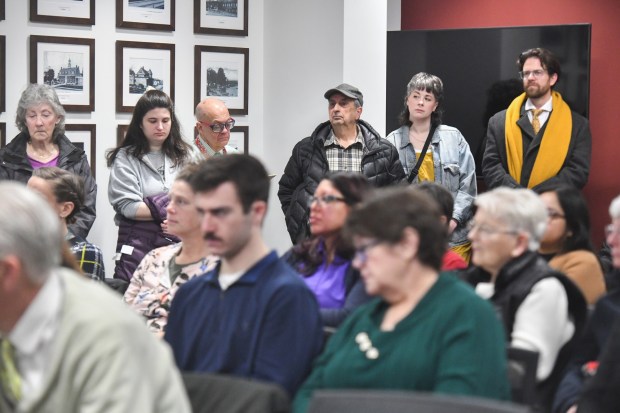 People stand against the wall in the crowded board room during the Lackawanna County Commissioners Meeting in the county government center in Scranton Wednesday, March 4, 2026. (SEAN MCKEAG / STAFF PHOTOGRAPHER)
Some of Wednesday’s public speakers, including Elizabeth Aguilar of Taylor, shared personal anecdotes. Aguilar, a 37-year-old citizen born in California who moved with her family to Pennsylvania in the late 1990s, told commissioners of how her parents fled civil war in El Salvador and came to the U.S. “illegally” before securing protections from removal and eventually becoming citizens themselves.
She described living in fear as a child that her parents would be taken away, fear she said she inherited from them.
“And I am thankful for the sacrifice that my parents have made … to travel from El Salvador to California, even though it was not the right way,” Aguilar said. “They didn’t have the means. A lot of these immigrants don’t have the means, otherwise they would do it the right way.”
“Everybody just wants to come here,” she continued. “They want to work, they want to go to church, they want to send their kids to school, they want an opportunity that the United States has always said that (it) could provide to all immigrants.”