
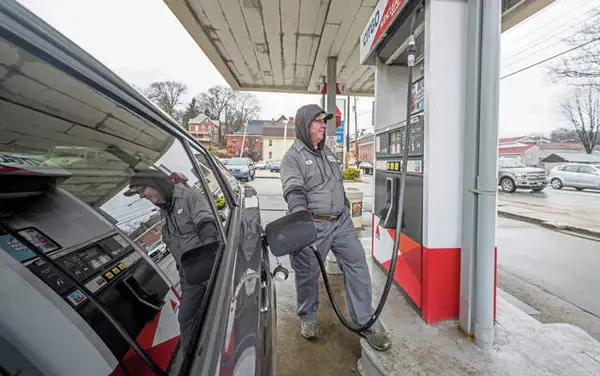
The pain at the pump has returned for Western Pennsylvania motorists as U.S. and Israeli attacks on Iran create uncertainty over the global oil supply, a volatility that economists say could wreak havoc on the local economy.
Gas prices across the Pittsburgh region jumped between Monday and Wednesday as the impact of the burgeoning war in the Middle East spread across oil-producing countries. Some stations in the Alle-Kiski Valley and Westmoreland County raised prices by 16 to 19 cents per gallon overnight Tuesday, after increading them 10 cents on Monday.
AAA East Central reported Wednesday that the national average for a gallon of regular gas reached $3.10, but local towns are seeing even sharper spikes. Jim Garrity, a AAA spokesman for the region, said some local areas have seen prices climb significantly higher in just 48 hours. Garrity said local fuel prices also are being impacted by a seasonal increase in demand.
“I don’t anticipate this ending anytime soon,” said Risa Kumazawa, an associate professor of economics at Duquesne University in Pittsburgh.
“At this point, all eyes are on crude oil, which accounts for 50 to 60 cents of each dollar you spend at the pump,” Garrity said. He noted that Pittsburgh-area refineries and distributors are beginning the annual transition to summer-blend gasoline — a factor that typically pushes Western Pennsylvania prices higher each spring anyways.
West Texas Intermediate crude oil ended Wednesday at $75.59 per barrel, up $1 from Tuesday.
Adding to the uncertainty over the war is that the Trump administration has not indicated when military operations in Iran might conclude.
The last time regional oil prices were similarly effected by a conflict was in 2022 following the Russian invasion of Ukraine, but Iran’s protracted war on Iraq in the 1980s also had an impact on oil prices as well, Kumazawa said.
“This is the worst time to have oil prices go up with a weakening economy,” which could trigger a recession, Kumazawa said. “It’s a horrible place to be in.”
It’s too early to tell if the rising price of fuel — both at the pump and in use in the manufacturing of products — will trigger inflation, said Mitchell Isler, a Federal Reserve of Cleveland research analyst who spoke at an Economic Growth Connection of Westmoreland program Wednesday in North Huntingon.
“We haven’t seen it yet,” Isler said. That will depend on how long the war continues, Isler added after a presentation to business and community leaders.
‘Chokepoint’ for global oil
As bad as the bombing has been on the oil prices, transporting the oil out of the Middle East from the oil-rich Persian Gulf countries poses problems during the conflict.
“The only way out of the Persian Gulf is through Stait of Hormuz … with Iran on one side and Oman on the other,” said Ola Johansson, a geography professor at the University of Pittsburgh-Johnstown and chairman of its Geography Department. The Strait of Hormuz connects with the Gulf of Oman, which opens up to the Arabian Sea and the Indian Ocean.
The 21-milewide Strait of Hormuz is where about one-third of the world’s global supply is shipped, Johansson said.
Because the strait is so narrow, there are no international waters for a shipping lane, he said.
“It’s pretty easy to threaten any ship with missles” from Iran, Johansson said, so the shipping industry won’t take the risk of moving the tankers. He said Iran also could mine the waterway, which it has done in the past, essentially closing the channel.
“It’s the main route to get oil over to China and Japan. It’s a global chokepoint,” said Jennifer Baka, an associate geography professor specializing in energy geographies at Penn State University.
A large Saudi oil refinery that refines 500,000 barrels a day already has been hit by a bomb, Baka said. Seven percent of the global oil supply has already seen the impact, Baka said.
Price jump
Mike Jamison, owner of Jamison’s CitGo in Greensburg, felt the price hike when he ordered a tanker load of fuel — usually between 7,000 gallons and 8,000 gallons — and the price shot up for Wednesday.
The retail price rose some 16 cents a gallon and was $3.35 a gallon.
Jamison said he will keep his prices the same while that fuel is in his tanks, regardless of the daily price fluctuations.
“I consider it ripping off the customers” to raise prices on fuel that was cheaper when he received it, Jamison said.
At the Flying J Travel Center off the Smithton exit of Interstate-70 in South Huntingdon, prices from Tuesday to Wednesday went up more than 30 cents a gallon, to $3.09 a gallon for regular, a spokesperson said.
Featured Local Businesses
Local motorists at gas stations in Tarentum, Salem and Lower Burrell said Wednesday they expect costs to continue climbing.
“I’m concerned more about gas prices in the long term, as opposed to right now,” said Paul Jobe of Greensburg, as he filled his Chevrolet truck at the GetGo in Salem. Jobe watched the pump click to $3.59 per gallon, a jump from just a few days ago. His total surpassed $75, significantly more than he paid only weeks prior.
In Tarentum, Leechburg resident Greg Ausk said at a Marathon station that he expected the market to react the moment the war started. The increase is already changing his driving habits.
“I just hang out at the house. I’m trying not to use it as much, but I’m still paying more,” Ausk said. As of Wednesday afternoon, the Tarentum Marathon listed regular unleaded at $3.39.
Mike Woods of Sarver said he believes the economic strain will carry political consequences for President Trump in the midterm elections.
“We don’t appreciate (gas prices). We don’t appreciate people out here starving. I feel like the things he’s doing; it’s going to cost him,” Woods said. “I’m sure it’ll go up to $4, easy.”
In New Kensington, Sue Nix of Delmont expressed a mix of economic worry and political support while filling her car at a GetGo.
“It makes me feel worried and sad because it was tough before and now it’s going to be tougher,” Nix said. However, she noted her support for the military action. “It was either us or them, and he struck first. He really had to do it.”
At Shamey’s, a full-service station on Tarentum Bridge Road, worker Rick Toney said the local business is trying to keep prices consumer-friendly. On Wednesday afternoon, Shamey’s listed regular at $3.39, mid-grade at $3.60, and premium at $4.08.
“We’re 20 cents cheaper. That’s a savings of $2 on a $10 purchase,” Toney said. While he worries daily about rising costs, he said the business is leaning on its loyal local customer base.
“You can’t be political at the pump,” Toney said.