
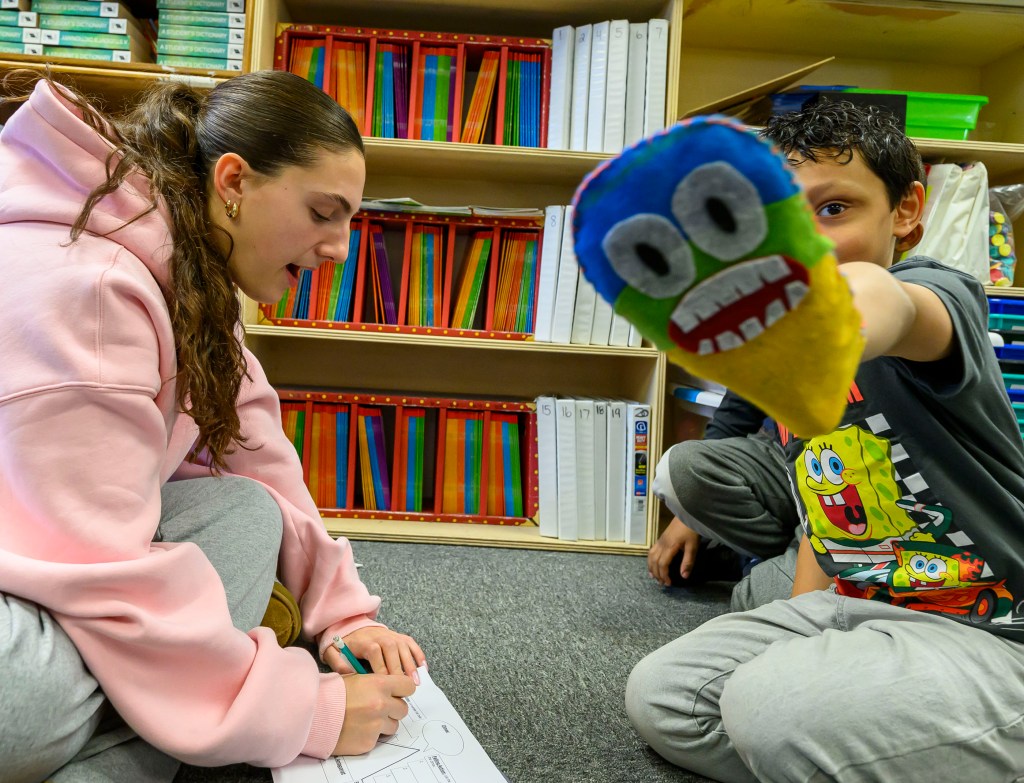
A dog named Doge takes a rocket ship to Mars to retrieve the family members of his alien owner, Mr. Nonchalant. That’s the plotline two Bethlehem third graders pitched to their Moravian University mentor during a recent storytelling workshop at William Penn Elementary.
Other student stories featured more grounded plots, such as a tale in which Oscar the Grouch and Elmo solve a conflict over a stolen cookie.
The plot development lesson Monday marked the midpoint of a collaboration in which Moravian students bring the third graders’ characters to life using puppets that will eventually star in original children’s books.
The William Penn students are the creative engines of the partnerships. To start, the third graders completed a brainstorming packet with character details. The Moravian students made felt puppets to those specifications and then brought the puppets in to inspire the plot-building workshop.
Now that both the puppets and the plots are in place, the Moravian students will write and illustrate children’s books that they will later share with their third grade partners.
“I just see all the smiles,” William Penn Principal Nancy Zoudeh said, calling the workshop series a “fun, creative” way to work outside the traditional curriculum while building writing skills.
The Moravian students are “basically celebrities in our kids’ eyes,” Zoudeh said, adding that the creative writing partnership is one way her community school is strengthening its partnership with the university in its backyard.
The 24 university mentors come from Moravian’s art and child development course. The class is required for art education students, but enrollees come from a wide variety of majors, with many preparing for careers in fields like pediatrics or speech pathology.
Art is a form of expression that allows students to communicate feelings even when they don’t have the words, said Moravian freshman Siria Moretti, who is studying neuroscience and would like to pursue a career in ophthalmology.
“It’s something that they can all connect with,” Moretti said.
Moretti’s 8-year-old partners, Yamoussa Traore and Julian Jones, choose the name “Mr. Nonchalant” from a list of personality words on their brainstorming packet.
Yamoussa said being nonchalant means being someone who is “really chill” and “doesn’t bother being annoyed.” He said the dog’s name, Doge, came from internet memes featuring a dog playing piano.
Nine-year-old Jason Breidinger and 8-year-old Adriana Ortiz drew their characters from “Sesame Street.”
Adriana said she likes how the characters on “Sesame Street” learn, saying she’s learned “that you can try new things” from watching the show.
Jason and Adriana worked with Moravian freshman Lilian Driscoll, who is considering a career in speech-language pathology or pediatrics.
Art provides a dopamine boost that helps students enjoy their schoolwork, Driscoll said.
“It’s a really good way for kids to express themselves and work through the emotions that they feel,” she said.
Having enough university mentors to provide one-on-one support helped the third graders unlock their individual creativity, third grade teacher Eric Smith said.
The workshops provided a chance to “branch outside a bit” beyond the district’s focus on math and literacy, Smith said, adding that he considers himself “one of the least artistic elementary school teachers you’ll find” and he appreciates having creative partners.
Intergenerational mentorship fuels creativity, Moravian assistant professor MaryJo Rosania Harvie said. The storytelling workshops are the product of one such partnership, Harvie said, explaining that she first met William Penn third grade teacher Lindsey Dalla Piazza when Dalla Piazza taught Harvie’s son. The two educators are now several years into their creative writing collaboration.
“This is something that’s just so different,” Dalla Piazza said, calling the workshops a break from the traditional school day that “brings creativity out through a different lens.”
Using puppets is an intentional, research-based strategy that has proven successful not just in education but also in fields like speech pathology and pediatrics, Harvie said.
Harvie draws inspiration from the Educators’ Neighborhood learning community at the Fred Rogers Institute, which is based out of St. Vincent College, the home of the famous puppeteer’s archives.
Puppets support social and emotional skills such as trust building, Harvie said.
A $600 National Art Education Association grant helped Harvie buy additional puppet-building supplies and put on after-school workshops, including a talk with author and illustrator Michael Reggiani.
The feedback she’s received from Moravian students shows the relationship-building part of the storytelling collaboration is working, Harvie said.
Moravian students report that third graders are unafraid to share ideas, which makes the college students less anxious to express their own thoughts, Harvie said, adding that Moravian students say they’re teaching the younger students patience and planning.
“That age gap actually adds a lot to the creative elements of the project,” Harvie said.
For Jason and Adriana, that means reminding Driscoll to come back with googly eyes for all the “Sesame Street” characters. For Yamousse and Julian, it means ensuring Moretti can get them all the way to Mars — and back.