
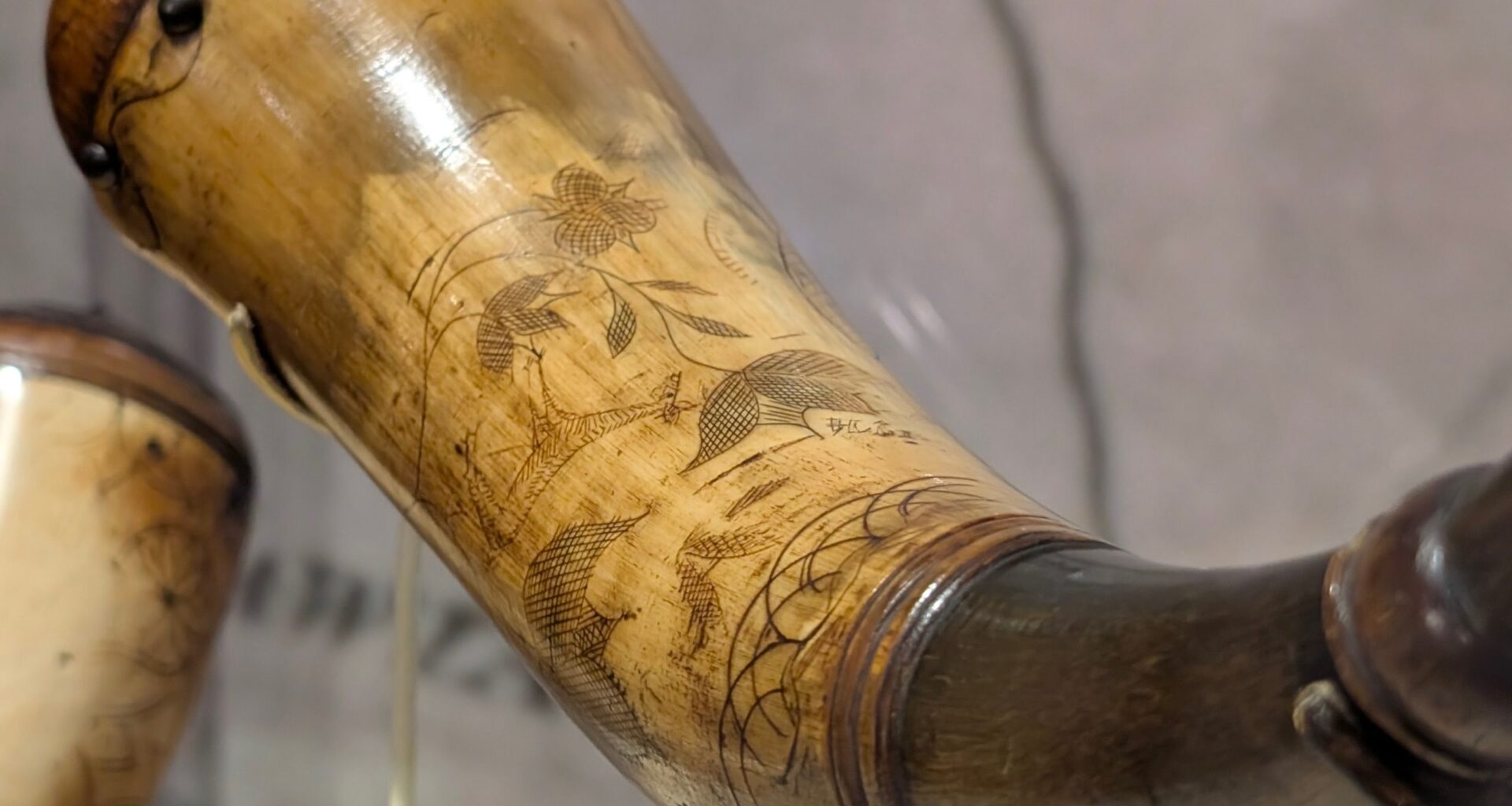
While Pittsburgh isn’t quite as integral to the American Revolution as Philadelphia or Lexington, the three rivers and Fort Pitt’s title, “the gateway to the west,” tie the region to the United States’ inception in little-known ways.
The Fort Pitt Museum’s latest exhibit, “Pittsburgh’s Revolution,” is open now and digs up the region’s Revolutionary-era history — literally.
Mike Burke, assistant director of the Fort Pitt Museum, says it was important for the museum to create an exhibit that highlighted Pittsburgh’s longstanding connections to history and tradition dating back to the founding of the nation. “Pittsburgh’s Revolution” was crafted to disseminate those themes to the visitors drawn to the city by the upcoming NFL Draft in April and the United States’ 250th anniversary in July.
“By the time of the American Revolution, Fort Pitt is absolutely critical to the broader expansion of America and support for Native diplomacy,” Burke says. “When they come here for the draft and the 250th, we want people to visit the museum, check that out, get a sense of that history, understand that the revolution isn’t something that just takes place in the east — it has a very important place out here in the west as well — and it helps to shape the city that develops after the war.”
Burke says the exhibit includes a mix of the museum’s core objects plus some that have never before been hosted at Fort Pitt.
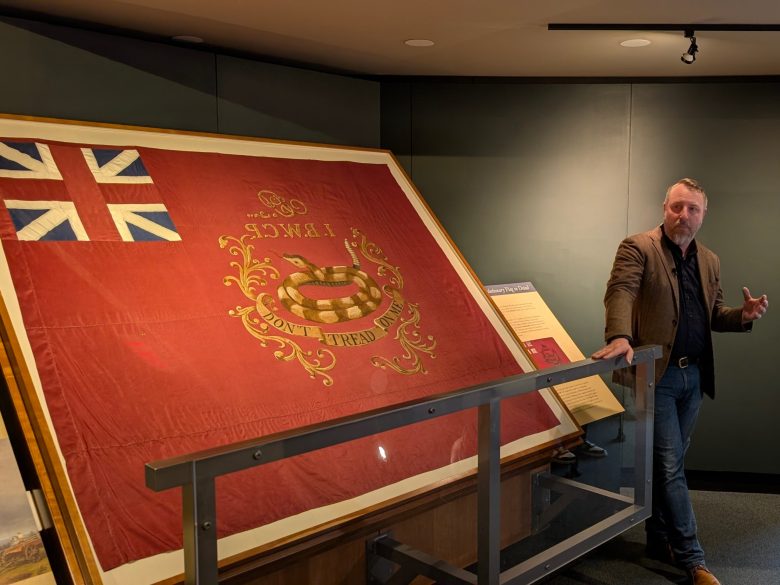 Mike Burke, assistant director of the Fort Pitt Museum, poses in front of the flag of Col. John Proctor’s 1st Battalion of Westmoreland County. The flag is one of the oldest Revolutionary War artifacts. Photo by Roman Hladio.
Sitting front and center in the exhibit’s entryway is the flag of Col. John Proctor’s 1st Battalion of Westmoreland County from 1775 — one of the rarest local American Revolution artifacts. Its main body displays a rattlesnake and the revolutionary slogan “Don’t tread on me,” but it also has a Union Jack in the upper-left corner — a stark reminder that the Battalion’s members were still British citizens at the time.
Burke says Proctor’s flag is displayed in the summer months — with a replica on display the rest of the year — due to light sensitivity.
On display for the first time are a trunk and tea canister belonging to John Boreman, a Revolutionary paymaster, which were donated by his descendants.
“The idea in the family story is that Boreman smuggled the currency … needed to pay the troops out here in this trunk and in this tea cannister, and he disguised himself as a peddler so he wouldn’t get robbed on the road out to Fort Pitt,” Burke says.
He adds that the Heinz History Center — the larger entity that the Fort Pitt Museum exists under — also owns Boreman’s account book, which reveals that Boreman would carry some $200,000 in cash to pay troops.
To Burke, some of the most impressive artifacts on display are from Hanna’s Town, which was the seat of Westmoreland County until it was destroyed by a Native and British force in 1782.
The objects were excavated from the former village grounds and maintained by the Westmoreland County Historical Society. Burke says they provide key insights into what life on the frontier was like.
“If you look at these objects, these are some of the things that people at Hanna’s Town had and used on a daily basis,” Burke says. “There’s export porcelain from China; there’s English creamware, tea sets, all sorts of domestic goods, glass bottles, table knives, combs and a variety of personal adornments.”
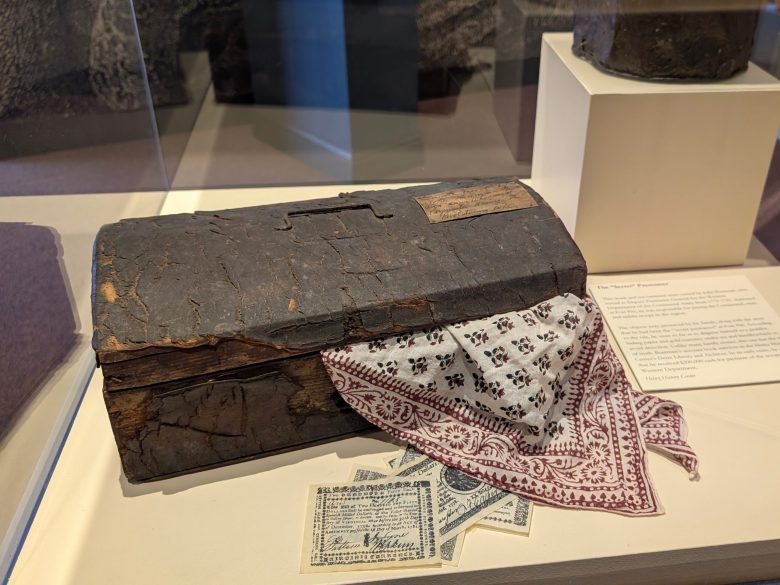 John Boreman, a paymaster, smuggled soldiers’ pay to them in this trunk and accompanying tea canister. According to associated documents, he carried as much as $200,000 at a time. Photo by Roman Hladio.
Burke adds that dozens of ornate buttons and cufflinks were found on-site as well.
“We think of, sometimes, the frontier as being this place where everyone’s clad in buckskins and rough-and-tumble,” he says. “Clearly, people in Hanna’s Town were not like that — they spent their money on luxury goods.”
While “Pittsburgh’s Revolution” opens amid a broader push to prepare for the country’s 250th anniversary this July, it’s designed to be a longstanding fixture of the Fort Pitt Museum — though the displayed artifacts may change in the future, museum officials say.