
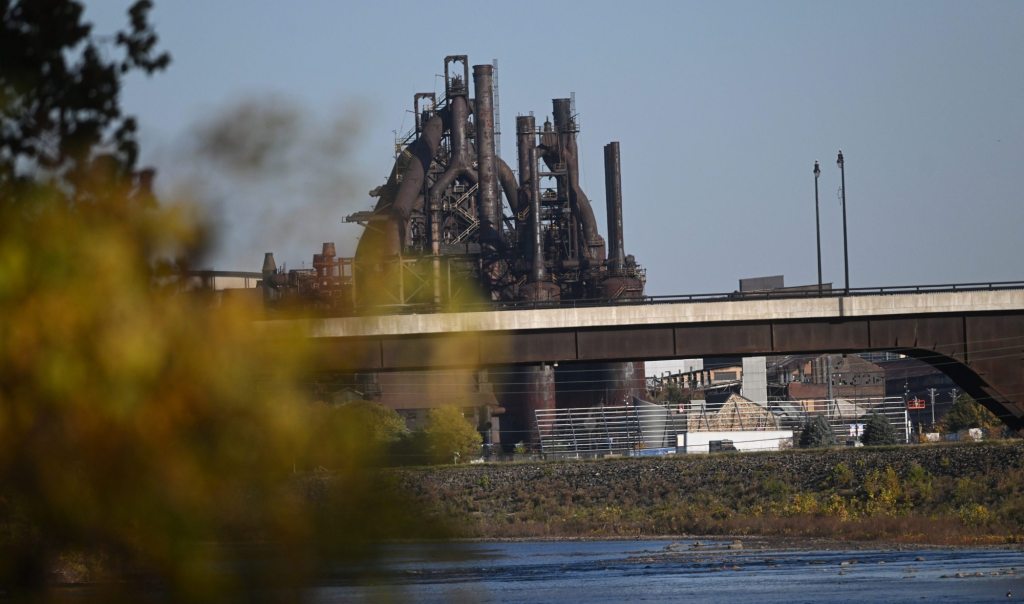
Journalists with the Financial Times, a London newspaper that covers global economics and politics, believe that Bethlehem can provide a window into the mood of Americans through Donald Trump’s turbulent second term in office.
Financial Times journalists will visit Pennsylvania’s seventh largest city throughout the next three years — at least through the end of Trump’s second term — as part of an in-depth reporting initiative called the “Bethlehem Project.”
Among the Financial Times’ global audience, interest in U.S. politics is at an all-time high as Trump’s attacks on Iran and threats to invade Greenland threaten to upend the international world order.
Financial Times journalists are honing in on reporting in the Lehigh Valley because voters in the region hold a disproportionate amount of power in a swing congressional district in a swing state. How those voters feel about the economy, Trump’s performance and other major developments can provide a crucial key into how future elections play out, the Financial Times believes.
Northampton County is one of few “bellwether” counties in the United States — its voters have voted for the presidential winner in every election except for three in the last 115 years.
“Everybody in our readership is now fixated on America, and what’s going on in America. I mean, that’s true for the BBC, it’s true for the times of London, of the New York Times, everybody’s fixated on this one story in America,” Derek Brower, U.S. news editor at the Financial Times, said in an interview with The Morning Call. “People are fixated on this, and so they want to know about what’s going on in America. But they also don’t want — I strongly believe this — they don’t want just to be told what Donald Trump has just put on Truth Social all the time. They want something to understand what is going on in the world’s most important democracy and most important economy.”
Editors at the Financial Times began the project because they were looking to understand “the mood of the American people” during Trump’s consequential second term as president.
Bethlehem fit several criteria editors were looking for when scoping an area in the United States to base its in-depth, interview-focused reporting: It’s in a swing state, has a diverse population, and is part of a mid-sized region that is “big enough for us to have stories to write, but small enough for us to get a handle of,” Brower said.
The project already has produced several pieces on Bethlehem, including stories that explore the decline of the local manufacturing industry, rising inflation putting a strain on local consumers, and a high-profile ICE raid in Bethlehem that resulted in the arrest of 17 construction workers.
Brower has said the response from the Financial Times audience, which is a global, largely educated group, has exceeded his expectations.
“The number of views in the stories and the engagement with them is above the benchmark for equivalent stories in that area of the paper,” Brower said.
The goal is for Financial Times journalists to feel like a part of the Lehigh Valley community, Brower said. Though the newspaper does not have an office in the area — the closest is in New York City — journalists spend at least several days at a time reporting on the ground in the area, looking to go beyond “parachute” journalism, a term for when journalists drop into an unfamiliar area for a breaking news story without plans for further follow up.
“I am hopeful that the extensive and nuanced reporting the Financial Times is doing will allow people to understand the depth of the challenges that our country is facing, and that the only way for us to make progress is for us to come together in a way that rejects a lot of our individualistic impulses about how these problems can be solved,” said Bethlehem Mayor J. William Reynolds, who told The Morning Call he has been interviewed at least four times already by Financial Times journalists as part of the project.
Plans for the project include an in-depth look at the impact of data centers on the region, and increasing its presence and reporting in the Bethlehem area during and leading up to the midterm elections in November.
The outcome of the project has only further confirmed Brower’s hunch that Bethlehem can serve as a “macrocosm” of the country with an abundance of stories relevant to the Financial Times’ international audience.
“What has been the outcome so far of the reporting we’ve done, is that it confirms that this is frankly a great macrocosm of the country,” Brower said. “And there’s just a wealth of stories. … As soon as you start diving into something, you start understanding and caring about where that story goes, you find new leads, and you find new angles, and — everything always becomes richer and richer, and that is the entire point of the project, is to just to follow our nose, be led by people, come listen to what they have to say, write it down, tell our readers about it.”
Reporter Lindsay Weber can be reached at Liweber@mcall.com.