
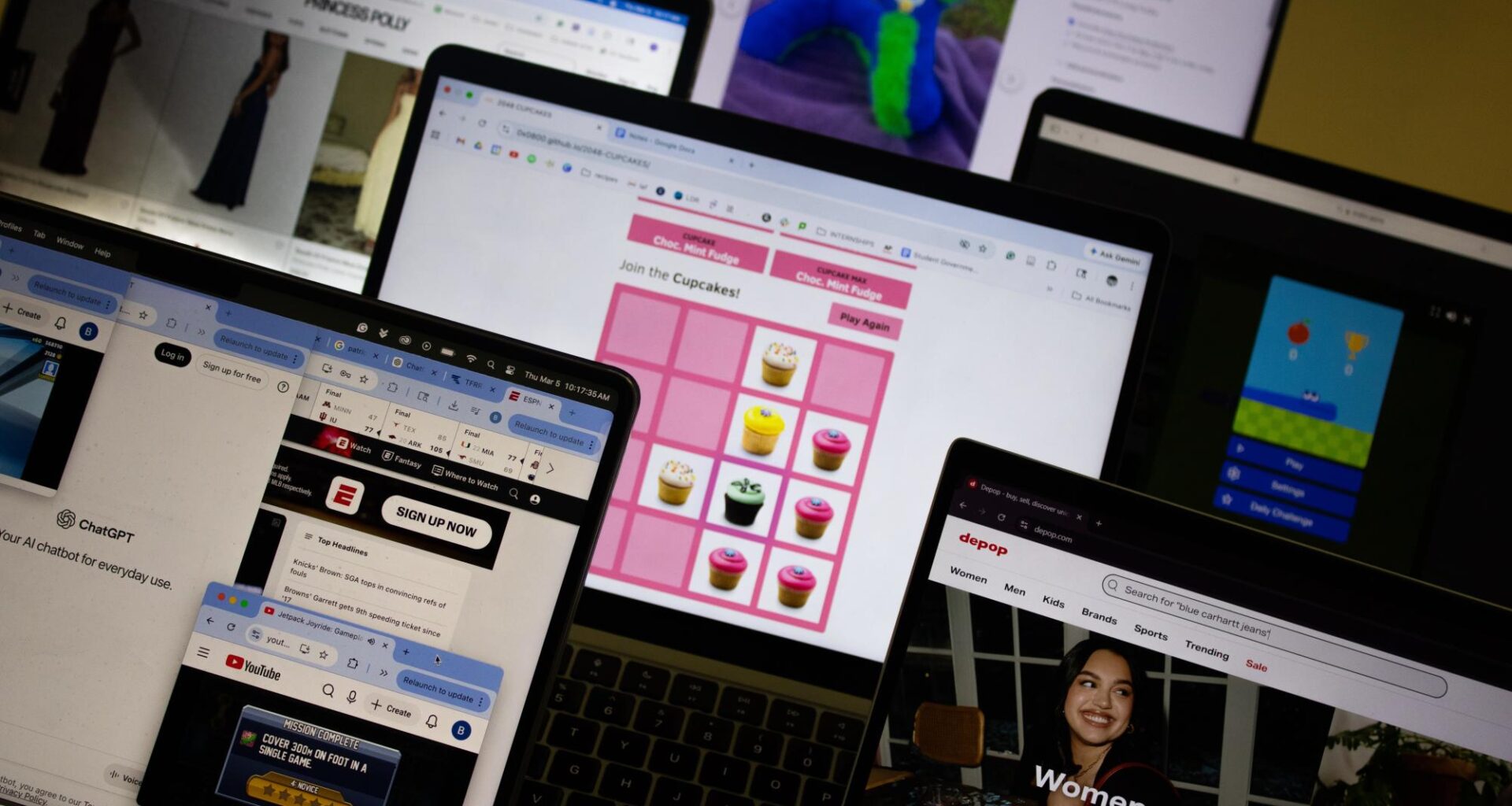
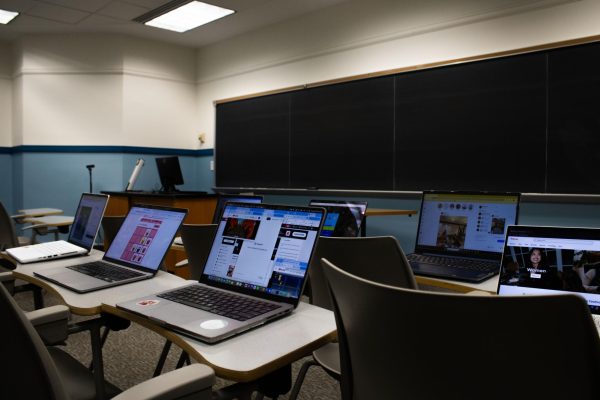
 Some Lafayette College professors have implemented a no-laptop policy. (Photo by Selma O’Malley)
You’re on your laptop in your 8 a.m. class, trying to take notes and resist the temptation to switch tabs to check your spot in the Ticketmaster queue. But the person on your right has been shopping for a formal dress. The person on your left is looking at stocks. In front of you, you can only see screens filled with games and social media.
In an age of ubiquitous technology and artificial intelligence, Lafayette College’s students and professors are navigating the best ways to teach and learn. While the next generation of students has a reputation for short attention spans, professors expressed understanding with the constant presence of technology.
“There’s a whole world in there,” said Julia Nicodemus, an engineering studies professor. “It’s a very distracting world, and it’s easy to get sucked into if you haven’t put it away.”
Some professors have gone Luddite in the classroom as a remedy.
“The quality of discussion has been so much better since I forced everybody to just put phones and computers away,” neuroscience professor Henry Hallock said.
Economics professor Michael Carter said that he has a “no laptops” policy, citing a study that associates laptop use in the classroom with a GPA decline. He cited his in-class oral exams that mimic and prepare students for an interview.
“As we’re moving into this world of AI, there’s a little bit of the question of ‘What is college doing for us?’” Carter said.
To cope with AI use and constant distractions, many professors have adjusted their assignment and grading systems.
“I think that what is being eroded is the opportunity to focus on things that might have delayed gratification or might take longer or might feel more challenging,” Hallock said about the student use of AI.
Theater professor Courtney Ryan uses an effort-based grading system for students “to get them to continue to buy into the idea of creating original ideas and art themselves.”
Ryan doesn’t allow AI use in the classroom.
“It’s a writing and art class, and we have this privilege and this space to create art and ideas together and we don’t want to rob ourselves of that opportunity,” she said.
“I think what a liberal arts college can do is teach us how to think and teach us how to learn, teach us how to access new information, connect things,” Nicodemus said.
History professor Paul Barclay said that he was able to focus better when he was a student because before technology, “I didn’t have options.”
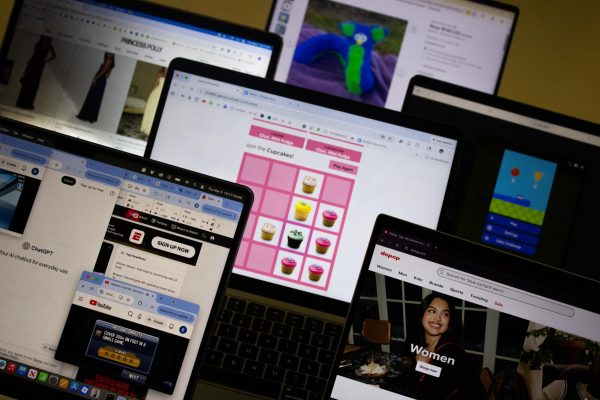 Many faculty find classroom use of potentially distracting technology to be unavoidable. (Photo by Elisabeth Seidel)
“So when I’m talking to my students, I’ll say, look, I would go buy a record at the record store, put it on a turntable and listen to the whole thing, and then listen to it again, and call my friends, and we would listen to it again,” he said.
Computer science professor Christian Lopez Benscome said that due to the “technical” nature of many of his classes, students have their computers “constantly open to work on activities.”
“From time to time, I say, ‘OK, close your computers so we can discuss and get sharing,’” he added.
In the absence of “spending five years in the woods, just staring at trees,” or moving to “a monastery and just focusing on making pebble art,” Hallock suggested students work on improving their attention span by putting themselves into situations where they can think deeply.
“I mean, to me, that makes logical sense,” Hallock continued. “It’s the opposite of the thing that shortens your attention span, right?”
Even with the challenges presented by technology distracting students and tempting them to take shortcuts or cheat, professors remain undeterred.
“I want to keep evolving to meet the moment,” Ryan said.
Sara Feinseth ‘27 and Elisabeth Seidel ‘26 contributed reporting.