
Where others see dead ends, Mekia Elizabeth sees possibilities.
An undeveloped plot of land in her Southwest Germantown neighborhood? That would be the perfect place for a fruit and vegetable garden. A rarely used and run-down parish house? Let’s make that a community clubhouse and safe afterschool space. The front porch of her own home? Why not set up a mini coffee shop and hire local kids to staff it?
“When I go to a place and I see nothing, I envision what it could be,” says Elizabeth, 37, (whose legal surname is Matthews, but prefers to use Elizabeth as her last name, she says, in honor of her grandmother Elizabeth and other “women who carried and shaped me”). The visionary believes her former career as an event planner helps her see the potential in places and people. “That’s my gift.”
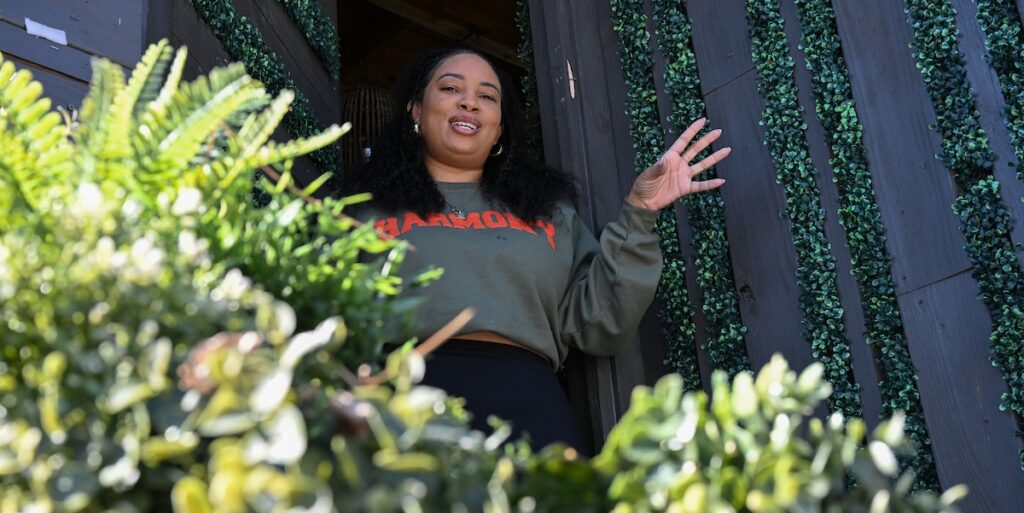 Mekia Elizabeth. Photo by Sabina Louise Pierce.
Elizabeth’s enthusiasm is infectious: In the six years she’s spent building a small village within a bustling city, she’s inspired dozens of dedicated neighbors to work to overcome problems that can stem from race, age, or income differences. Hers is a neighborhood where teenagers once viewed as potential troublemakers now organize all-ages summer events, and long-time residents who previously felt sidelined now showcase dormant skills.
“People learn each others’ names. Families who never cross paths feel like they belong. They see kids once labeled as ‘bad’ running popcorn machines and serving cotton candy and hot dogs,” Elizabeth says. “Our work doesn’t just give us new experiences. It gives us new eyes and new hearts.”
For all she does, and all she’s planning to do in the future, The Philadelphia Citizen is honoring Elizabeth with its Block Captain of the Year award. She will be honored alongside her fellow Citizens of the Year at a dinner celebration on April 22, at Fitler Club Ballroom. (You can read about all of this year’s winners here, and find out about tickets and sponsorships for the star-studded event here.) The modest honoree says the recognition gives her the opportunity “to tell the story of what’s happening here, because what’s unfolding on our block and in our neighborhood is a miracle.”
“I’m not surprised that my neighbors, roughly 50 years old, are helping. I’m always surprised by the 17- to 19-year-olds.” — Neighbor Steve Hoke
An unexpected pandemic silver lining
Elizabeth’s life was very different before the pandemic.
An event planner, she and her longtime partner Raheim Brown, an educator, were raising her then-preteen twin daughters and focused, as most busy people are, on their family responsibilities, not the betterment of the community at large.
Then Elizabeth inherited her childhood home on the 4500 block of Fernhill Road. The family moved into the house with the plan to sell or rent it. Neither she nor Brown had a desire to resettle in the neighborhood where they’d both been raised.
“Life on the block was … kinda messy, honestly,” she says. “It felt fragmented: lots of litter and trash on the sidewalks, zero gardens, broken concrete, homes in need of TLC, overgrown invasives, territorial neighbors who put chairs in parking spots, kids screaming or fighting, public alcohol and cannabis consumption. It wasn’t unsafe if you minded your business, but there definitely wasn’t a sense of a shared purpose, little warmth, and it felt like everyone was just kind of getting through each day.”
Covid-19 changed their plans. That’s when the pay-what-you-wish café was one of Elizabeth’s first neighborhood projects. Because of health protocols, people were limiting their contact with others, leaving many feeling isolated. Elizabeth thought that establishing an outdoor neighborhood gathering spot with simple beverages available in a self-serve format would help neighbors connect. Nothing fancy — a kettle and a burner and other basic supplies were the only things needed to launch the idea — and nothing permanent.
So that’s what she started. On her own front porch. “Our goal was that neighbors would get to know each other, just know the names of people on the block, just say hi,” Elizabeth says.
Then, like many of her ideas, the project snowballed. It started simply but soon grew into something much larger and more significant with an impact she could never have imagined.
Neighbors started making porch visits a part of their routines. Elizabeth’s twins, Eva and Nya, now 19, decided to put time spent watching baking shows to good use and tried their hands at making cookies and cake pops. The idea for a “pay what you wish” café was born. One neighbor, a handyman known as Big Al, offered to help build what Elizabeth calls an “IKEA-style outdoor kitchen on the patio” in exchange for treats and a place to watch “The Young and the Restless.”
“It was an act of bravery for people to share what they had and to trust that they’d still have enough.” — Mekia Elizabeth
”As we learned each others’ names, we started learning each others’ stories,” Elizabeth says. “It’s a really diverse neighborhood, economically, racially, culturally, and there were people three blocks over who might never have interacted before. We started to see magic happening and people connecting.”
Others soon wanted to join the project. Someone donated a toaster oven. Some provided cups; others donated saucers. A few offered favorite recipes, while others provided baked goods.
“People were practicing sharing. At one point, we had to turn things away because we were just getting too many things, but that was also exciting because I’d never seen such community,” Elizabeth recalls.
The generous giving was particularly noticeable during a time of crisis.
“It’s not like this was a bunch of people who had extra money to throw around,” Elizabeth says. “It was an act of bravery for people to share what they had and to trust that they’d still have enough.”
Neighbor Julie Hoke first learned about the café when she met Elizabeth. Having a front porch of her own, she had a difficult time imagining the setup at Elizabeth’s and Brown’s house.
“I walked over there and I remember being totally stunned at how beautiful it was,” Hoke says. “I was just inspired. I was like, ‘Tell me, how did this happen?’ And she told me who did the electricity and who built the floor and who would come by to get a coffee or whatever, and it was so fun to meet the people that helped build it.”
The name of the café, fittingly, is St. Harmony Café. Despite the word “saint” in the name, the program isn’t affiliated with a specific religious denomination. Instead, the word reinforces that this is a sacred space for the community, a place where “we celebrate diversity and take great pride in having neighbors of many religious backgrounds doing life together,” Elizabeth says.
Harmony is one of Elizabeth’s favorite words.
“I’d been hoping to help people reach a common ground, where we could see each other more fully and have more harmony with each other,” she says. “It wasn’t about making everybody want one particular thing. It was seeing value in each other.”
She never imagined that a neighbor with restaurant experience would come forward to provide free training to aspiring baristas, or that these busy young people would give their time to serve others for little more than a free sweet treat or other small reward. The “pay what you wish” system soon followed, with the collected funds going towards other community projects. The café was so successful that they were able to help one hardworking barista with a $2,500 college scholarship.
Elizabeth definitely never imagined that, years after its launch, the café and “café life” would still be flourishing and, in fact, growing. Most recently, local teens have begun performing for café-goers.
“When I saw how the community could come together, I knew this is what I was supposed to do,” Elizabeth says.
“She’s constantly building connections, plugging people in, hearing what they care about and what their vision is, and seeing how we can help each other and do it together.” — Neighbor Julie Hoke
Taking pride in the park
The pandemic also prompted Elizabeth to consider how the community could improve its relationship with Fernhill Park, an appreciated but perhaps underused resource. Hoke says Elizabeth joined the Friends group — she’s now co-chair — and brought with her “a lot of energy and momentum and ideas that I don’t think would have occurred to me. She’s constantly building connections, plugging people in, hearing what they care about and what their vision is, and seeing how we can help each other and do it together.”
Among the ideas she brought to Fernhill, in 2022: planting a fruit and vegetable garden, even though “none of us knew what we were doing,” Elizabeth says. “We didn’t even have water.”
Then the pastor of nearby New Hope Temple Baptist Church — “Someone I knew only to say ‘hi’ and ‘bye’ to,” Elizabeth says — asked her if she’d thought about establishing an after-school program, and offered free use of the church’s parish house.
“He gives me the keys and says, ‘I just feel called to give this to you,’” she says. “And I’m like, ‘OK, now there’s an afterschool club in the parish house.’”
The snowball effect that had engulfed the café? It came rolling around for the afterschool program, too.
“Someone says, ‘I’ll tutor’ and someone else says, ‘Oh, I’ll make lunch for the kids,’ and it turned into a thing. One neighbor makes tacos for 40 kids every Tuesday, paying for all of the supplies and bringing it over and we serve it!” Elizabeth says. “We have a professional animator in the neighborhood, so now we have an animation club. We have professional dancers, so we have a dance club. These people don’t have children who are this age. They’re doing it for the future of our community.”
Navigating challenges
Of course, while it all seems seamless now, change hasn’t been easy.
One of Elizabeth’s other early initiatives was spearheading her block’s inclusion in Playstreets, a well-established Philadelphia Parks and Rec program that allows residents to shut down roads during certain hours during summer months to provide safe spaces for children to play. Also, the City provides food for participants, especially important for those who get the bulk of their nutrition from school-funded meals.
Elizabeth felt in over her head, Brown recalls. After long hours supervising children at play, she would come home, in tears, exhausted, and take to her bed, saying, “What have I gotten into?”
But others never saw those doubts, he says.
“The next day, it was like she was never crying the day before. She’s out there running around, having a water balloon fight with the kids, doing everything she can to make things work,” he says. “You would never have known she’d had a bad day. She just came up with a solution for what had happened. It’s like nothing stops her.”
“Rupture is the precursor to repair, and repair is where the transformation lives.” — Mekia Elizabeth
Still, Elizabeth remembers one early incident that she says nearly broke her.
With the afterschool program established, she and a group of young people decorated the block with Halloween décor, and neighbors agreed to hand out candy. One resident put full-size candy bars in a basket so trick-or-treaters could help themselves.
One young participant took one candy bar for himself — and then everyone else’s. He emptied the basket, which led to an altercation with another youth. Elizabeth says she went home that night and wept.
“I felt deep heartbreak, like maybe this ‘new way’ was wishful thinking,” she recalls.
Both children were told they could not participate in any neighborhood programs, even visiting the café, until they’d agreed to submit to an adult volunteer-led mediation process that would offer “support, accountability, and community care.”
The boys agreed. Apologies came next. Friendship followed. And the intervention did more than make peace between warring factions, Elizabeth says. It also introduced them and their peers to new ways of thinking and behaving.
“The child who acted from scarcity became a generous giver. The child who fought for justice learned self-control,” Elizabeth says. “That’s one of the moments that reminded me why we don’t give up at rupture. Rupture is the precursor to repair, and repair is where the transformation lives.”
Intergenerational bonds
Another unforeseen but appreciated development of Elizabeth’s efforts? The improved relationships between the generations.
“I’m surprised by how many high school kids and college-aged kids she gets to be involved in the parties in the park, running concessions, selling popcorn and other snacks, cleaning up, setting up and cleaning up,” says Steve Hoke, Julie’s husband and co-leader of the multi-generation, 12-person Fernhill Fam Band, which plays frequent summer park concerts. “Sometimes there will be a crew of young men I haven’t met yet, and they just walk over and say, ‘[Me]Kia sent me to do something. What am I supposed to do?’”
“I’m not surprised that my neighbors, roughly 50 years old, are helping,” Hoke adds. “I’m always surprised by the 17- to 19-year-olds.”
Among those dedicated helpers are the twins, Eva and Nyla, gifted musicians who give piano and violin lessons. The Hokes’ daughter, Alliyah, 17, is actively involved in the gardening program.
“It’s great that she gets to meet other adults (who) are not teachers in school. They’re just teachers by example,” Steve Hoke says.
Elizabeth and Brown recently took in two 18-year-old boys whose families were in “a season of transition,” as she describes it. The boys are co-captains of the Harmony Home Team, a club for those ages 7 to 18.
“Our boys are cutting grass, they’re planting trees, they’re seeding clover. They’re really the hands of what we’re doing because so many of the adults are working two jobs and don’t have the time or the energy,” Elizabeth says.
The boys are also respected by the younger club members. “They’re so cool, it’s like having our personal superstars,” Elizabeth says — so if an adult calls Elizabeth to say kids are fighting on their block, she can send one of these young leaders over “and they’ll have kids immediately picking up litter.”
For Elizabeth and her neighbors, taking care of their surroundings and each other has been life-changing. These successes can’t be credited to grants or donations. They’re possible because people are willing to give of themselves, their time and energy and their skills, while patiently waiting for positive change to take hold.
Says Elizabeth, “That’s what makes us a real village.”
 BLOCK CAPTAINS IN THE NEWS
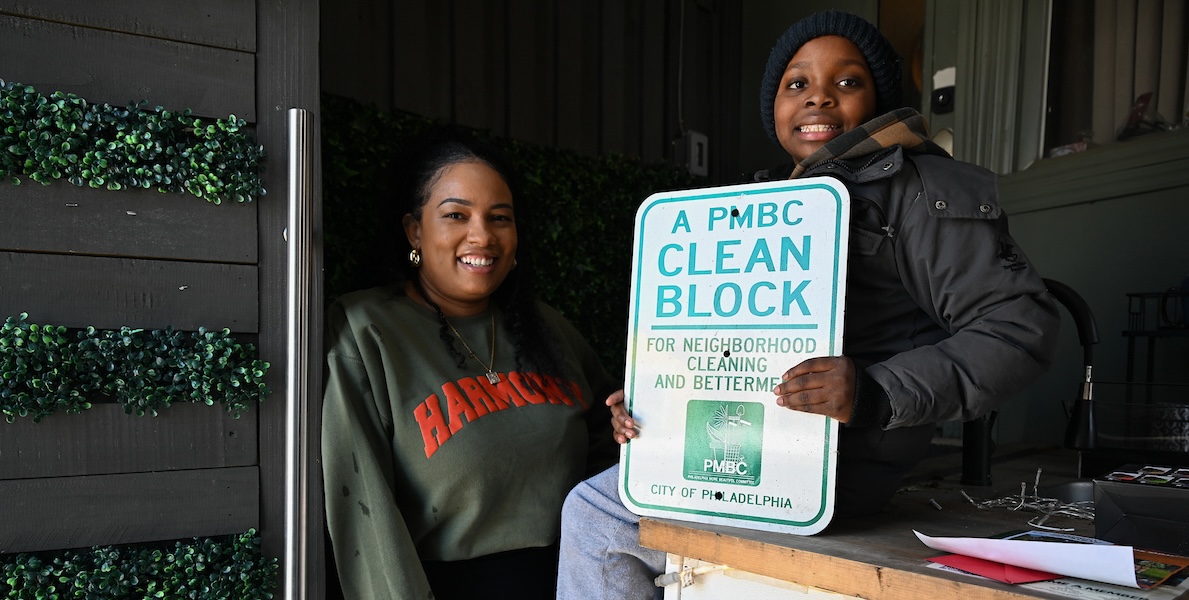
Mekia Elizabeth, Philadelphia Citizen Block Captain of the year, with her neighbor Sair Couch, 10. When a series of events brought her and her husband back to live in her childhood house, she fell in love with her Germantown neighborhood. Now, as co-Block Captain, she has converted her front porch into a cafe — staffed by the teens in her community — organizes community plantings and parties, cleanups and childcare, camps and gardens. “Kids learn the art of friendship on this block,” says Matthews. Photo by Sabina Louise Pierce/All rights reserved.