
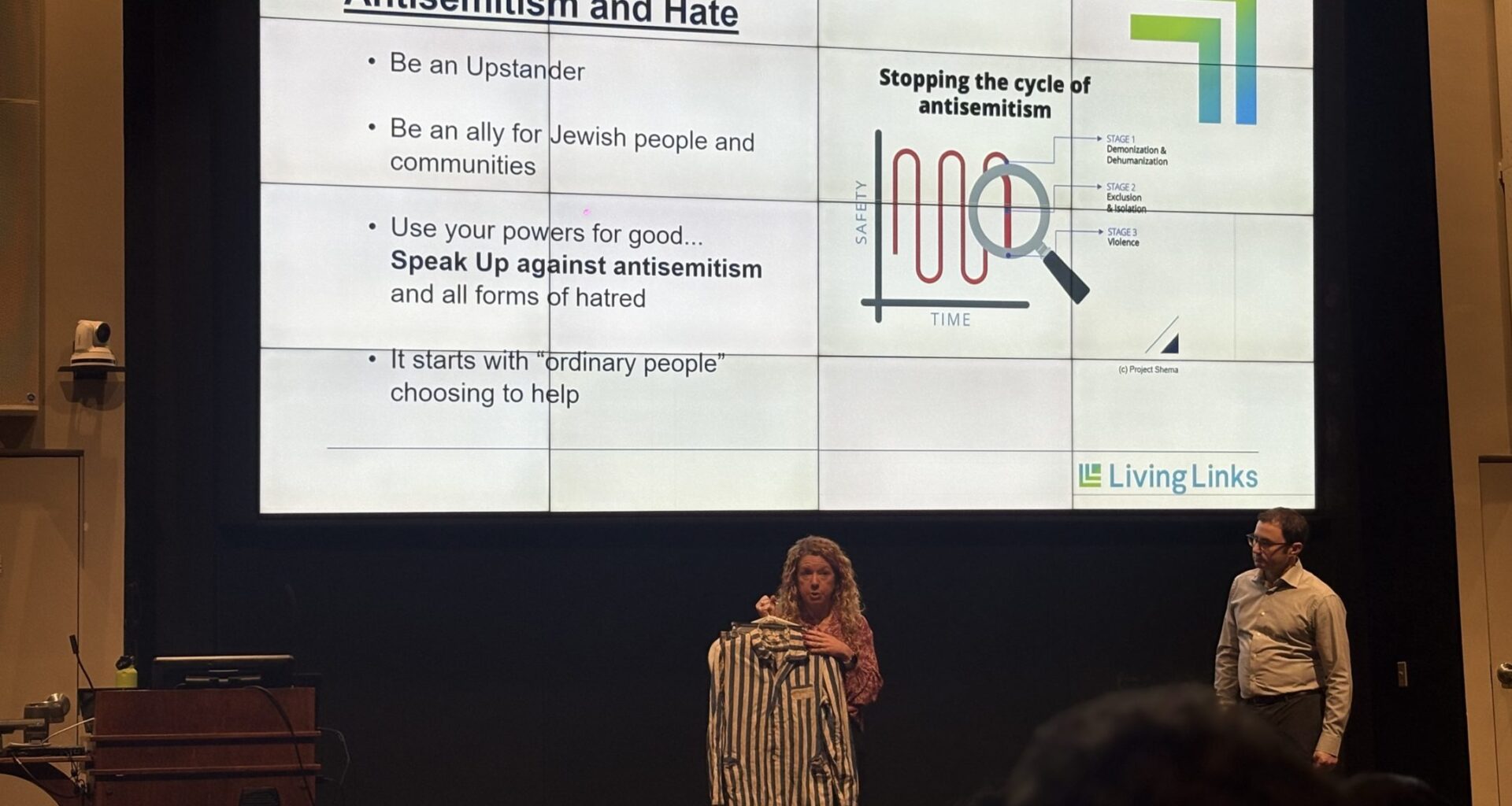
On Tuesday, the Interfraternity Council and Lehigh’s chapter of Alpha Epsilon Pi invited two members of Living Links to speak about the Holocaust and antisemitism. The event took place in Packard Hall and was hosted by Dave Wachs, ‘02, and Amy Goodman.
The presentation began with statistics assessing the level of knowledge and awareness U.S. millennials and Gen Z have about the Holocaust and antisemitism. Wachs said 59% of millennial and Gen Z Pennsylvanians aren’t aware that 6 million Jews were killed in the Holocaust. In some states, such as Arkansas, he said the number can be as high as 65%.
As a Lehigh Chi Phi alumnus, Wachs reminded the audience — made up of members of Lehigh’s fraternities — that antisemitism can occur anywhere, including college campuses and fraternities, which he described as a “hot-bed.” Jewish students make about 16% to 18% of the university’s student body.
Jacob Pesso, ‘29, attended the event with his fraternity, Delta Upsilon.
“Talking about antisemitism on campus is very important, because there’s a lot of Jewish people on campus,” Pesso said. “The antisemetic jokes (made) on campus can affect a lot of people.”
Pesso said during his short time at Lehigh, he’s witnessed few incidents of antisemitism and has generally found the student body to be welcoming toward Jewish students.
After Wachs’ brief introduction, Goodman stepped on stage to tell the story of her grandfather, Joseph Krosberg, a Jewish Holocaust survivor.
Goodman said her great-grandfather was a victim of antisemitism and was beaten to death for being Jewish while Krosberg’s mother, Shayndl Szabason, was pregnant with Krosberg in 1920. Struggling to make ends meet as a widowed mother, Goodman said Krosberg and his mother moved to Belgium for “better opportunities” in 1928.
In May 1940, the Nazis invaded Belgium. Krosberg was 19.
Goodman said Krosberg and Szabason attempted to flee to France shortly after the invasion, believing they would be safe from the Nazis. As the train approached the French border, police conducted passenger checks, and Goodman said her grandfather was pulled from the train car because of his Polish nationality. As a Pole, she said he was expected to serve in the Polish army.
She said her grandfather was taken to a “bunker warehouse,” where border police further assessed his documents. After a few days of being detained, she said authorities discovered he was Jewish and sent him to the Le Vernet Internment Camp in France.
Goodman said prisoners were bused from their barracks at Le Vernet to work at local factories. In July 1942, she said Nazis burst into the factory where Krosberg was working and forcibly returned him to the camp.
A few days later, he was sent to the Drancy Internment Camp in France. After three days at Drancy, Goodman said Krosberg was transported to the Auschwitz-Birkenau Concentration Camp.
Goodman said prisoners traveled for days in “cattle cars” packed so tightly that it was impossible to sit down. Around 150 people were squeezed into a single train car, she said, with many becoming sick from the lack of food and air.
“If the (prisoners) are sick, they’re right next to you,” Goodman said. “If they vomit, they’re vomiting all over you. If they need to go to the bathroom and there’s no bathroom, it’s all over you. It was a pretty horrific way to travel.”
Krosberg became a prisoner at Auschwitz-Birkenau on Aug. 14, 1942. Goodman said her grandfather described his first moments at the camp as pure terror and chaos.
“You’re coming off of three days of being on this train with no food, air, water and bathroom, and all of a sudden (the SS) are yelling at you in a language that most people didn’t know,” she said. “They were speaking German, and many of the (prisoners) were either French, Polish or other nationalities.”
Goodman said Krosberg was forced to work as a coal miner in the camp, which he described as a major safety hazard because he breathed harmful fumes for hours each day.
In an effort to demonstrate his work ethic to the soldiers, Goodman said Krosberg volunteered for extra tasks that were less labor intensive. She said he believed this would make the soldiers “value” him more and make them less likely to send him to be killed.
Goodman said Krosberg cleaned showers and soup kettles and washed uniforms for soldiers. She said he secured extra soap from the showers to keep himself clean and would scrape soup from the side of kettles before cleaning them to make an extra bowl for himself and a friend.
In December of 1944, Goodman said her grandfather became very ill. His life was spared, she said, because he was known as a hard worker. She added that most prisoners who became sick were usually killed or left to die.
“(Krosberg’s) friends told the guard who’s in charge of the showers that my grandpa was in the infirmary, and that guard went to the infirmary and vouched for my grandpa,” she said. “He said, ‘Do not send him to be killed, he’s coming back to the camp.’”
Shortly after Krosberg recovered from his illness, Russian forces began closing in on the Nazis and liberated the camp on Jan. 27, 1945. Following his liberation, Goodman said her grandfather traveled with the Red Army for several months before returning to Belgium later that year.
When Krosberg arrived, Goodman said his uncle, Avrum, was waiting for him at the train station. She said trains carrying refugees who’d survived the war continued to arrive at the station, as family members waited in hopes of recognizing loved ones. When Krosberg stepped off the train, he asked where his mother was, and Avrum told him he believed she would arrive on one of the many trains still coming.
Goodman said Szabason never arrived.
She said Krosberg spent the rest of his life trying to discover what happened to his mother but was never successful. Goodman said she continues to search for information about her great-grandmother and hopes to one day learn what happened to her during the war.
“There’s new documents that are being translated all the time, and I’m hopeful that someday we’ll get some confirmation,” Goodman said. “It is believed that (Szabason) was sent to Auschwitz and perished there.”
After returning to Belgium, Goodman said Krosberg moved in with his uncle. After meeting his wife, he moved to Sosúa, Dominican Republic, in 1952 as a political refugee. In 1958, he immigrated to New York City.
He spent the rest of his life in the U.S. publicly sharing his story, speaking at antisemitism awareness events and classrooms before passing away in 2004.
After Goodman concluded her grandfather’s story, Wachs said sharing stories like Krosberg’s is one of the most effective ways to raise awareness about the Holocaust. He said it can also help combat antisemitism, as many don’t understand the true scale of atrocities committed.
Referring to Krosberg’s story, Wachs said prisoners were stripped of their individual identities when their clothes and belongings were taken from them. He said this dehumanized and isolated Jewish prisoners, making them easier targets for violence and hatred.
“Isolated Jews can be targeted with violence,” Wachs said. “This can be carried out by governments and/or by individual and small groups.”
Wachs said the cycle of dehumanizing Jewish people continues today, citing the 2017 Charlottesville Chant, “Jews will not replace us.”
He also expressed concern about the rise in antisemitism following the Israel-Palestine conflict, arguing that Jewish people are sometimes blamed for the actions of the Israeli government despite their personal beliefs.
“Just because you are Jewish or Israeli, doesn’t mean you adhere to the policies of the Israeli government, just as you may not agree with policies of the U.S. government, and (shouldn’t) go after all U.S. (citizens),” he said.
To conclude the event, Goodman emphasized the importance of brotherhood to the fraternities in attendance, encouraging them to stand up to antisemitism and support their friends.
“There’s a reason I came and told you (Krosberg’s) story, and the reason I came to tell you the story is because we’re trying to stop the (antisemitism) cycle, which ultimately leads to violence,” she said. “Identify when there’s problematic concerns before they lead to violence. Be an up-stander.”