
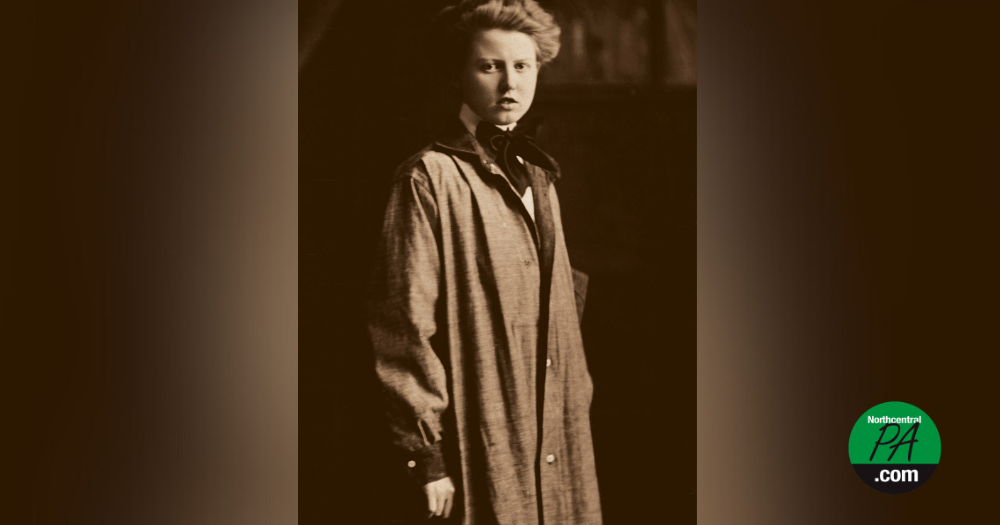
Bellefonte, Pa. — Born on May 24, 1889, Anna Wagner Keichline was the first female to be registered as an architect in the state of Pennsylvania.
That, in itself, is impressive. Still, it’s far from her only achievement. It’s not even the top of the list. Once you start learning about Anna Keichline, it becomes a rabbit hole of amazing achievements.
Anna was born in Bellefonte, the youngest of four children born to John and Sarah Keichline. As she grew up, she expressed an interest in building, and her parents gave her a workshop and some carpentry tools. She used these to make some furniture, and displayed talent at it.
At 14, she won a prize at a county fair for a table and chest she had made, and was interviewed by a local newspaper. She informed him that she wanted to go into industrial design — never mind that most women didn’t work outside the home at that time. Anna knew what she was going to do with her life.
She attended Penn State for a year, studying mechanical engineering, and then went to Cornell University. She graduated in 1911, and was the fifth female there to receive a degree in architecture. She became the first woman in Pennsylvania to be licensed and registered as an architect.
In addition to designing houses, in which she was known for creating convenient and user-friendly kitchens, Anna invented her own products. She became the holder of seven patents.
“Modern ways of housekeeping require modern construction,” she said in a 1929 newspaper interview.
The most notable of her patents was for the K-brick, a sort of lightweight and versatile brick that was hollow and could be more easily used. This became the predecessor to today’s cinder blocks.

Bald Eagle and Nittany Valley Presbyterian Church in Mill Hall, Clinton County
She designed and built the Bald Eagle and Nittany Valley Presbyterian Church in Mill Hall, Clinton County. This church was completed in 1915 and was considered architecturally notable for its time. It was a gothic revival style building, notable for its kitchen designed for large events and the truss effect of the sanctuary.
But architecture wasn’t the only thing she did with her life. Anna was involved in the suffragette movement, campaigning to get women the right to vote. She had her own car, which was a bit different for women at that time; most of the cars were owned by males. Anna was a delegate to a conference during the Hoover administration, providing her input and expertise.
During World War I, she joined the war effort, becoming a special agent with military intelligence, a position she requested.
She applied and asked for a field job, stating on her application, ”The above might suggest a drafting or office job, but if you should deem it advisable to give me something more difficult or as I wish to say more dangerous, I should much prefer it.”
She served in this capacity during the war, receiving complimentary letters from her superiors.
A historic marker to Anna stands in Bellefonte outside the Plaza Theater, which she designed. Anna died at 53 on Feb. 5, 1943, and was buried in Union Cemetery in Bellefonte.
Her influence is still felt in architecture throughout the country. If you spend any time in buildings at all, ever, it’s likely that you owe a debt to Anna Wagner Keichline and her work.
Success! An email has been sent to with a link to confirm list signup.
Error! There was an error processing your request.
Get Our Free Newsletters
Never miss a headline with NorthcentralPa.com newsletters.
Sign Up Today!
Morning Headlines: Would you like to receive our daily morning newsletter?
Afternoon Update: What’s happening today? Here’s your update!
Daily Obits: Get a daily list straight to your email inbox.
Keep your news local
Access to independent, local news is important, do you agree?
We work hard to deliver timely, relevant news, for free. 100% of your contribution to NorthcentralPa.com goes directly to helping us cover news and events in the region.
Thank you for saying that local news matters!