
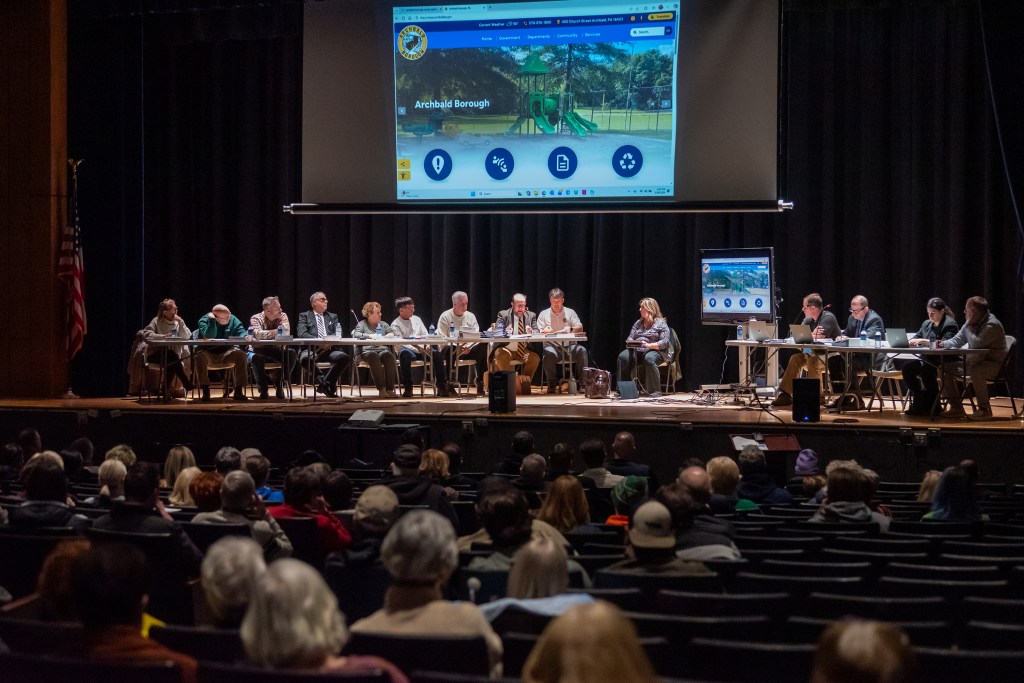
Public hearings will continue throughout March to address data centers in the Midvalley as developers look to build a dozen data centers in Olyphant and seven more in Archbald.
Archbald will hold a public hearing March 19 at 5 p.m. in the Valley View High School auditorium, 1 Columbus Drive, to consider a conditional use application for the “Project Green” data center campus, which seeks to build seven data centers at the Stavola Quarry off the Casey Highway. Project Green is the sixth data center project proposed in Archbald and would use Salem Road for ingress and egress.
Less than two weeks later, Olyphant will hold a public hearing March 31 at 6:30 p.m. in the Olyphant Borough Municipal Building, 113 Willow Ave., to listen to testimony on a zoning amendment regulating data centers. Council could then consider voting on the ordinance during its April 14 meeting at 7 p.m. in the Municipal Building.
Both municipalities scheduled the hearings via public notices published Tuesday in The Times-Tribune.
Although Olyphant has not yet received any applications for data centers, the borough has received interest for a developer to build 12 of them at the Triboro Industrial Park, solicitor and borough Manager C.J. Mustacchio said Thursday.
The industrial park, which is surrounded by the Casey Highway, Route 247 and Marshwood Road, was previously slated for four warehouses, each more than 1 million square feet.
It is now at least the 12th data center project sought in Lackawanna County, with other proposals in Archbald, Clifton and Covington townships, Dickson City, Jessup and Ransom Twp.
Depending on the crowd size during its March 31 hearing, Olyphant already reserved space in the Mid Valley High School auditorium if needed for subsequent hearings, Mustacchio said.
Archbald will also hold its second public hearing for the Wildcat Ridge Data Center Campus on Tuesday at 5 p.m. at the Valley View High School auditorium. Wildcat Ridge applied with the borough to build 14 data centers across 574.2 mountainside acres above Business Route 6 and extending up Route 247, or Wildcat Road. It would use up to 3.3 million gallons of water per day and 1.6 gigawatts of power.
Olyphant
Municipalities in Pennsylvania must allow for every type of lawful land use somewhere within their borders, or else they expose themselves to zoning challenges if they are exclusionary to a use, like data centers.
Olyphant’s proposed zoning ordinance defines data centers and associated uses while restricting them as conditional uses in the borough’s “large scale mixed commercial/manufacturing district,” or CM-2 zone. The CM-2 district encompasses land south and east of the Casey Highway opposite most of the town. The district includes the Triboro Industrial Park.
Missouri-based real estate firm Sansone Group spent $80 million since June purchasing the four lots from Triboro, whose managing member is Charles DeNaples, the son of Keystone Sanitary Landfill co-owner Dominick DeNaples. Sansone now advertises the property under the Triboro Industrial Park branding.
The zoning district is for Olyphant’s heaviest industrial uses, Mustacchio said. The nearest residential area is about 1,000 feet away, but that was an existing, nonconforming use, he said. The nearest actual residential zoning district is 1.5 miles from the site, which was a major consideration for the borough, Mustacchio said.
“We thought it was most important to isolate it, because when you’re talking about effects, you’re really talking about effects on residential areas … schools, hospitals, things like that,” he said. “The CM-2 zone that we have is really a great distance away from any of those.”
As conditional uses, data centers in Olyphant would be required to adhere to a slew of conditions outlined in Olyphant’s draft ordinance, and to move forward, projects will need approval from borough council following a public hearing.
Prior to holding any hearing, Olyphant’s proposed ordinance requires developers to submit a preliminary sound impact analysis, an environmental impact analysis and a community impact analysis.
Those preliminary reports must include:
• A narrative of the on-site activities and operations, including the market area served by the facility, hours of operation and total employees per shift.
• A site plan indicating proposed improvements, flood plains, wetlands, waterways, and cultural and historic resources on the property or within 500 feet of its boundaries.
• An evaluation of potential positive and negative impacts from the data centers, including on emergency services and fire protection, water supply, sewage and solid waste disposal, school facilities and school district budgets, municipal revenues and expenses.
• Environmental impacts, including odor, noise, smoke, dust, litter, glare, vibration, electrical disturbance, wastewater and stormwater, with specific measures employed to mitigate any negative impacts.
The ordinance would limit data centers to 80 feet tall, and if a data center adjoins a residential area, it must have a 200-foot setback from the property line.
Applicants would be required to submit an analysis of their raw water needs from private or public sources, and if the source is from a municipal system, they have to include documentation showing the utility can supply their water, according to the ordinance. If developers plan to use nonpublic water sources, they must submit a water feasibility study to determine if there is an adequate supply from existing wells.
“No Data Center shall be approved without sufficient water supply and no Data Center shall be approved that demonstrates the likelihood of adverse impacts on existing wells in the vicinity,” according to the ordinance.
On-site power generation is prohibited as the primary source of power for data centers, though the ordinance allows the use of backup generators during power outages, emergencies, and required testing and maintenance.
Data centers would be required to receive power from Olyphant Borough Electric, which is Olyphant’s own electric company, according to the ordinance.
The data centers would have to pay for all supply lines and electric substations to ensure capacity, along with reimbursing Olyphant for all expenses associated with providing power to the site.
Unlike other local municipalities, Olyphant and neighboring Blakely administer their own electricity.
Despite that, the ordinance still requires written verification from PPL Electric Utilities, which provides the service lines to Olyphant Borough Electric, showing PPL has adequate capacity. The verification would also have to document any known impacts on electricity rates or availability directly attributed to the data center project.
Other requirements in the draft legislation include an as-built sound study within six months of the data centers receiving an occupancy permit; requirements to provide any specialized equipment needed for first responders and to ensure there is adequate radio coverage within the buildings so emergency crews can communicate; architectural standards to address aesthetics; requirements for fencing and security standards; woodland standards like a minimum 50-foot woodland buffer; design specifications to minimize impacts on “sensitive receptors” like schools, day cares, places of worship, parks and playgrounds; and decommissioning/abandonment/removal stipulations.
Archbald
Project Green became Archbald’s latest proposed data center campus when the borough received a Jan. 26 conditional use application from Green Mountain 6 LLC, filed through a Pittsburgh law firm.
Green Mountain 6 wants to build seven two-story, 138,000-square-foot buildings with backup generator yards, a PPL-owned switchyard and a customer substation along an L-shaped piece of land immediately east of the Casey Highway and less than a mile south of Aylesworth Park. The buildings would be up to 65 feet tall, though they can be as tall as 90 feet, and there would be an estimated 28 generators per building, according to a preliminary sound study.
The data centers would be built on previously quarried land on a campus spanning 270.88 acres. Green Mountain 6 entered into a memorandum of purchase and sale agreement with the quarry owner, Stavola, on Sept. 3 to buy the land.
A preliminary sound study estimates there would be 40 air-cooled, roof-mounted cooling systems, or chillers, on top of each data center.
The application also includes a will-serve letter from Pennsylvania American Water, but the request isn’t for water to cool the data centers — just 14,000 gallons per day for domestic use, such as in sinks and toilets.
“It has not been determined whether water will be needed for cooling purposes or what quantities for that purpose will be requested. If water is needed for cooling purposes, it will be coordinated with PAWC,” according to the application. “If PAWC is unable to provide the requested demand, alternative measures will be pursued but does not include groundwater or surface water withdrawals.”
Little information is available on the developer, though the project has numerous similarities with the “Project Gravity” data center campus, which is proposed by data center developer Western Hospitality Partners.
Like Project Green, Project Gravity also wants to build seven two-story, 138,000-square-foot buildings, but between Business Route 6 and the Eynon Jermyn Road. Both projects use the same local engineering and law firms, and both registered their limited liability companies with the Pennsylvania Department of State using the same Colorado-based law firm.
The company behind Project Gravity, Western Hospitality Partners, operating as Archbald 25 Developer LLC, has explored data centers in Kentucky, Illinois and Indiana.
Archbald has so far held initial public hearings for two other data center projects. If Project Green’s hearing follows similar pacing, it will likely be the first of multiple hearings in the coming months.