
Love Philly? So do we. Let’s be friends. The Billy Penn newsletter keeps you informed about everything Philly, with a quirky vibe of healthy skepticism and persistent optimism. Join us and sign up today.
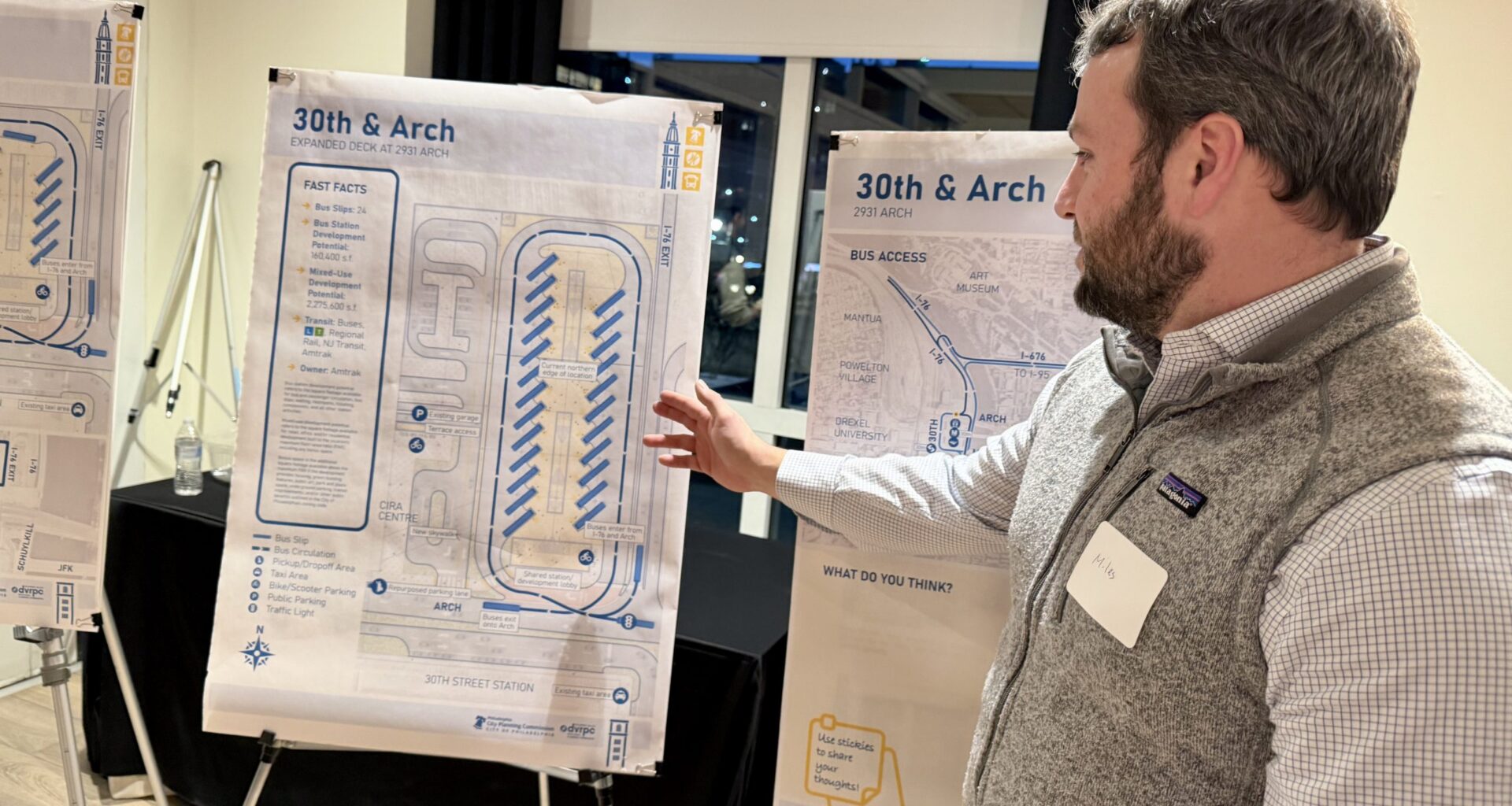
The city’s recent open house on where Philadelphia should build a permanent intercity bus station generated substantial interest, as well as follow-up questions and comments about the site options.
The Department of Planning and Development has narrowed its top choices down to three properties; they’re near Amtrak’s 30th Street Station, at 15th and Vine streets, and at 8th and Arch streets. The city is soliciting feedback via public meetings, an online survey and emailed comments.
After the Feb. 25 open house, Billy Penn and our readers had a few questions.
Why not permanently run buses through the former Greyhound station on Filbert Street, which the city is reactivating on a long-term temporary basis starting in May? Are planners aware of potential problems with the 8th and Arch site? What does Amtrak think of building a station over active train tracks?
The project is still in a very early stage, and definitive answers aren’t available to most questions. But we were able to get a little information about some of them.
Ruling out a permanent Filbert Street station
The bus terminal scramble began in June 2023, when Greyhound vacated the station on Filbert between 10th and 11th that it had occupied for 36 years. Since then carriers have been doing all their pickups outdoors, from sidewalk curbs, drawing complaints from neighbors and passengers.
As this summer’s FIFA World Cup games, America250 celebrations, and other events approached, the city and the Philadelphia Parking Authority decided to give the expected surge of visitors a more welcoming travel experience by reopening the old station building.
The city is leasing the Filbert Street property for 10 years, with an option extend the deal for an additional 5 years. But it can’t lease it any longer than that, or buy the building, a planner for the city said at the open house.
Why is that?
I’d like to hear a real answer as to why the existing filbert street bus terminal can’t be permanent. 15 year lease, why not buy the property? Feels like we’re overthinking this. https://t.co/4FH7r2T6mw
— Harrison Finberg (@harrisonfinberg) February 27, 2026
There’s nothing barring the city from buying the building, but “based on what we know right now, the property owner is not interested in selling the site at a price the city would pay,” Planning Department spokesperson Bruce Bohri told Billy Penn. “Of course, things can change within 15 years, but all indications are that this site is not an option for a publicly owned intercity bus station. It’s a great solution for right now.”
It’s not clear how much it would cost to buy 1001 Filbert St. The owner, Criterion Holdings LLC of New York, didn’t include a price in a since-deleted property listing. The 13,413-square-foot property is assessed at $3.3 million. When it last changed hands in 2006, it sold for $8 million, the equivalent of $13 million in 2026 dollars.
Coincidentally, the PPA expects to pay $13 million to rent the building over 10 years. The rent is starting at $100,000 per month and will increase over the course of the lease. The agency hopes to recoup the cost by charging companies to use the facility’s bus bays.
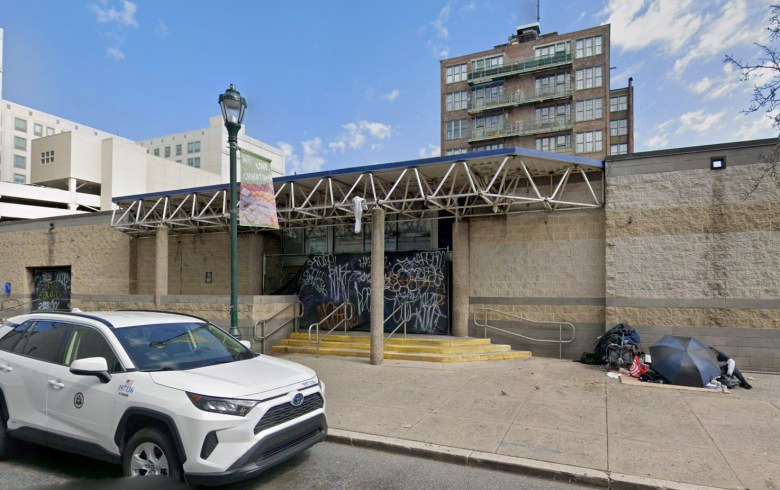 The former Greyhound bus station on Filbert Street has been boarded up since it closed in June 2023. (Google Maps)
The 76ers had a deal to buy the property as part of their plan to raze buildings in the area and build an arena on Market Street. The price was never announced and the transaction was canceled along with the rest of the project. A 76ers spokesperson did not respond to a question about the deal.
Criterion’s future asking price could be influenced by many factors, including a nascent plan to revitalize the Market East neighborhood through tax incentives and other measures. If that works out as hoped, demand for redevelopable, centrally located properties could rise and boost the property’s value.
Bohri’s statement suggests planners are not interested in using the building regardless of the purchase price. That could be in part because buses have to drive through Chinatown to get there, and the city’s criteria for a station include “avoiding residential areas.” A map of 35 potential station locations appears a dot on the property, but like most of them it did not ultimately make the cut.
The ICE office next door
One of the three areas that did reach the finals is a parking lot at 8th and Arch, next to the African American Museum.
The city’s planners say it has several advantages — it’s close to several transit stops, I-676 and I-95, the development could take over the adjoining museum building after a planned relocation takes place, and the city could build a parking structure over a new station.
The Planning Department’s presentation says there would be “limited impact” on residential neighborhoods, and “some impact” on surrounding federal offices, including the FBI, a Federal Detention Center, and U.S. Immigration and Customs Enforcement.
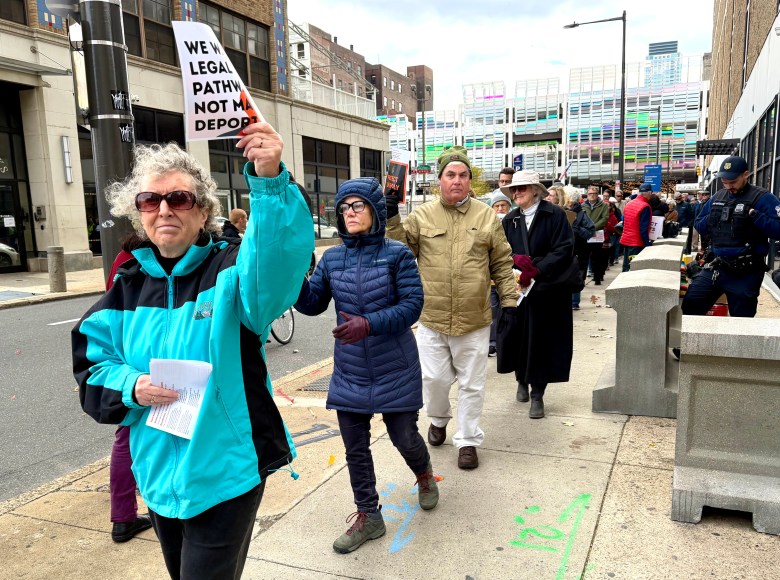 Protesters marched in a procession around the building that houses ICE offices on 8th Street in Center City. Nov. 11, 2025. (Meir Rinde/Billy Penn)
That potential impact alarms some residents.
Susie Nuessle said her son attends aftercare and a summer program at Children’s Village, a daycare located just north of the possible station site, across an alley called Appletree Street. The center has an open-air, second-floor play deck that looks out over the parking lot.
“Many elementary schools bus or walk the kids to aftercare in the neighborhood,” she wrote in an email to bus station planners. “Pick-up in the afternoons is already congested with traffic. Adding a permanent bus terminal there, across from the crowded DMV, a women’s center, and immigration center, where groups of small children already traverse daily, is a HORRIBLE idea. It would be bad for safety, traffic, and noise/bus exhaust pollution.”
She said the bus terminal “should not be crammed into a space that will endanger children” and suggested putting it at the lightly used North Philadelphia Amtrak station, which is located near the intersection of North Broad Street and Indiana Avenue. From the city’s planning map, its appears that idea was considered and rejected.
Bohri said the city has received “significant feedback” about the 8th and Arch site, focusing on the ICE office. The area has been the location of frequent anti-ICE protests over the past year.
“It’s too early to speculate about whether this and other anticipated challenges are enough to remove the site from consideration,” Bohri said. “Whatever site we select, there will be a traffic study to understand the impacts of the site.”
Amtrak amenable to nearby “investment”
Residents have been invited to vote on their preferred option online and at the open house, and 30th Street is so far “the crowd favorite” and the most popular location, Bohri said.
The site’s advantages include a host of nearby connections to Amtrak’s William H. Gray III 30th Street Station, SEPTA, I-76 and other transportation and no impact on residential neighborhoods, but building over active train tracks would be complicated and expensive, city officials have said.
Bohri said the city talked to Amtrak about the site when city planners were trying to figure out where to put an interim bus station, before they settled on Filbert Street. At the time, officials at the national train operator “expressed concerns about building a new bus station while undergoing their own construction,” he said.
That’s a reference to the $550 million renovation of the historic station, which is scheduled to wrap up in 2028. The main concourse and south portion of the station are being renovated now and the redesigned south concourse will reopen later this year, spokesperson Beth Toll said.
The site identified as a bus terminal option is an Amtrak-owned parking deck just north of the train station, wedged between I-76 and the Cira Centre officer tower.
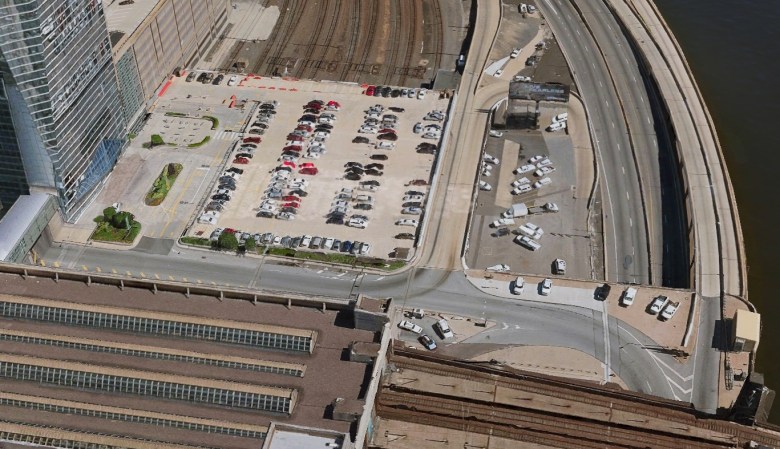 Amtrak owns a parking deck, at center-left in the photo, located just north of 30th Street Station. The city of Philadelphia is considering trying to develop the lot into an intercity bus station. (Bing Maps)
Toll declined to comment on whether the railroad company might make a deal with the city to redevelop the site. She repeated the organization’s statement that it is “always open to discussing options to improve mobility and connections with other transportation providers” — provided that they support Amtrak’s service needs and “come with adequate investment and fair compensation.”
The city has floated the idea of incorporating a new bus station within a larger mixed-used project that could include offices, stores and homes. Planners say the 30th Street parking deck, if expanded, could accommodate a 2.3 million-square-foot development.
Amtrak might welcome a big new development next door as it works to become the nation’s “preferred mode of intercity travel,” Toll suggested. “Gray 30th Street Station is strategically located on the Northeast Corridor, and investment in the station and surrounding area will help Amtrak reach that goal.”
At the same time, she said building above active tracks is extremely complex, “requiring extensive analysis, planning, and coordination.”
“There are operational constraints, limited construction windows, structural and technical hurdles involving detailed designs and due diligence to avoid interfering with existing rail infrastructure, safety and environmental issues working with energized catenary lines and potential environmental remediation, as well as long term planning considerations to account for potential future transit,” she said.
Next public meeting in the fall
Bohri said the city’s online survey will remain open through March. After evaluating all the feedback, Planning Commission staff will draft a final report identifying a preferred site, which will include updated design sketches and info on financing.
After holding a second public meeting, possibly in September, they’ll begin the next phase of work, “a much deeper look at the site and development of the plan,” he said.