
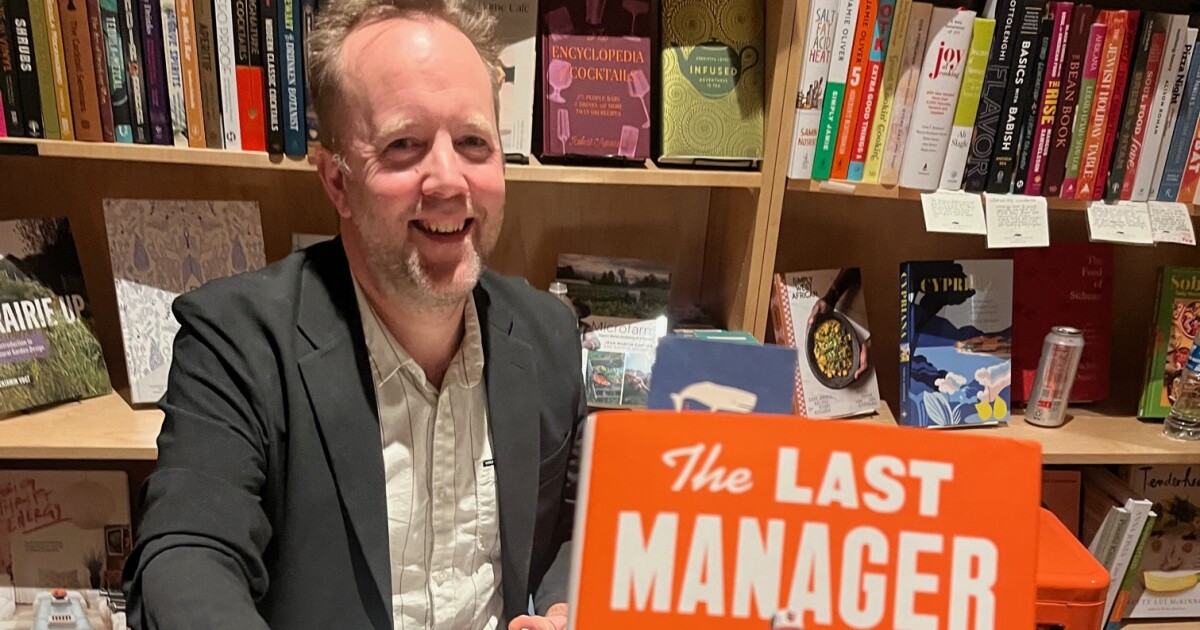
Former Wall Street Journal reporter John Miller is a lifelong baseball fan. He grew up in Belgium with — thanks to family in Maryland — a particular fondness for the Baltimore Orioles.
More recently, Miller, who lives in Pittsburgh, spent three full years researching and writing a biography of legendary Orioles manager Earl Weaver. He dug through newspaper archives and crisscrossed the country to conduct more than 200 interviews with people who knew, or knew about, the famously argumentative yet innovative skipper.
“The Last Manager,” Miller’s first book, was published by Simon & Schuster in March 2025, just in time for baseball season. But as a short search on Amazon revealed, it quickly had company.
“I punch in the title and then, to my surprise, there were like nine different versions of my book and none of them were by me,” Miller said.
The books had titles like “Earl Weaver: The Science of Rage,” “The Life and Legacy of Earl Weaver” and — this one’s in German — “Earl Weaver Biografie.”
Earl Weaver retired from baseball in 1986 and died in 2013. Improbably, eight of these other books about him were published in the couple of months after Miller’s “Last Manager” came out; one actually hit Amazon a couple weeks before.
The books, Miller determined, were all created by generative artificial intelligence. As far as he could tell, none of them outright plagiarized “The Last Manager” or any other writing about Weaver, and most appeared to be full-length volumes.
Rather, it seemed that whoever was prompting the AI software to spit out these volumes about the Hall of Famer, each probably generated in seconds or minutes, were simply exploiting the success of the critically acclaimed biography Miller had sweated over for three years.
“They’re surfing on the attention that my book generated and they’re trying to make a buck,” said Miller, who’s also head baseball coach at Allderdice High School.
‘Unfair competition’
Knockoff books like these are not a brand-new phenomenon, but it seems to be growing, says Mary Rasenberger, CEO of the Authors Guild, an advocacy group with 17,500 members.
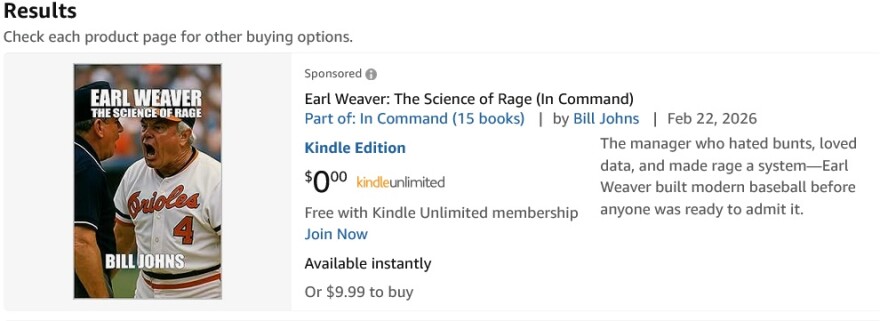
One of the apparently AI-generated books that appeared days after Miller published “The Last Manager.”
“There’s a lot of what we would call unfair competition happening with AI-generated books in the marketplace right now,” Rasenberger said.
“There is definitely more of it,” said Param Singh, a professor of business technologies and marketing at Carnegie Mellon University who studies the unintended consequences of AI. “If you just go on Google and search for ‘AI-based books,’ you will get many websites, like hundreds of websites, which show you how to create books from like very minimal ideas out there.”
The issue of such knockoffs is distinct from the more widely publicized matter of large language models (LLMs) being trained on texts without the original authors’ permission. Several lawsuits on that issue are in progress, and one, a class action against Anthropic, was settled in September. (The authors will receive about $3,000 for each of the 500,000 books involved.) The Authors Guild itself is among the plaintiffs in a similar suit against OpenAI.
Singh said the business model on Amazon works like this. Someone with an AI account — a ChatGPT Plus account costs about $20 a month — tells it to write a book about, say, Earl Weaver. Posting that book on Amazon is free, and the versions for sale are typically cheaper than the $30 hardback of “The Last Manager” — perhaps $14.99 for a paperback and even less for a version on the Amazon-owned Kindle Store.
Physical copies of the book, if sold, can be printed on demand, so there’s no upfront risk to the publisher. Any sales are almost pure profit.
Indeed, Singh said Kindle Unlimited lets publishers earn a few cents if a consumer so much as leafs through a couple pages of a given book. “So, eventually, if you have thousands and thousands of [copies of] this book you can have some steady income coming,” he said. “You don’t even have to sell the whole book.”
How many of the millions of books on Amazon are AI-generated is unknown, Singh said. Some advertise themselves as “summaries” of human-authored titles.
It’s also unclear how much the knockoff phenomenon is cutting into sales of human-authored titles.
But, as Miller put it, “There’s no way it wouldn’t.”
His own book is a best-seller, with multiple printings in hardback. But in a recent search for “Earl Weaver” on Amazon, “Last Manager,” despite its high customer ratings, came up third. Topping it were “Earl Weaver Biografie” and “The Science of Rage.”
The strange case of ‘Bill Johns’
Nonfiction titles that parrot human-authored books can seem like obvious shams, if only because they look so fake. Some have essentially no cover design at all, or use AI-generated photorealistic images of men in Orioles uniforms who look only kind of like the crotchety, white-haired older Weaver.
The cartoonish cover illustration of “The Life and Legacy of Earl Weaver,” for its part, suggests that Weaver resembled a young George Clooney with a beard.

Someone thinks there’s a market for AI-generated, German-language biographies of the late Baltimore Orioles manager.
Often the author credit is a clue. “Earl Weaver: The Science of Rage” is attributed to one “Bill Johns,” who to date has some 375 Amazon titles to his credit, on subjects ranging from college sports to bourbon, true crime and “small modular nuclear reactors.” Another of Johns’ titles: “The Confidence Game: Swindlers, Grifters and the Architects of Trust.”
“I tried to find this guy. I couldn’t find him,” Miller said. “He’s a made-up person.”
In the months after “The Science of Rage” was published alone, “Bill Johns” — whose author page, complete with a seemingly AI-generated photo, says he lives in the Chesapeake Bay area — published a dozen books on Baltimore sports figures, including several who played for Weaver.
The prose in such books is grammatically correct but typically rhetorically repetitive, often vaguely worded and sometimes factually inaccurate. (AI authors also seem inordinately fond of alliteration, though the same might be said of some human writers.)
But such books are not, generally, illegal.
AI excels at saying similar things with slightly different words, and paraphrasing doesn’t infringe on copyright. Moreover, so much has been written about a figure like Weaver — and even by him, in three books he wrote himself — that tracing any sentence to a given source is difficult.
“The current copyright law is insufficient to kind of block these,” said Singh. “So that needs to evolve itself.”
‘You’ll lose trust’
Asked about AI books, an Amazon spokesperson wrote in an email that company policy permits it to remove titles that violate its content guidelines, including for use of copyrighted material without permission. And the company encourages customers to report suspected inappropriate content.
“We do have a relationship with Amazon where when we bring infringing books to their attention, and they will take them down,” said Authors Guild CEO Rasenberger.
But Amazon doesn’t ban AI-generated books outright. And that can leave authors like Miller with little recourse.
None of the so-called Big Five book publishers, including Miller’s publisher, Simon & Schuster, responded to requests for comment on AI books. But some observers offer ways to address the problem.
CMU’s Singh suggests Amazon start charging a small fee to post a book. Even $10 dollars per title, he says, might discourage sham posters working with low profit margins.
Rasenberger, meanwhile, said thousands of authors have signed on to an Authors’ Guild program to mark their books as “Human Authored.” The Guild is also working with publishers on the issue.
In any case, Singh predicts something needs to change.
“Even Amazon in the long run is not going to profit from this,” Singh predicts. “Remember, if you are one of these people who go on Amazon.com to look for good books, every time you see something like this summary and you kind of end up paying for that … you’ll lose trust in Amazon’s recommended system as well as the kind of content that is out there.”