
• Academic research finds mega-events rarely produce large, sustained local gains relative to public cost and risk.
• A recurring problem is impact vs. benefit: Gross spending gets headlines, net welfare and fiscal outcomes tell the truth.
• The best hosts use the deadline to solve resident problems, spread benefits, cap downside risk and commit to transparent, independent evaluation.
Alexander Graham Bell’s telephone was first displayed to lure visitors to Philadelphia.
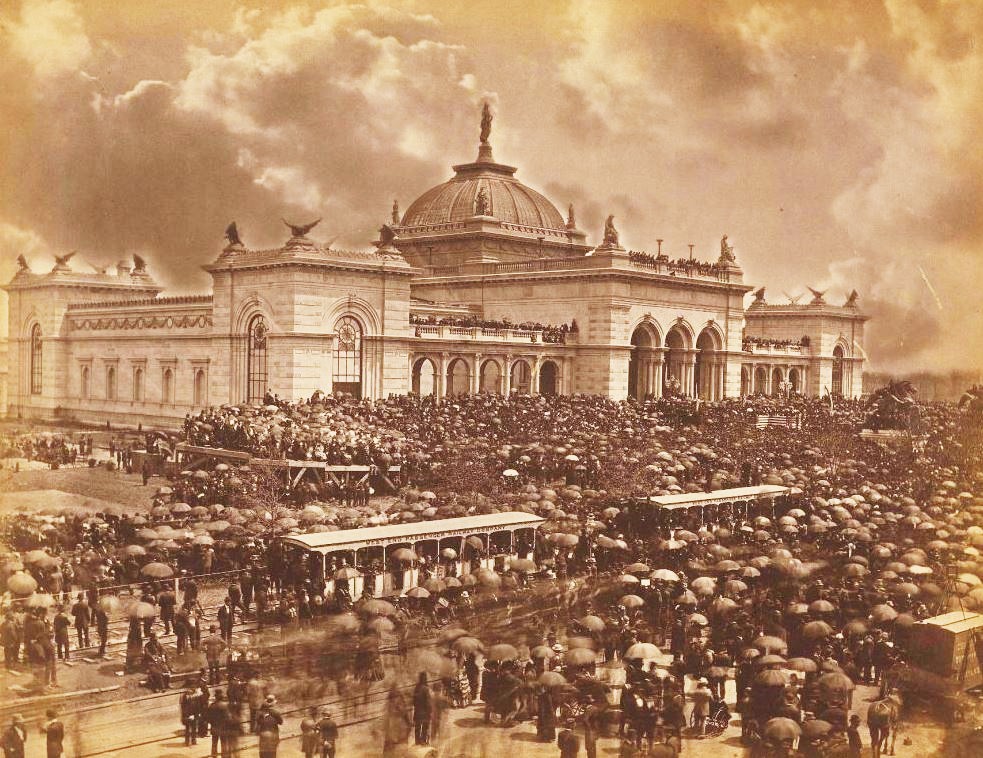
In 1876, it was a centerpiece of the Centennial Exposition, a sprawling event that attracted 10 times more visitors than the city had residents. Organized to celebrate the country’s 100th anniversary, it was among the first of what we now might call a “mega-event”: a burst of attendance that meets or exceeds the host region’s population and brings global attention.
The Centennial Exposition organizers invested in spectacle (they brought in portions of the unfinished Statue of Liberty) and innovation (setting up a demo of a then-new early-childhood approach called “kindergarten.”) From it, Philadelphia gained widespread recognition, follow-on visitors and pieces of built environment that are still in use today.
Big cities are best known for this kind of thing, but it also happens elsewhere, from music festivals to state fairs.
A century later, in 1976, Philly tried to summon that same effect during the country’s Bicentennial, hoping a national celebration might jolt the city out of postindustrial drift. It badly underperformed. Symbolically, conventioneers caught a pneumonia so rare that the mega-event gave it a new name.
To this day, host cities always envision a celebration closer to 1876 than 1976. Plenty are trying their luck.
In 2026, the US Semiquincentennial, Philadelphia leaders are once again making a try, stringing together the PGA Championship, MLB All Star Game and a slate of FIFA World Cup matches. Elsewhere, Los Angeles is also hosting the World Cup while it builds toward the 2028 Summer Olympics. This week Austin, Texas hosts SXSW, one of the world’s largest same-city festivals, and next month Pittsburgh will host the NFL Draft, which has become its own bonanza.
Big cities are best known for this kind of thing, but it also happens elsewhere. I grew up in a rural county that hosts an annual state fair with far more visitors than there are local residents.
All mega-events get state and local subsidy in one way or another, be it direct government funds or in-kind services. And all are part of a longstanding strategy behind place-making: Get gobs of people to come once and, they say, create long-term economic change. Today’s concert-goer or tailgater could become tomorrow’s homegrown startup founder.
Economic developers remain believers. Last week, I led an opening plenary discussion on the topic at an annual summit hosted by the International Economic Development Council, a trade and certifying group celebrating its 100th anniversary. I shared the stage with a suite of big-city economic organizers who committed careers to mega-events.
In an informal poll of IEDC attendees representing 50 or so jurisdictions, roughly two-thirds of respondents viewed mega-events positively, compared with fewer than 15% who viewed them negatively. Three in 10 called them “very” positive.
But the academic literature is far less romantic.
Over decades of research, mega-events rarely generate large, sustained, local economic gains commensurate with their public cost and risk.
Local organizers pay consultants to tally up the “economic impact” of these events, often by including the gross total of everything that surrounds them. But a more accurate assessment for local impact is calculating the “economic benefit” — the net change that considers what might have happened if the event never took place.
Even when there are net gains, the research suggests they tend to be narrow and time-bound: modest spikes in hotels, food service and transport rather than broad-based employment booms. And mega-events bring widespread risks. Studies link Olympic hosting to direct evictions, as well as indirect displacement through gentrification and housing-cost pressures.
That’s the past today’s economic leaders say they’ve learned from. Will they fare any better?
‘Our responsibility is the people who already live here’
“Ultimately, our responsibility is for the people who already live here,” Stephen Cheung, president and CEO of the Los Angeles County Economic Development Corporation, said during the IEDC panel. He’s among that city’s chief wranglers for the World Cup and Olympics games. “A good host makes visitors feel at home, and like they’ve learned something about you.”
An economic leader’s best framework is not “How will we attract the most people” but “How will this get us closer to our region’s goals.”
Mega-events don’t make this easy. Costs and revenues often accrue to different entities. Public agencies more often carry capital and security burdens, while rights-holders and organizing committees capture media and marketing revenues.
Los Angeles organizers vowed a “no-build” Olympics, to limit the risk of bloated infrastructure investments that have dogged Olympics past. Scrutiny is widespread. But LA’s “Twenty-eight by ‘28” campaign has the region steadily confronting the region’s notorious traffic congestion with new transit investments, Cheung noted.
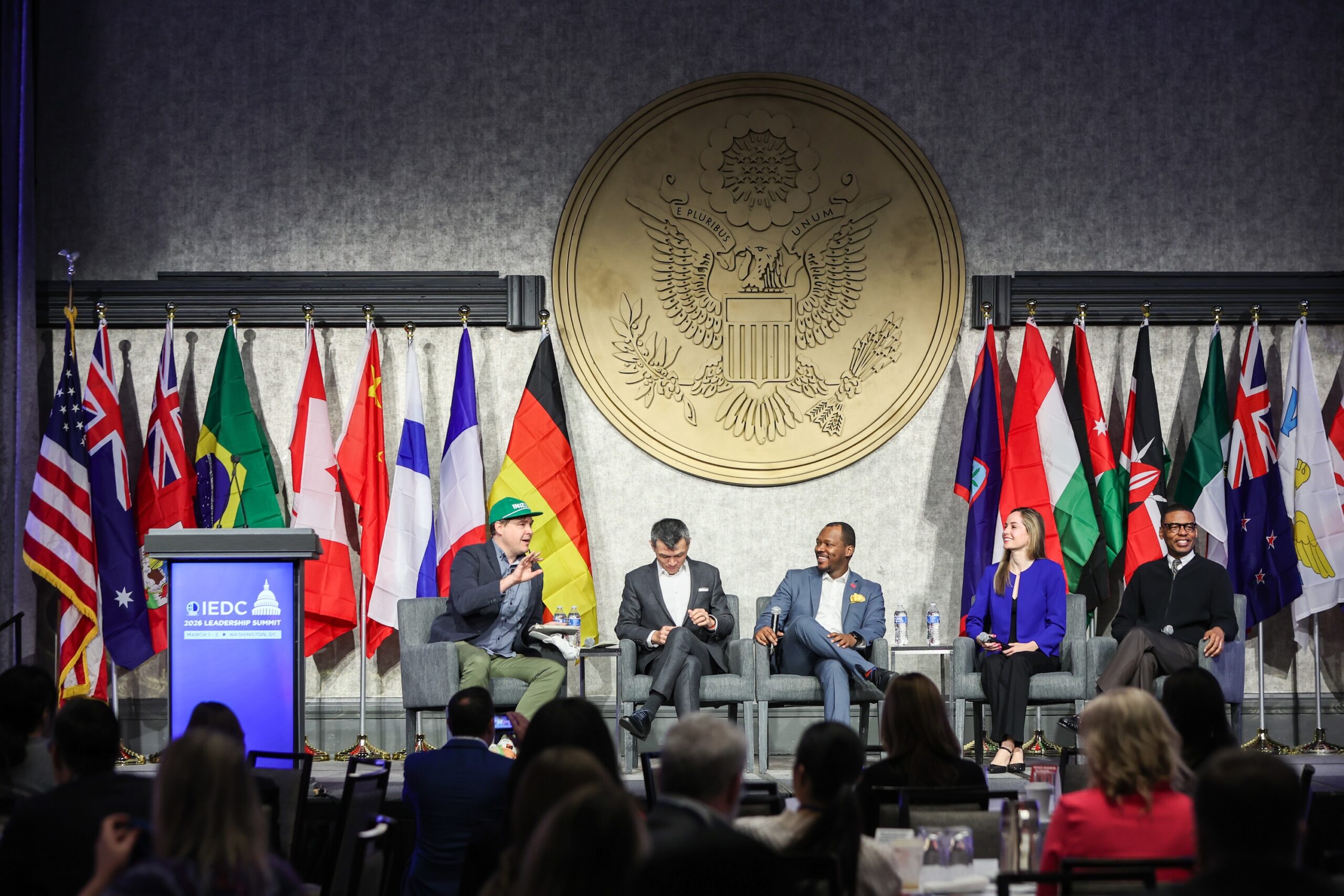 Technical.ly publisher Chris Wink leads an opening plenary panel at IEDC Leadership Summit in March 2026, Washington DC (Courtesy IEDC)
A major event’s story isn’t a marketing wrap at the end of the work, said Vaughn Taylor, VP of economic development for the Seattle Metropolitan Chamber of Commerce. It’s the work itself.
“Leaders are forced to make choices of what to highlight, where to send people and how to tell a community’s story,” Taylor said. “There’s no perfect story, but we can include more of our residents in that story.”
The trap of modern mega-events is that visitors may arrive for the match, not the place. If the host does not deliberately foreground local life, it becomes background noise.
Seattle’s approach, Taylor said, includes practical tools for small businesses and deliberate design choices that push foot traffic beyond the most obvious stops. It’s a civic routing problem as much as a branding problem: Where do you send people, and who benefits when they get there?
‘If we want an international crowd, we need to welcome an international crowd’
Economic development leaders change buildings. They also change rules.
Philadelphia is pursuing extended hours for bars and clubs during World Cup visits this year, said Raheem Manning, that city’s “nighttime economy” director.
“If we want an international crowd, we need to welcome an international crowd,” Manning said.
That goes beyond late-night drinks. Manning pointed out that night-shift hospital staff, delivery drivers and emergency services are also part of what makes a city feel dynamic and safe after dark. In host-year planning, those workers can become invisible even though they’re the ones carrying the load.
In the research, this shows up in two ways. First, the tendency for benefits to cluster in narrow slices of the economy, leaving the rest of the city wondering what the fuss was about. Second, the risk that increased demand and redevelopment pressures sharpen affordability problems for vulnerable residents, even when metro-wide GDP or employment effects are statistically small.
Economic leaders serious about service should commit to independent, comparable evaluation, not sponsor-led analysis.
It’s fair to include intangibles like civic pride and reputation, even as difficult they are to quantify. But a transparent cost-benefit analysis can benefit all stakeholders.
Any plan ought to align with existing goals, reminds Caroline Valvardi, a public affairs VP at Seregh, a real-estate developer specializing in mixed-use development centered around sports and entertainment venues.
“Dynamic places have people there 365 days a year, and so plan for that, not just for a few big crowds,” Valvardi said.
Mega-events risk saddling locals with debt and distraction, Valvardi added. Regional leaders need the discipline to refuse false promises, and instead set clear goals, develop with intention and include honest accounting.
Philadelphia’s dueling anniversaries still offer the cleanest caution.
In 1876, the event worked because the city had local buy-in and a story of itself that it could plausibly show the world. In 1976, the official celebration could not reverse the deeper civic drift. That year’s most enduring narrative was not a marketing slogan, but a movie, the seemingly unflattering story of a working-class boxer running through graffitied and trash-strewn streets.
A half-century later, Rocky has outpaced any other Philadelphia tourism campaign. That’s the lesson leaders often resist because it’s inconvenient: organically occurring stories outlast focus-grouped ones.
You can host the crowd. You can’t fake the place.