
 Local Jewish women meet in person during a Jewish Women International financial literacy event. (Courtesy of Jewish Women International)
Jewish Women International has a mission of ending violence against women and girls. The nonprofit organization’s leaders are well aware that “99% of survivors of domestic violence are victims of financial abuse,” said Meredith Jacobs, JWI’s CEO.
But even for women who aren’t victims of domestic violence, financial independence and empowerment are essential, according to Jacobs. That’s why JWI’s Young Women’s Impact Network and the Jewish Federation of Greater Philadelphia’s Women of Vision group are launching a new series on the “Money Mindset” for young women in the Philadelphia area.
This season’s “Money Mindset,” a series teaching practical money skills to women between the ages of 22 and 34, took place over the course of four sessions in Center City last month.
The sessions focused on “Your Money Story,” “Taking Control: Spending, Budgeting and Credit,” “Making Money Choices That Stick” and “Money Talks.” That last session explains the series: It’s about practical money skills, yes, but it’s even more about getting women together to talk about a topic that can make them uncomfortable.
JWI has run these types of series in Washington, D.C., and San Diego, too, according to Jacobs. But the Philly version took a slightly different approach: It focused on helping the women “identify their emotional relationship with money, where that comes from, how to overcome it. We talk a lot about money affirmations, taking the negative associations and replacing them with a positive mindset about money,” said Karen Greene, the JWI board member who taught the classes.
“A woman who controls her money controls her future,” Jacobs added.
But women often don’t grow up being told that they should control their money, according to the CEO.
“They’re told, ‘Oh, this is something your father handles or your husband will handle one day,’” Jacobs said.
This can create an anxious relationship when women graduate and get jobs of their own. Even women who do everything right have expressed anxiety to Jacobs.
“They’re setting aside savings in their 401(k). They’re budgeting. And yet they still feel anxious when they look at their banking app,” she said.
In “Money Mindset,” the first goal is to unpack these feelings. Once the women do that, they can start to build healthier relationships with money. It’s also perhaps most helpful for them to talk to each other.
“We do it in cohorts and in community, so there’s that sense that they’re not alone in this,” Jacobs said. “It feels empowering and not intimidating.”
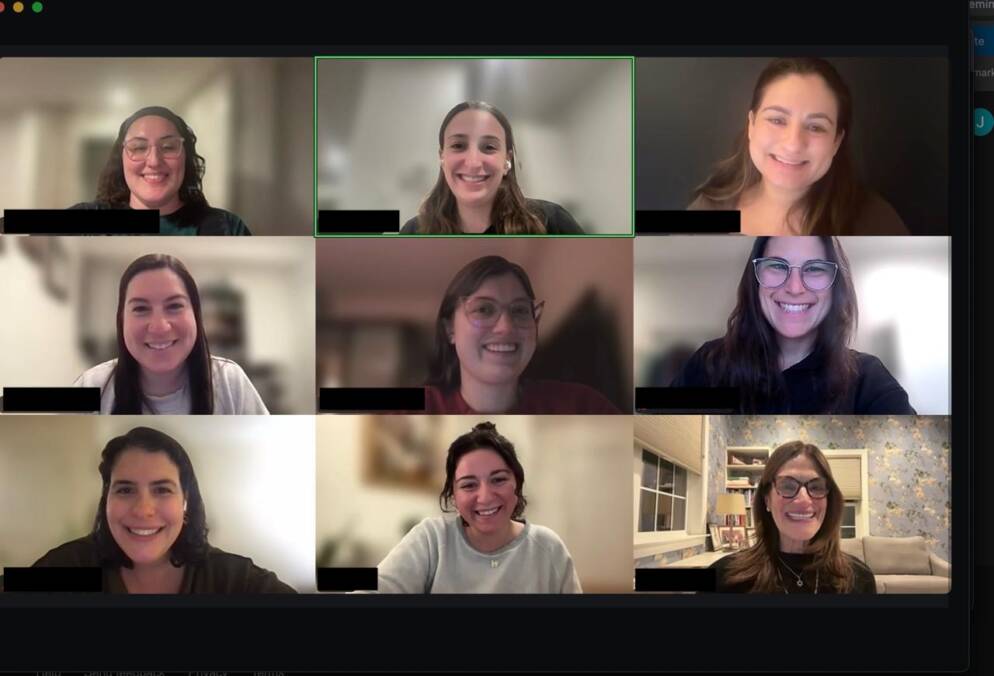 Local Jewish women meet online during Jewish Women International’s “Money Mindset” series. (Courtesy of Jewish Women International)
“Money Mindset,” though, is not just about individual and group therapy. It’s also about skill-building, according to Greene.
“They can budget; they can spend wisely; they can treat themselves. They are allowed to spend on wants that aren’t just needs,” said the teacher, a longtime head of investor relations at publicly traded companies. “Budget is not a bad word. A budget is really a plan. A plan is empowering. A plan helps you take steps and be in control of your actions.”
“You build the skills; you replace the negative talk with the positive talk,” Greene added.
Alyssa Berman Bender, a Center City resident, participated in this first cohort in Philly. She decided to participate because she’s been involved with JWI’s YWIN Philly group for over a year. But she also thought it would be helpful and interesting to talk to other women about money.
“To talk with a non-judgmental, very open group,” she said.
The 29-year-old recently started a new job. She’s also starting to think about saving for a house and family.
“Getting to talk to people in the same life stage but who come at it from different perspectives was something I find valuable,” she said.
“I think it’s interesting to hear how people set up their savings and how they budget each month; different savings and investment accounts; who’s using a financial planner; not really things that are part of everyday conversations when you’re with your peers,” she added.
Those conversations quickly developed from budgeting to investing. That’s the next series that JWI might like to host. As Greene explained, it’s really the next level in the money mindset.
“Now that we’ve got this covered, how can we be smart and build our savings? How can we build our nest egg? How can we invest our money wisely? How can we take it to the next level?” Greene said.
Jacobs said this series has been growing. Locally, she plans to repeat it in the spring, summer and fall. She also agrees with Greene that a 2.0 series should allow participants to “go deeper and learn more.”