
Following years of failing reading scores and an influx of COVID-19 pandemic federal funding, the Philadelphia School District purchased a new English and Language Arts curriculum.
The idea was that it would provide not just high quality resources but also uniformity across a district that didn’t have a guiding document or philosophy on how to teach kids to read.
“We had a variation across the district and that was a complete nightmare, where you’re going to different schools where you don’t have any continuity of instruction,” said Nyshawana Francis Thompson, the Philadelphia School District’s Chief of Curriculum and Instruction.
But a year and a half into the $20 million program, some district employees are raising concerns, both about the curriculum itself, the training and implementation.
Looking for comprehensive program
For the past decade, Philly students have been stuck at one-third being proficient or above in reading. That means the majority of children cannot read well enough to pass a state standardized test.
To address that gap, the district vetted several literacy programs. It landed on EL Education, a New York-based nonprofit that touts itself as providing a comprehensive English and Language Arts curriculum based on the Science of Reading.
It has a somewhat unique approach to teaching kids how to read. Students dive deeply on one topic — such as trees, pollination, or Greek mythology — for several weeks. The idea is that students then “build knowledge, make meaning of a text, and acquire critical vocabulary words,” according to the company.
“We were looking for a comprehensive program that would cover the knowledge building and the foundational skill,” Thompson said.
The district used $19.4 million of its American Rescue Plan Act funding to purchase two years worth of the EL Education curriculum for K-8. Every year after that will cost the district $10 million to pay for the licensing, workbooks, lesson plans and professional learning.
“It is entirely too dense, it’s convoluted.”
The new curriculum was launched at the start of the 2024-25 school year.
But after a quick summer tutorial for teachers on this new curriculum, some tell us they felt overwhelmed and frustrated.
“I left there absolutely my head spinning. It is entirely too dense, it’s convoluted,” said one teacher, who requested anonymity since teachers are not allowed to speak with the media.
Dozens of other teachers attended focus groups early last year where they complained about the program being rolled out too quickly and not enough teacher development. Some were critical of the curriculum itself, saying it did not have explicit phonics teachings.
Reading through pollination
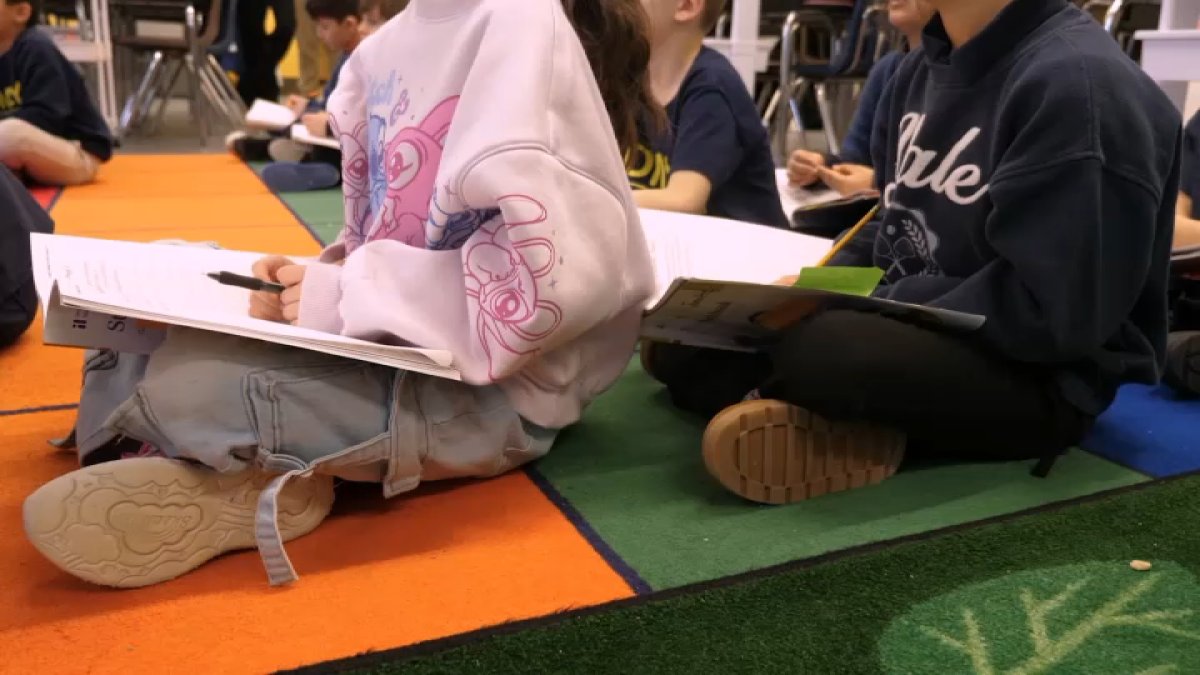
When we visited Watson Comly School in the Northeast, we saw a second grade class fully immersed in the world of pollination. Not for science class but for its reading and writing courses.
“When the new flower is pollinated by bees what happens?” one teacher asked a group of students.
The kids took turns saying “nectar” and “it turns into a fruit.” They then wrote down sentences in their workbook answering the initial question.
Everything the children in this class will read and write for the next several weeks will revolve around pollination.
“There’s a lot of research behind repetition and making sure you’re giving students repeated exposure to something,” Thompson said.
One principal, however, told us some of the text is not relevant to students and so they are “bored out of their minds.”
And that is where there is some mixed messaging.
Teachers and others in the district we spoke with for this story say they were told to stick to a script, not deviate, and that they must read exactly what the curriculum calls for.
But Thompson tells us the district wants teachers to add other relevant books and make the lessons interesting through their own creativity and teaching experience.
“When you understand how to teach children how to read, the autonomy lives in what is happening between you and your students as they’re responding to the program,” she said. “But if we don’t provide access to the high quality material and then we just do things like go on websites and print off worksheets, that’s not instruction, right. So we want to keep the rigor of the high quality instruction.”

We [teachers] have to learn and teach alongside that program.
Thompson said the district has already adjusted some of the curriculum based on teacher feedback. She says the pacing was adjusted after some complained that there wasn’t enough time to get through each lesson.
“We don’t have the luxury of going in a lab and taking our teachers in a lab and saying, ‘You can spend the whole year in this lab practicing teaching this program and then go into the classroom and teach it,'” she said. “We have to learn and teach alongside that program.”
Drexel University Literacy Studies Professor Mary Jean Tecce Decarlo says the key to any new curriculum is teacher training.
“Even if you have the best professional development ahead of time, teachers need to master the curriculum to get really good at developing it,” Decarlo said.
She is familiar with the literacy program Philly is using, and said it is a complex curriculum with various moving parts.
An ideal rollout, she said, would be to start with first grade and expand the curriculum with that class.
I’m not surprised to see our reading scores went down in Philadelphia…because we’re figuring something out.
“Then you keep going and now the second graders use it. That sort of staged rollout does have some evidence behind it. And also how you upskill the teachers in this space,” she said.
One principal we spoke with complained that the curriculum assumes a child — such as a third grader — already learned certain things in second and first grades that are specific to the EL Education curriculum.
Thompson said the district couldn’t wait to do a gradual implementation.
“In a city like the School District of Philadelphia where you have a significant number of students that are not being able to perform at grade level, we have to make decisions with a sense of urgency,” Thompson said.
After the first year of the new curriculum, reading scores dropped by one percentage point– with still two-thirds of students not being proficient in reading.
“I’m not surprised to see our reading scores went down in Philadelphia, right? Because we’re figuring something out,” Decarlo said.
Thompson said the district did not consider the test scores of other districts and schools that have used EL Education during the selection process.
“Looking at results from somewhere else is not going to be the only thing that’s going to tell you whether a program is going to work in your context,” Thompson said.
Gains every day
The NBC10 Investigators looked at standardized test scores for districts that use the EL Education ELA curriculum, including Detroit, Hamilton County in Tennessee, and Wake County in North Carolina. All are mentioned on EL Education’s website as success stories.
Those districts had varying results– from staying flat the first year but increasing scores later to having early success and then continuing to have falling scores since then.

“We should be expecting to see gains everyday”
EL Education declined an interview.
“EL Education’s top-rated language arts curriculum is built by teachers, for teachers, and is grounded in decades of research on student learning and development,” a spokesperson wrote in an e-mailed statement. “Third-party research has found that students around the country using the EL Education curriculum have shown greater levels of growth and achievement.”
The other school district also did not respond to requests for comment.
Thompson said the district has seen improvements in reading and writing this year but couldn’t predict whether the district will see gains following the next standardized tests.
“We should be expecting to see gains every single day,” she said.
DeCarlo says it may take years for Philly to see a turn in reading scores as a result of the new curriculum.
The district’s literacy program has a tremendous impact on the future of Philadelphia.
“We have a workforce that wants to work, contribute to their community, contribute to their family, but in some ways they’re capped out by their literacy,” she said.