
Love Philly? So do we. Let’s be friends. The Billy Penn newsletter keeps you informed about everything Philly, with a quirky vibe of healthy skepticism and persistent optimism. Join us and sign up today.
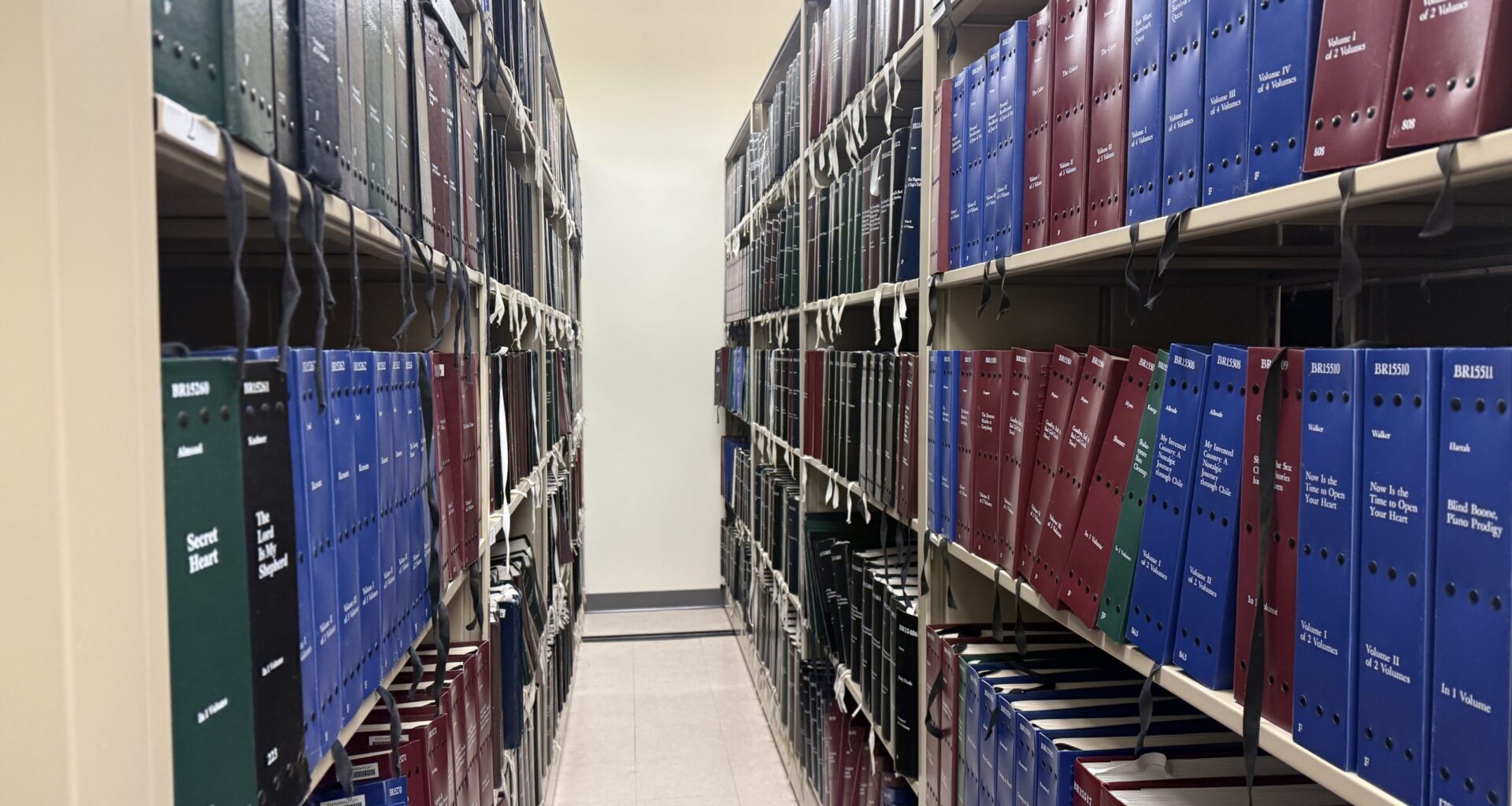
When you walk through the Library of Accessible Media right off of Spring Garden Street, the first thing to catch your eye may be the stacks of Braille.
Nestled inside hundreds of movable shelves, LAMP’s Braille collection aims to give its readers a wide variety of titles to choose from, said Tara Lynne Murphy, the organization’s chief librarian.
“We lend out Braille,” Murphy said. “And a Braille book is a lot different than your regular hardcover. Braille is a lot bigger because it’s embossed, and so it could be anywhere from one volume to, say, I know the Joy of Cooking is something like 30 volumes of Braille.”
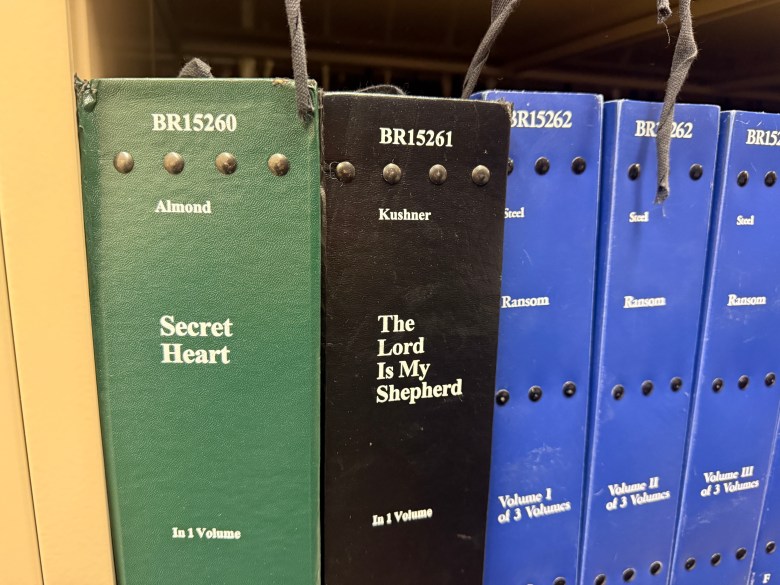 Braille often takes up multiple volumes for each title on the shelves (Violet Comber-Wilen/Billy Penn)
The Library of Accessible Media for Pennsylvanians, or LAMP, is one of two spaces in the state that offers materials for its patrons.
Although they don’t have a browsable, in-person collection, their reach is wide.
“We serve anyone who cannot pick up a book with their two hands and read like that,” Murphy said. “So it’s not just people who have vision challenges.”
The library provides services to Pennsylvanians with temporary or permanent disabilities and is a part of the Library of Congress’ National Library Service, Library for the Blind and Print Disabled.
The nationwide network circulates materials free of charge to eligible participants of all ages. LAMP serves Pennsylvania through two locations at the Free Library of Philadelphia and the Carnegie Library of Pittsburgh.
“We send out Braille, we send out large print to our patrons, and we have audio players and refreshable Braille devices that we’re able to send out for that have the materials either preloaded on them, or they can download them to their devices,” she said.
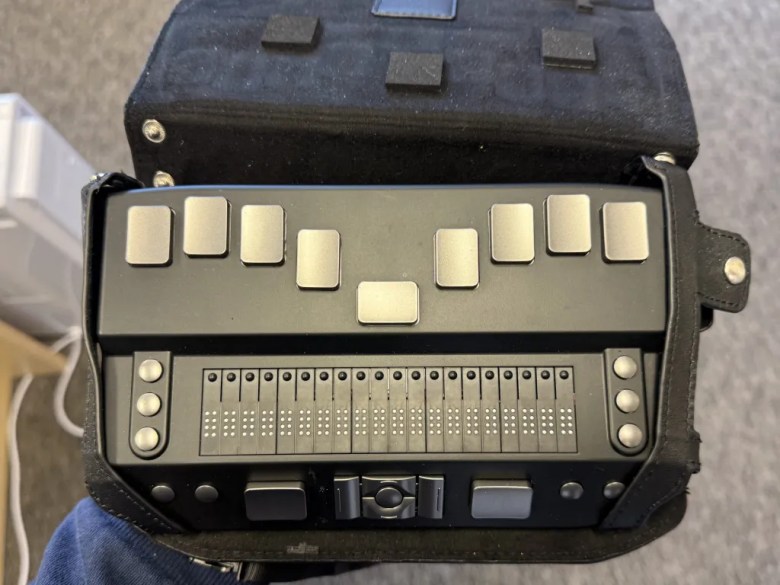 Refreshable Braille devices can be mailed out to eligible patrons, Murphy said. (Violet Comber-Wilen/Billy Penn)
Materials
Murphy said the library has a variety of special materials – this includes books for those with dyslexia or declining vision, and books for those with a temporary or permanent disability who have lost the ability to use their hands.
There are also hundreds of Braille stacks for blind readers.
Murphy said having lots of Braille materials is important – especially for children.
“It’s really important to keep the literacy going,” she said. “Braille is incredibly important for people who may be born blind to be able to learn that literacy aspect. It really helps with your brain development. And, say, if kids go to school without knowing how to read with Braille, it’s going to be a real challenge later on.”
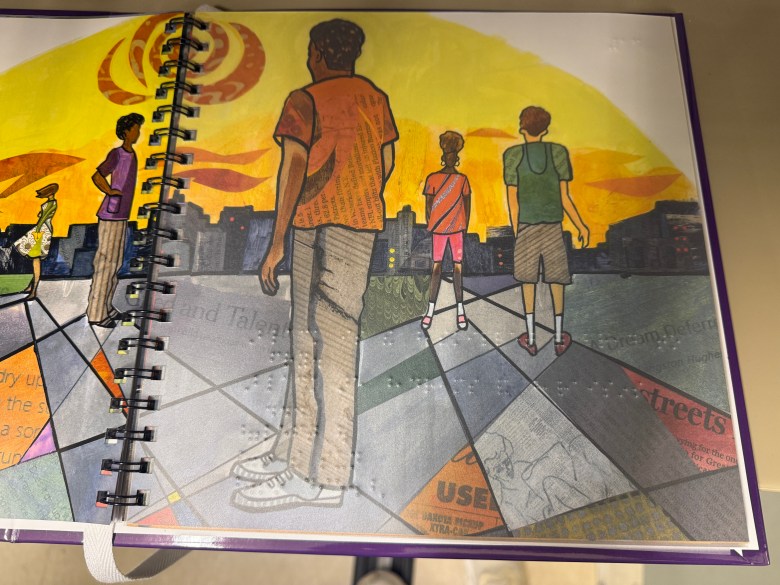 A “twin vision” book in the LAMP collection, which allows both blind and sighted readers to read together (Violet Comber-Wilen/Billy Penn)
Twenty-five percent of the library’s books are geared toward children. One such resource is “twin vision” books – books designed to allow both blind and sighted readers to read together.
These books have clear, plastic braille sheets overlaid on standard printed text. This allows for families of varying vision levels to read together.
Murphy said having a wide variety of titles available for the Dyslexic population is vital as well.
“For the state of Pennsylvania, [it’s important] just being able to get them to the resources,” she said. “Because that is a very common condition that drops through the cracks a lot, especially with our kids in our education system.”
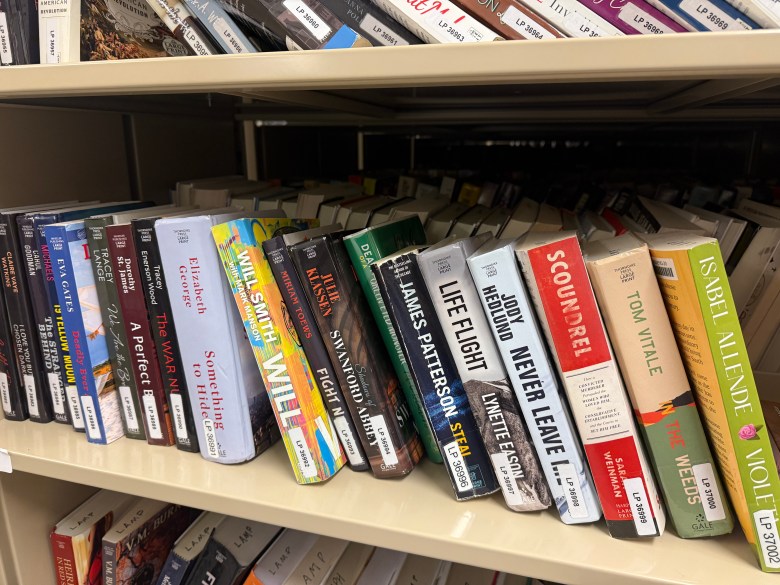 The library has a selection of large print books as well. (Violet Comber-Wilen/Billy Penn)
Murphy said another unique aspect of the library is personalized recommendations and materials for patrons.
“So in their profile, it shows like, ‘Oh, you’re interested in romances, but it has to be clean romances, no swear words, no naughty content or anything like that,’” she said. “A lot of Amish romances are very popular with our patrons, but we also have detective stories or other books if somebody wants something more graphic.”
She explained that the traditional Free Library of Philadelphia branches don’t keep a record of books patrons check out once they’ve checked them back in. But at LAMP, books stay on people’s records – allowing for a better understanding of what books people enjoy.
“So you fill out the profile, and then our system goes through and actually selects the materials for you,” she said.
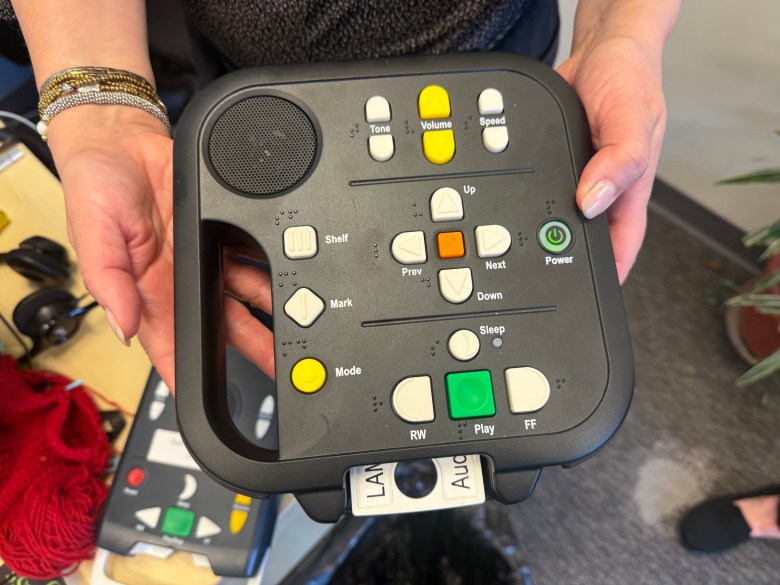 The library also lends out audiobook players. (Violet Comber-Wilen/Billy Penn)
Recording studio
One of LAMP’s newest additions is a recording studio – where volunteers read audiobooks for the library.
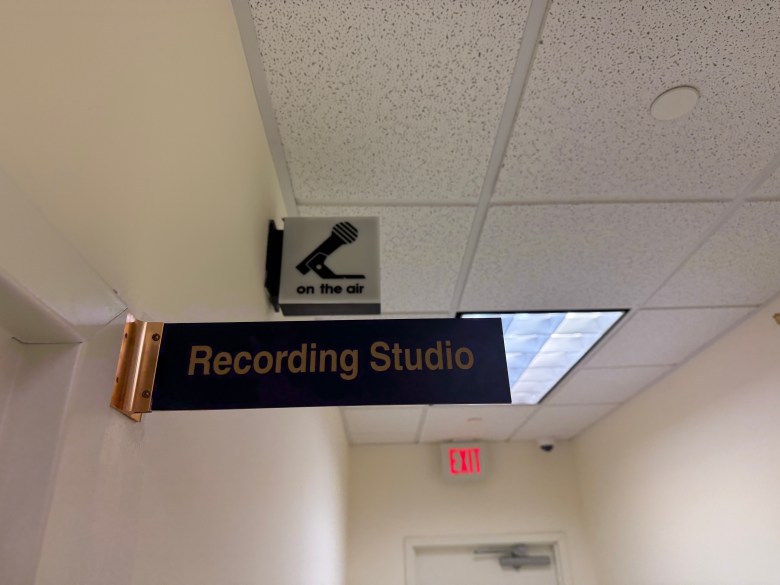 LAMP’s recording studio is located in a cozy corner in their building. (Violet Comber-Wilen/Billy Penn)
Due to recent media attention, Murphy said the recording studio has received hundreds of volunteer applications. However, she said this is welcome news.
“We still would like interested parties to sign up,” she said. “They need to go through the whole process of being a volunteer with the Free Library, which does include clearances.”
Kate Loitz is one of the organization’s volunteers.
“I’ve been doing this work for about 50 years, starting in a closed circuit radio station, and eventually got into book recording for the Talking Book & Braille Library books in Seattle,” she said. “So when this reopened last summer, I was the first one in.”
Loitz was an English major and works as an actor and singer. She explained that this work is extra fulfilling to her.
“I know that I’m providing a valuable service to people who have requested what I’m doing,” she said. “These aren’t randomly selected books. These have been requested, so I know someone is waiting to hear them, and it’s that person I’m reading to, typically, and then they go into the permanent collection.”
Murphy said virtually any book can be recorded if it hasn’t been recorded already by another author or narrator.
“Because we’re part of the National Library Service for the Blind and Print Disabled, we have some very relaxed copyright situations, so we can record anything that basically hasn’t been recorded before,” she said.
She explained patrons can request books that they want to read, but that the recording studio does a lot of recording for local titles.
“We focus mainly on local titles or local interest, whether it is just in Philadelphia proper, or the state of Pennsylvania,” she said. “We do talk to our sister location in Pittsburgh to make sure we’re not duplicating any titles that are coming through.”
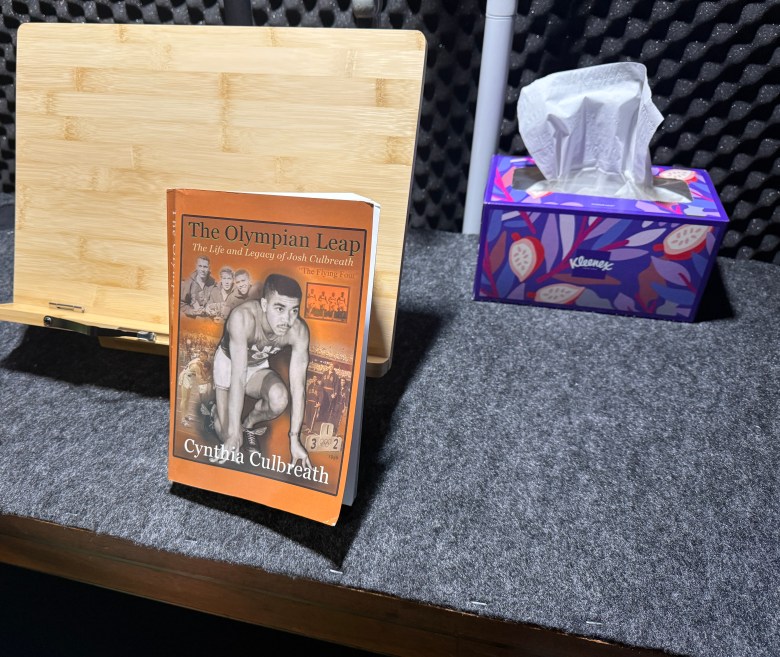 Loitz showcases a local title she is currently recording (Violet Comber-Wilen/Billy Penn)
The recording process can be lengthy, Murphy said.
“It usually will take about 20 to 30 hours of actual recording time to get that book done, and then we have the back-end processing of making sure it’s marked up with the right chapters and that sort of thing,” she said.
But Loitz explained that this work is vital.
“My attitude is that books can save people, and people who can’t read a physical book deserve access just as much as anyone else to all kinds of books, whether they’re dirty books or history books or an adventurous novel,” she said. “People deserve to have access, and that’s what we give them.”
For the future, Murphy said she hopes to expand offerings even more.
“We are looking to start up more programming here,” she said. “I’ve doubled the size of my staff in the past two and a half years so that we have more people to do outreach. We want to make sure that people understand that they’re welcome here.”
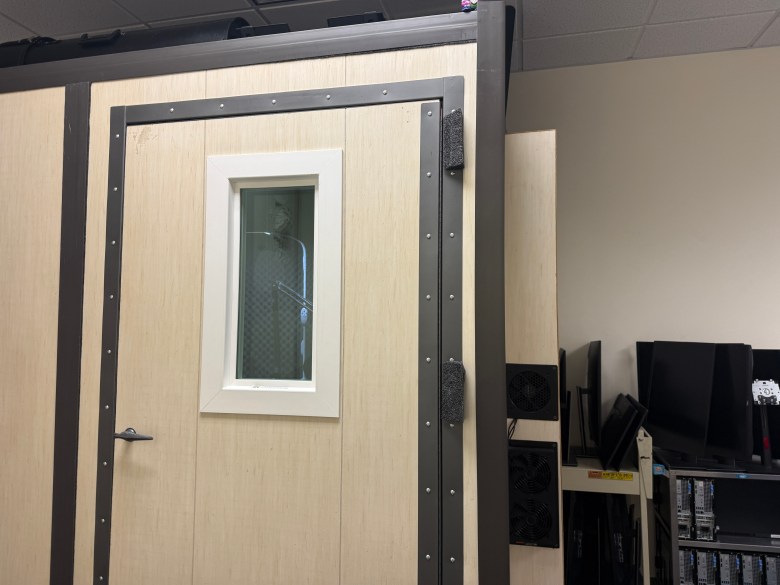 For now, hundreds of volunteers will continue to rotate in and out of the LAMP recording studio’s doors (Violet Comber-Wilen/Billy Penn)
Other potential resources include a “Cooking without Looking” program, or cooking classes for those with visual impairments, and expanding on materials like Braille LEGO sets.