

DICKSON CITY — Borough Police Chief William Bilinski lacked the authority to sign an agreement with U.S. Immigration and Customs Enforcement allowing authorized Dickson City police to perform certain functions of federal immigration officers, an outside attorney for the borough advised in a recent memo.
The memo from attorney Liz Kelly of the borough-contracted law firm KingSpry — which Dickson City Council President Jeff Kovaleski read into the record at Tuesday’s council meeting — also raises questions about whether council could enter into the agreement with ICE, given council’s limited authority under the Borough Code.
Council, which was not advised before Bilinski unilaterally signed the controversial agreement with ICE on Feb. 19, took no official action on the pact Tuesday and did not endorse it. But the meeting did feature a discussion between Kovaleski and Bilinski about Kelly’s memo and the broader ICE agreement, which purports to establish the borough police department’s participation in the task force model of ICE’s 287(g) program.
Authorized state and local law enforcement personnel participating in the 287(g) program’s task force model and operating under agreements with ICE have limited authority to exercise powers and duties otherwise reserved for federal agents, such as interrogating suspected noncitizens about their immigration status and arresting people for immigration violations.
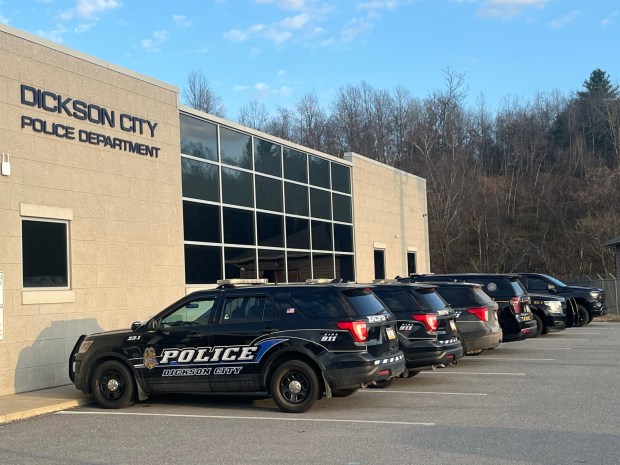 Police vehicles are seen here parked outside the Dickson City Municipal Building on Tuesday, March 10, 2026. (JEFF HORVATH/STAFF PHOTO)
Dickson City will apparently not pursue participation in that program, but the status and fate of the agreement itself were not immediately clear.
Bilinski and Mayor Bob MacCallum — who told the newspaper last week Bilinski was rescinding the agreement before walking that back — said Bilinski would formally move to terminate the ICE agreement if council gives such a directive.
Borough Solicitor Bill Jones, meanwhile, said the borough would send a letter to ICE advising that council never authorized the agreement. He told a resident inquiring about the status of the pact that it “was never in effect.”
Kelly’s memo notes she reviewed the ICE agreement upon request.
“According to the ICE agreement, the Chief signed it on Feb. 19, 2026,” she wrote. “Unfortunately, from what I read in the Borough Code, the Chief does not have the authority to commit Borough police and Borough resources to uses that are outside of the Borough (except in the case of agreements with other police or fire departments for emergency assistance). While this Agreement does not say that it will have a cost to the Borough, it will have a cost.”
Bilinski acknowledged he has no estimate of what those potential costs might be, but noted the possibility of federal reimbursements. The 287(g) program does offer federal funding for equipment, new vehicles, officer overtime, and salary and benefit reimbursements, according to ICE.
Kelly also wrote that its “unclear whether Council could enter into the ICE Agreement if Council wanted to, because Council’s authority under the Borough Code generally only includes taking actions for the benefit of the Borough.”
Under state law, she noted later in the memo, the borough has authority to enter contracts for “lawful purposes and for carrying into execution the laws of this Commonwealth.”
“This cannot be read to include enforcement of federal immigration laws,” Kelly wrote. “The Borough acts through Council to make contracts, not the Chief of Police. While the Borough may allow the Chief of Police to contract for some things for the benefit of the police department and by extension, the benefit of the Borough, this Agreement is intended to make Borough police engage in functions that are normally handled by ICE at the Borough’s expense. Is there a benefit to the Borough to do this?”
Council did not engage in public debate on that question, but Kovaleski told Bilinski he was “under no authority to go ahead and sign” the agreement.
Bilinski reiterated that he discussed the matter with the mayor, the “head of the police department under the Borough Code,” but Kovaleski countered that there would be costs involved with the police department’s participation in the ICE program.
“If there’s a cost involved that means it comes to us (council),” he said. “That’s it. Thank you.”
“So my question now is, what’s your position please?” Bilinski asked Kovaleski.
“There is no position,” Kovaleski responded, referring back to Kelly’s memo. “We can’t even look to adopt (it), according to our solicitor.”
No other Lackawanna County law enforcement agencies have signed on to participate in the 287(g) program to this point.