
Hitting the gym a few times per week may not be enough to guard against cognitive decline as we age, according to new research.
New data from a University of Pittsburgh researcher has found a connection between Alzheimer’s disease and lack of exercise in adults over 50. Participants in the seven-year study who spent more time being sedentary over time were more likely to “experience cognitive decline and neurodegenerative changes, regardless of how much they exercised.”
Dr. Marissa Gogniat, assistant professor of neurology at Pitt, co-authored a study with Dr. Angela Jefferson, professor of neurology at Vanderbilt University Medical Center. The study, “Sedentary Behavior Is an Independent Risk Factor for Alzheimer’s Disease” revealed that having an active lifestyle is most effective in preventing mental decline.
“Reducing your risk for Alzheimer’s disease is not just about working out once a day,” says Gogniat. “Minimizing the time spent sitting, even if you exercise daily, reduces the likelihood of developing Alzheimer’s disease.”
The seven-year study supported by the Alzheimer’s Association and the National Institute on Aging revealed that sedentary participants were most negatively impacted, especially those who carried the APOE-e4 allele genetic risk factor for Alzheimer’s disease.
“Reducing sitting time could be a promising strategy for preventing neurodegeneration and subsequent cognitive decline,” explains Jefferson. “It is critical to our brain health to take breaks from sitting throughout the day and move around to increase our active time.”
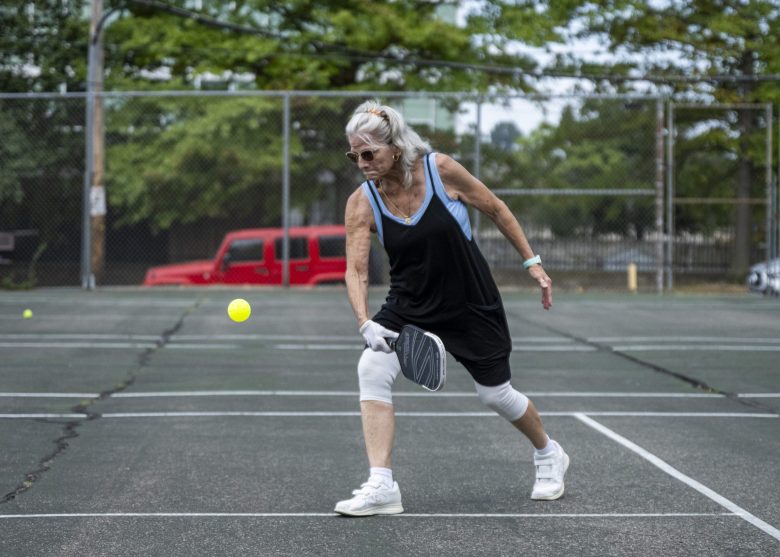 Photo by Nate Smallwood courtesy of Age-Friendly Greater Pittsburgh. Here’s where you can play pickleball in the region.
Aging in the Pittsburgh area
More than a third of Pittsburghers are age 50 or older. Statewide, Pennsylvania has the ninth-highest senior citizen population in the country (according to the 2020 U.S. Census).
“We are the second-oldest region in the country next to Palm Beach, Florida, when compared to other regions our size, based on the [Metropolitan Statistical Area],” says Laura Poskin, executive director of Age-Friendly Greater Pittsburgh.
Age-Friendly Pittsburgh is committed to reducing, reversing and slowing down dementia, says Poskin. Dementia refers to loss of memory, language, problem-solving and other thinking abilities severe enough to interfere with daily life. It is not part of normal aging. The most common cause of dementia is Alzheimer’s disease.
“In Pennsylvania over 280,000 residents 65 years old and older are living with Alzheimer’s disease, of which 12% are in Allegheny County. Older Black Americans are twice as likely as white Americans to have dementia,” says Poskin, emphasizing the importance of making resources available for everyone.
The mind-body connection
So what are older Pittsburghers doing to shake off sedentary lifestyles and stay fit? The possibilities are endless.
Caroline Hall, 71, a financial services professional with New York Life, finds it an absolute priority to stay physically fit. “I think it wards off a lot of diseases, and you just have to keep moving to stay healthy,” she says.
Having grown up on a farm, Hall always lived an active lifestyle. Now she incorporates exercise into her daily routine. “When I go shopping, I park far away from the stores, so I get some walking in, and enjoy taking my dog for walks around the yard and gardening,” says Hall. “Exercising allows me to move more freely.”
Inspired by her daughter, Hall took an introductory yoga class and continues to explore various opportunities to exercise. For example, she and her 69-year-old husband Mark go on the trampoline with their 9-year-old granddaughter Penelope, which teaches Penelope the importance of staying fit.
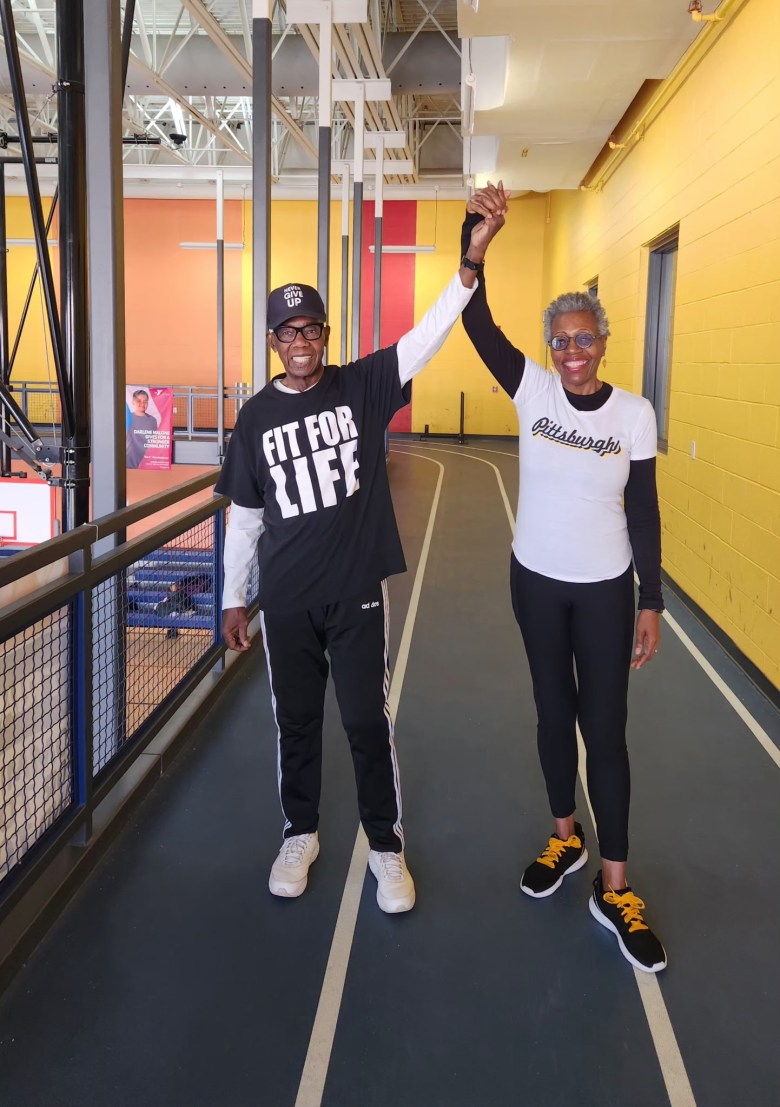 Reggie Howze and Shawna Bridgett Howze training for the National Senior Olympics. Photo courtesy of Howze.
Reggie Howze, an 81-year-old Hill District native, found his drive and passion for becoming active and healthy at the age of 50. “I got scared straight because my dad died at the age of 52. I thought that if I don’t make some major lifestyle changes, I’ll be right behind him.”
With that, Howze began his personal quest for physical excellence and overall health. In addition to earning his bachelor’s degree in nutrition and master’s degree in exercise science at the age of 65, he began competing in races and marathons, winning and medaling in local and national races. Most recently, during the 2025 National Senior Olympics hosted by the National Senior Games Association in Des Moines, Iowa, Howze placed second in the nation in the Men’s 80-84 5K Power Walk event.
Married in November of 2025, Howze is training his 70-year-old bride, Shawna Bridgett Howze, to compete as well. The newlyweds train at least five days a week at Thelma Lovette YMCA in preparation for an upcoming NSGA competition at Penn State University in Power Walking this summer.
Now Howze shares his secret for health and wellness through his business, Howze Your Health, noting that exercise is a critical part of prolonging one’s life. “I’m not talking about just living, I’m talking about abundant living!”
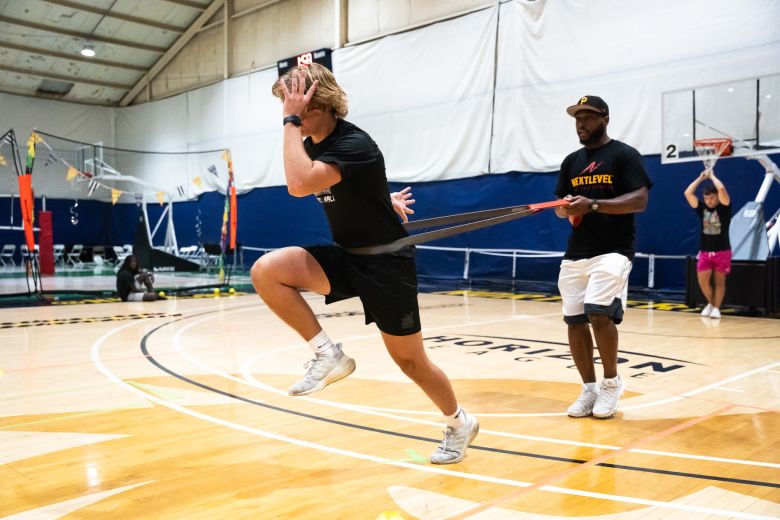 Antonio Williams, owner of Next Level of Athletic Fitness, training a client. Photo courtesy of Williams.
Some seniors choose to work with a professional trainer.
Antonio Williams, owner and sports director of Next Level of Athletic Fitness, provides workout routines to address strength and mobility, while helping clients maintain an active lifestyle. Next Level offers group classes specifically designed for seniors at their Green Tree location.
Since 2009, Williams has utilized his master’s degree in exercise science to assist clients with performance enhancement and injury prevention. Now he teaches clients about how exercise impacts their overall health while he studies for a doctorate.
“As we age, we can experience sharp mental decline,” says Williams. “Oftentimes older people think they can’t move or do as much, especially when they experience muscle imbalances or injuries that impact their physical and mental health. We want to make sure we’re focusing on clients so they can learn how to move better and more efficiently, without pain.”
More resources for staying active